THE issue is not a political statement condemning one side—it is a selective memory that goes deaf when allies commit crimes, yet suddenly awakens when adversaries err.
The text before us reflects a familiar official Arab posture: explicit condemnation of Iran, unwavering solidarity with Gulf states, and repeated invocations of international law. On the surface, it sounds coherent—even principled. But the real question is not what was said… it is what was deliberately left unsaid.
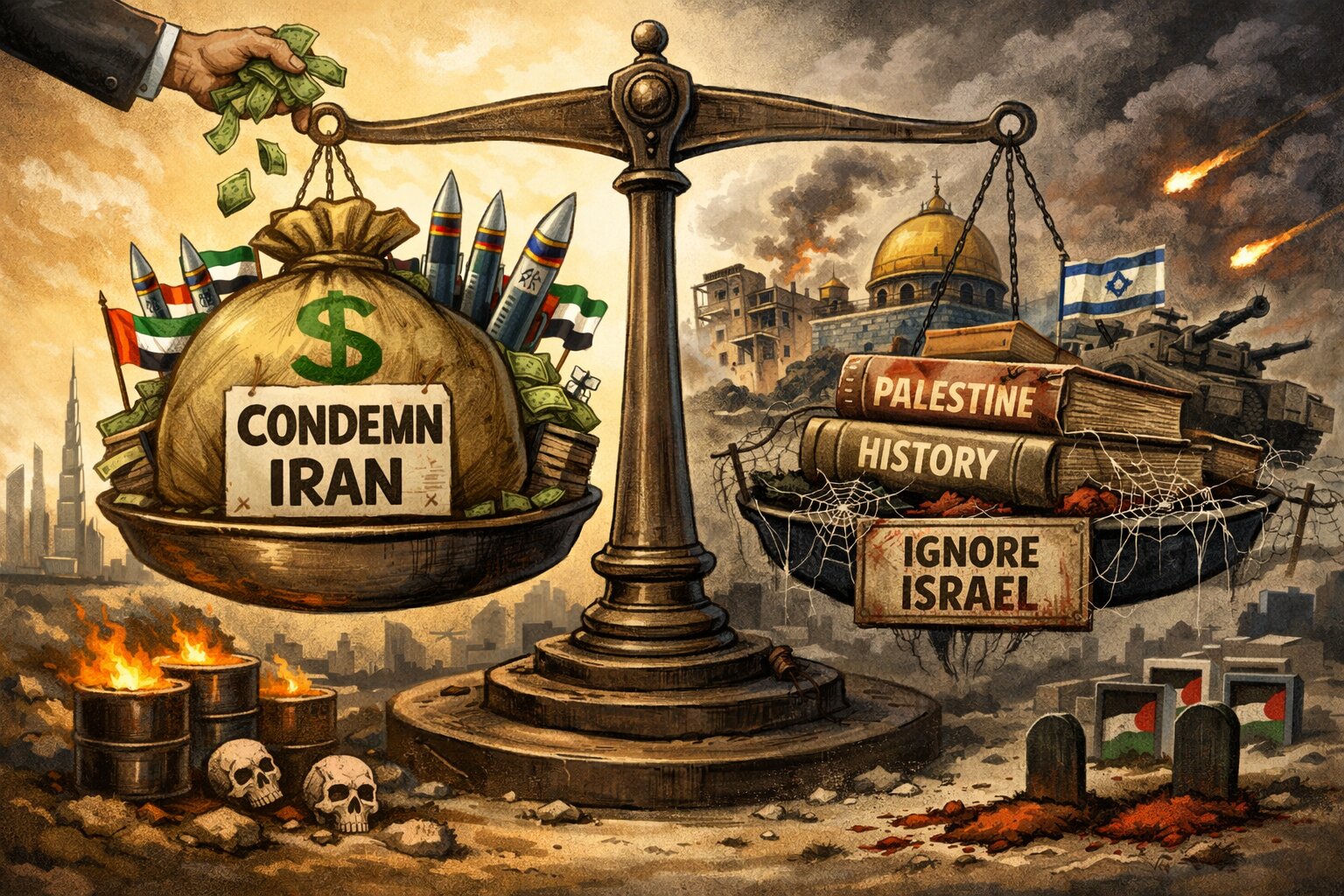
Where was this legal fervor when Gulf territories became long-standing platforms for U.S. military bases?
Where was “international law” when those bases were used in wars that devastated Iraq and Afghanistan, reshaping the region through fire and blood?
And where is this moral outrage when Israel continues to reject joining the Nuclear Non-Proliferation Treaty, while sanctions and isolation are imposed on others?
The painful paradox is that official Arab discourse calls for “good neighborliness,” while overlooking its most blatant violation: the ongoing occupation of Palestine, the daily devastation in Gaza, and the repeated assaults on Jerusalem and Al-Aqsa.
Have these issues slipped off the priority agenda? Or has the compass shifted… guided by the currents of money and alliances?
Double Standards:
The text condemns “Iranian aggression” as a threat to regional security… but what of repeated Israeli attacks?
Why is one labeled a “grave violation,” while the other is often met with cold, diluted diplomatic language?
This is not policy—it is a stark double standard.
International law cannot be fragmented. Sovereignty cannot be selectively respected. And Arab blood is no less valuable when it is shed in Gaza than anywhere else.
The Power of Money and Influence:
When the text speaks of “absolute solidarity,” it unintentionally reveals an unspoken equation:
Politics in the region is no longer shaped solely by interests—it is increasingly engineered by flows of capital and influence.
“The dominance of Gulf wealth” is not merely a rhetorical attack—it reflects a reality where positions are sometimes calibrated beyond national or ethical considerations.
Between Escalation and the Abyss:
Warnings of “catastrophic consequences” from escalation are valid—but incomplete.
The region is not standing at the edge of an ordinary conflict; it is teetering on the brink of a regional explosion that could spiral into a broader international confrontation, especially amid entangled global interests.
Yet more dangerous than war itself… is for states to become instruments in a conflict they neither control nor fully comprehend.
A Cutting Conclusion:
The problem is not condemning Iran… but remaining silent about others.
Not supporting the Gulf… but forgetting Palestine.
Not warning against war… but walking toward it without reflection.
History does not forgive.
And those who fail to read it carefully… may find themselves fuel for a fire they did not ignite—yet helped sustain through silence.