Ashraf AboArafe
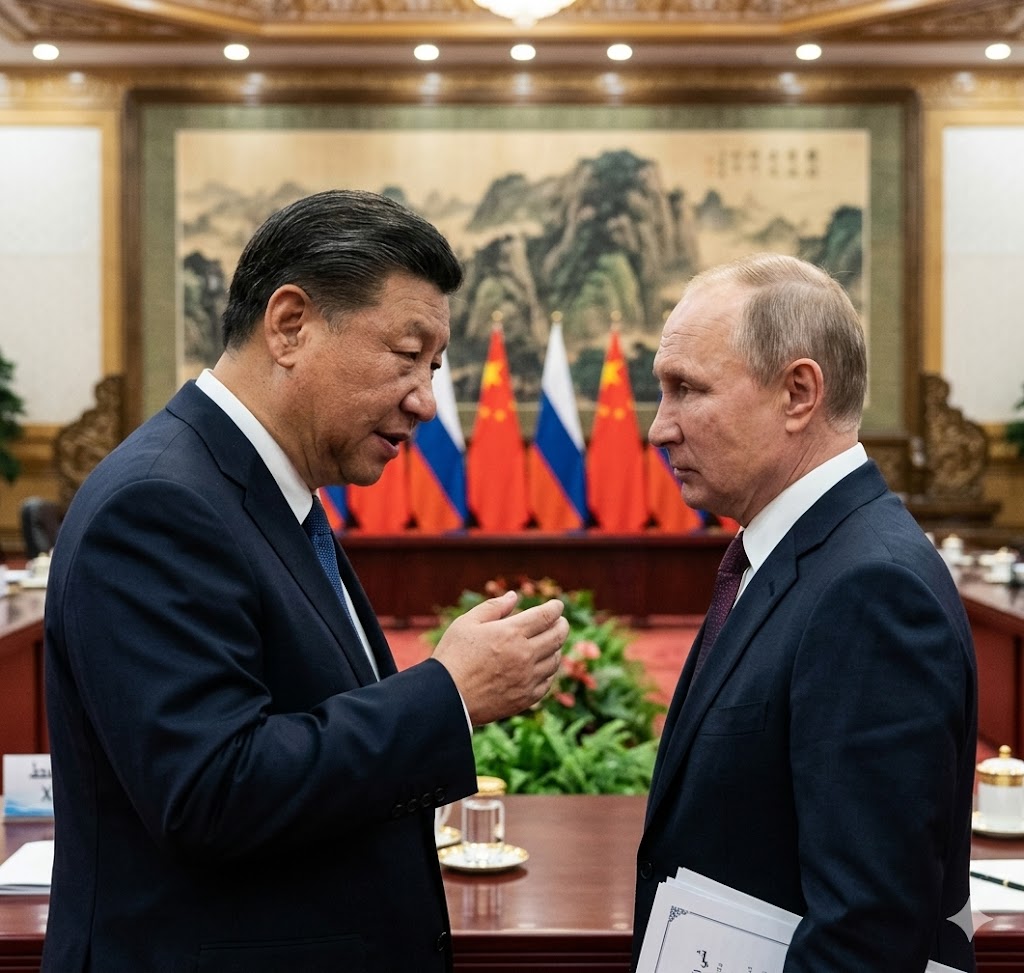
ON the morning of May 20, Chinese President Xi Jinping held talks with Russian President Vladimir Putin during the latter’s state visit to China. The meeting took place at the Great Hall of the People in Beijing. While the talks covered broader bilateral relations, this specific commentary isolates Xi Jinping’s perspective regarding the volatile situation in the Gulf region and the Middle East.
1. Core Themes & Rhetorical Stance
The text highlights China’s diplomatic positioning on Middle Eastern conflicts through several key talking points:
-
The Critical Crossroads: Xi Jinping characterizes the current state of the Middle East as a critical juncture “between war and peace.” This framing emphasizes the urgency of the situation, suggesting that the choices made now will have long-lasting historical consequences.
-
An Absolute Call for a Ceasefire: It is stated that a comprehensive ceasefire is an urgent necessity that “cannot tolerate any delay.” Xi explicitly rejects a return to active combat, calling it “unacceptable.”
-
The Primacy of Negotiation: Xi elevates the importance of adhering to negotiations, framing diplomatic dialogue not just as an option, but as a critical mechanism that carries “special importance.”
-
Global Economic Stability: A key element is how Xi connects regional peace directly to global markets. He notes that ending the war swiftly will mitigate disruptions to:
-
Energy supplies
-
Industrial and supply chains
-
The international trading system
-
2. Strategic Analysis: Reading Between the Lines
The Four-Point Vision: Xi Jinping put forward a “four-point vision” aimed at preserving peace and stability in the Middle East, crystalizing consensus within the international community, and preventing further escalation.
While the exact details of the four points are not explicitly listed in this excerpt, the broader geopolitical strategy highlights several key motivations:
| Strategic Objective | Institutional Alignment | Economic Motivation |
| Global Mediator Status | Multilateral Consensus | Securing the Belt and Road |
| By hosting Putin and issuing statements on the Middle East, China positions itself as a responsible global superpower capable of brokering peace, contrasting itself with Western approaches. | The mention of “crystalizing consensus from the international community” indicates China’s preference for multilateral frameworks over unilateral intervention. | The explicit mention of supply chains and energy security highlights China’s deep concern regarding its massive economic reliance on stable Middle Eastern oil and maritime trade routes. |
3. Conclusion
The text portrays a China that is deeply concerned with the spillover effects of Middle Eastern conflicts on global commerce and stability. By leveraging a high-profile state visit with Russia to broadcast these views, Beijing reinforces its desire to be viewed as a central, stabilizing anchor in a turbulent geopolitical landscape.