Ashraf AboArafe writes
At a time when climate crises are intensifying and major powers compete over influence, energy, and resources, Chinese President Xi Jinping appears to be offering the world a different equation — one that redefines power not merely through military or economic dominance, but through the ability to shape a more balanced future between humanity and nature.
In a detailed report published by Xinhua News Agency, the contours of what is known as “Xi Jinping Thought on Ecological Civilization” emerged clearly. It is no longer simply a domestic Chinese environmental doctrine, but a cross-border development vision extending its influence to the Arab world, Africa, and the broader Global South.
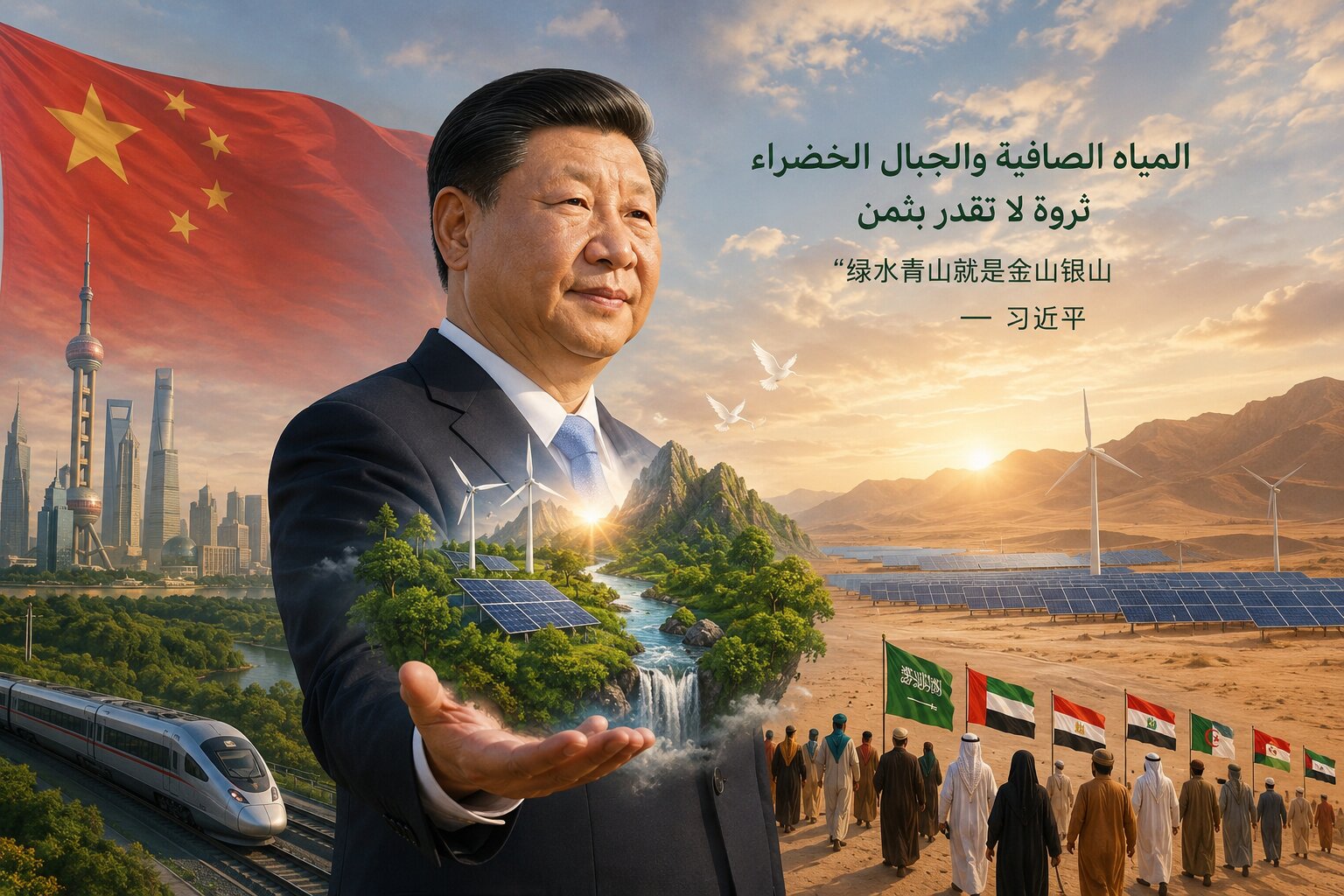
Under this vision, Beijing has transformed environmental policy from an economic burden into an engine of growth, and from a local concern into a form of soft diplomacy strengthening China’s international standing. Xi Jinping’s famous 2005 statement — “Lucid waters and lush mountains are invaluable assets” — evolved from a symbolic slogan into a political and economic philosophy reshaping China’s development model itself.
What is particularly striking is that China’s ecological experience has not remained confined within its borders. It has increasingly reached the Arab region through renewable energy projects, anti-desertification initiatives, and green technology transfers. From Egypt’s Benban Solar Park to massive solar projects across the Gulf, Chinese companies are positioning themselves as strategic development partners carrying investment, expertise, and long-term vision.
A deeper reading of this trajectory suggests that China, under Xi Jinping’s leadership, is not merely exporting technology — it is exporting a model. A model built on the idea that sustainable development can become a new bridge for international relations, and that environmental cooperation may evolve into a more acceptable and pragmatic political language in a conflict-weary world.
In the Arab world specifically, this vision resonates strongly with countries seeking to diversify their economies beyond oil dependency while preserving national sovereignty and securing reliable development partners. Consequently, the concept of a “green partnership” between China and Arab nations is no longer a media expression; it is becoming part of a new geopolitical equation quietly taking shape.
The praise voiced by Arab experts and officials regarding China’s achievements in renewable energy and environmental transformation also reflects a growing recognition that Beijing is no longer only “the world’s factory,” but increasingly one of the architects of the global green transition.
Ultimately, Xi Jinping appears determined to present China as a responsible global power — one that leads through sustainability, technology, and development rather than traditional dominance alone. It is a message carrying profound political implications in a rapidly changing international order searching for new balances and less confrontational partnerships.
In the end, China seems fully aware that the defining battles of the twenty-first century will not be won by weapons alone, but also by those capable of protecting the planet… and creating a greener future for humanity.