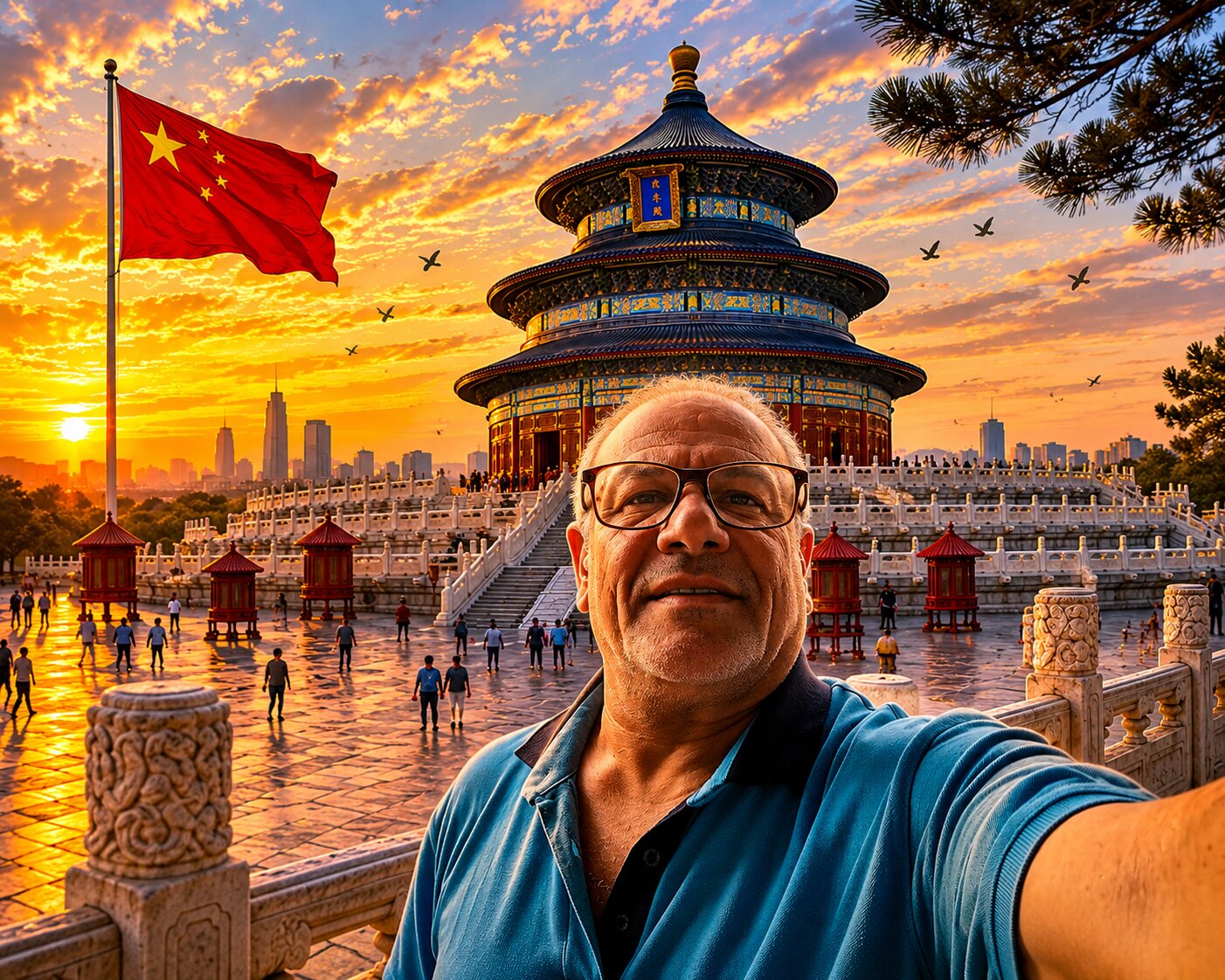
 Beijing – Ashraf AboArafe writes
INDEED, I am fortunate to visit the Temple of Heaven today, June 3, 2026, only days after the visit of former U.S. President Donald Trump. As I walk through its sacred grounds, I find myself wondering what reflections occupied his mind and how he might have compared this ancient civilization with his American homeland.
In a place that has stood for more than six centuries, a visitor is not merely a tourist exploring historic buildings. Rather, one becomes a witness to an enduring dialogue between humanity and the cosmos, between power and spirituality, and between history and the future.
Standing proudly in the heart of Beijing, the Temple of Heaven remains one of the greatest cultural and architectural treasures of Chinese civilization. From the very first moment, the noise of modern life fades into the background, replaced by a profound serenity that seems to echo across centuries of human experience.
A Sacred Imperial Legacy Beneath the Heavens
Constructed during the reign of Emperor Yongle of the Ming Dynasty in the early fifteenth century, the Temple of Heaven was built alongside the Forbidden City.
Yet it was never a temple in the conventional sense. Instead, it served as a sacred ceremonial complex where Chinese emperors prayed for abundant harvests, prosperity, and harmony throughout the empire.
The emperor was regarded as the “Son of Heaven,” a mediator between the earthly realm and the cosmic order, giving the site extraordinary political and spiritual significance. The legitimacy of imperial rule was believed to depend upon maintaining harmony between heaven, earth, and humankind.
Architecture That Speaks the Language of Philosophy
What distinguishes the Temple of Heaven is not merely its scale, but the profound philosophical symbolism embedded in every aspect of its design.
Circular structures symbolize heaven, while square foundations represent earth. Sacred numerical patterns appear throughout the complex, reflecting ancient Chinese understandings of cosmic balance and universal order.
The Hall of Prayer for Good Harvests stands as the most iconic structure within the complex and one of China’s finest architectural masterpieces.
Built almost entirely of wood without the use of a single nail, it continues to inspire architects, historians, and visitors alike.
When sunlight reflects upon its magnificent blue roof, the building appears less like a structure standing on earth and more like an extension of the heavens themselves.
What Might Trump Have Seen Here?
Only days after Donald Trump’s visit, one cannot help but ask:
What might he have seen in this extraordinary place?
Perhaps he saw a nation whose greatness is measured not by political administrations, but by thousands of years of accumulated civilization.
Perhaps he reflected on how China has managed to preserve its historical identity while simultaneously emerging as one of the world’s leading economic and technological powers.
In the United States, history is often measured in centuries. Here in China, history unfolds through dynasties, philosophies, and millennia of cultural continuity.
The comparison invites a deeper question:
How do nations build lasting strength?
Through wealth alone?
Or through their ability to transform historical memory into a living force that shapes the future?
A Living Sanctuary in Modern Beijing
Today, the Temple of Heaven is no longer a site of imperial rituals alone. It has become a vibrant cultural and social sanctuary where history and daily life coexist harmoniously.
Visitors encounter elderly residents practicing Tai Chi beneath ancient trees, musicians performing traditional melodies, and families enjoying moments of leisure among landscapes that have witnessed countless generations of Chinese history.
The result is a rare meeting of past and present. While travelers photograph a world-renowned heritage site, the people of Beijing continue to weave their everyday lives into the fabric of this enduring monument.
When Stones Become a Civilizational Message
The Temple of Heaven is far more than a UNESCO World Heritage Site. It is a civilizational statement that demonstrates how great nations preserve their heritage without becoming prisoners of the past.
In an era marked by rapid political, economic, and technological transformation, this remarkable monument stands as a reminder of a profound truth:
Civilizations that know how to preserve their memory also know how to shape their future.
As I left the Temple of Heaven on this summer day in June 2026, I carried with me more than photographs and impressions.
I carried a question that remained in my thoughts long after I departed:
How many secrets does the Chinese sky still whisper to those willing to listen?