 Ashraf AboArafe writes
THE younger Fahmy assumed the leadership of the Arab League not out of a desire for prestige, but as a destiny that forces him to confront the towering legacy of his late father’s pride. Will he sound the alarms for a new Arab awakening, or will Tel Aviv reopen old wounds to slap an Arab present that already moans under the weight of betrayal?
Genes of Defiance in an Age of Compromise
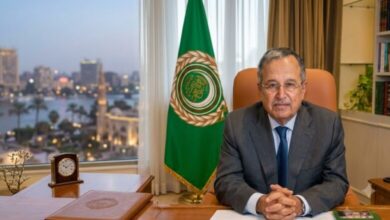
History does not merely repeat itself; it reproduces its wounds through familiar faces, forcing the human conscience to face harrowing trials. At the dawn of this July, when the veteran diplomat Nabil Fahmy (the new Secretary-General) took the reins of the Arab League, he was not receiving a mere ceremonial post as much as inheriting a legacy heavy with setbacks. He had no need for this cold chair; he is the descendant of political glory, the son of Ismail Fahmy, the former Egyptian Foreign Minister who shook the foundations of international politics in 1977. Back then, the elder Fahmy voiced a resounding “No” to the rush toward normalization and the Camp David Accords, immediately tendering his resignation to President Anwar Sadat. Today, it appears that the extremist occupation government led by Benjamin Netanyahu and his clique has not forgotten that historical slap, deciding to settle old scores with the son at the expense of Palestinian agony.
The Zionist Slap and the Legacy of Camp David
Upon assuming his duties, and reaffirming the centrality of the Palestinian cause, Nabil Fahmy submitted a legitimate request to the Palestinian Authority to visit the occupied territories. However, the Zionist response came swiftly and crudely with an absolute refusal. This rejection was not a mere security measure; it was a retaliatory political slap aimed at humiliating the very legacy represented by the name “Fahmy.”
The father, Ismail Fahmy, realized with sharp and visionary foresight that unilateral agreements would never bring peace. Instead, they would serve as a conduit for security weakness and dependency, engineering “the fragmentation of the bonds between Arab peoples.” What we are living through today—fragmentation, internal strife, political blackmail, and the erosion of moral and social values—is nothing but the bitter harvest of those seeds sown at Camp David and the blind train of normalization that followed.
The Silence of the Normalizers and the Blatant Aqaba Meeting
The glaring irony and clearest manifestation of this Arab impotence lies in the passive behavior of the normalized Arab states. The Arabs possess decisive leverage, alongside economic and political weapons capable of forcing the Zionist entity and humbling its arrogance. Yet, they chose to “turn a blind eye” and maintain absolute silence, as if the Palestinian Authority had become a mere administrative department governed by the settler government in Tel Aviv.
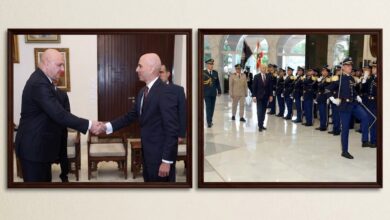
In an attempt to throw dust in the eyes and cover up this abandonment, the Secretary-General of the Arab League found no way to meet with Palestinian President Mahmoud Abbas (Abu Mazen) except in Amman, the capital of Jordan—a state itself bound by peace treaties and normalization. There, in the Jordanian capital, the Arab League statement issued on July 16, 2026, was drafted, exposing the deep chasm between the eloquence of words and the tragedy of reality.
The Official Statement: Cold Ink on Hot Anxiety
Despite the strong tone carried by the Secretary-General’s statement regarding “supporting the resilience of the Palestinian people” and “isolating the occupation internationally,” the facts and figures on the ground reveal a true catastrophe. The statement speaks of confronting plans to annex the West Bank and the expansion of settler terrorism, and calls for supporting the budget of the Palestinian Authority, which Israel is suffocating by confiscating tax revenues.
But how can rhetorical statements support financial resilience and a people being annihilated and displaced? How can the statement demand a focus on new generations and linking Gaza to an independent Palestinian state, at a time when Arab armies stand by as spectators to the destruction of the components of life? To speak of “legislative elections next November” under an occupation that uproots both humans and trees is like someone planning to paint the walls of a house whose roof is collapsing while its threshold and lintel are already demolished.
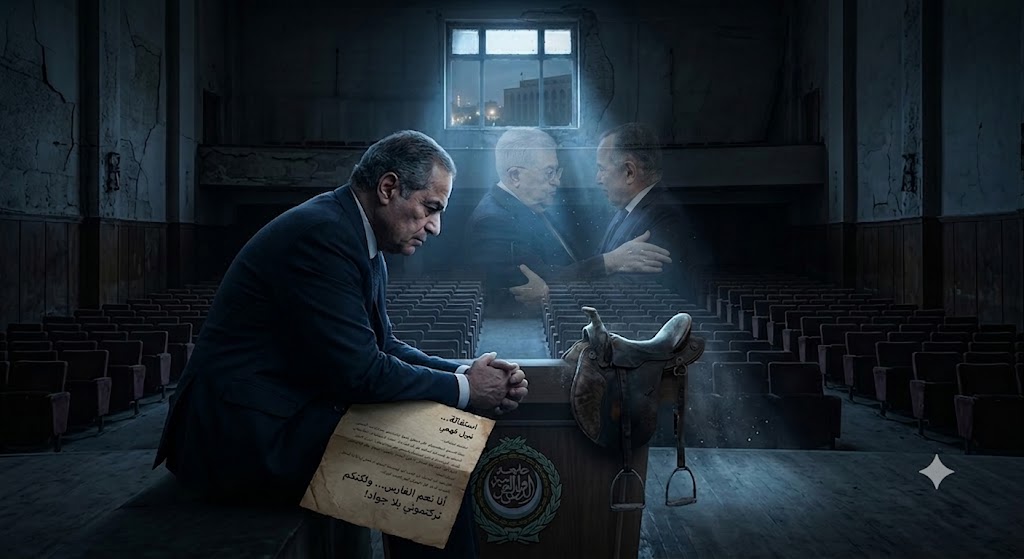
Conclusion: A Knight in Search of a Steed
Nabil Fahmy, with his national legacy and diplomatic integrity, represents a genuine driving force that could be invested in to revive the crumbling “House of the Arabs.” However, diplomacy without teeth is nothing but a plea for peace.
Therefore, this cry is directed to all people of resolve and the free spirits of the nation: spare nothing to salvage this moment, rally around the positions of the Secretary-General, and push toward activating real Arab power cards. If the collective Arab conscience does not move now to break the Zionist siege, we will soon wake up to a justified and resounding resignation by Nabil Fahmy—a resignation in which he will write with a bitterness matching that of his father:
“I am indeed a knight… but you have left me without a horse!”