Ashraf AboArafe reports
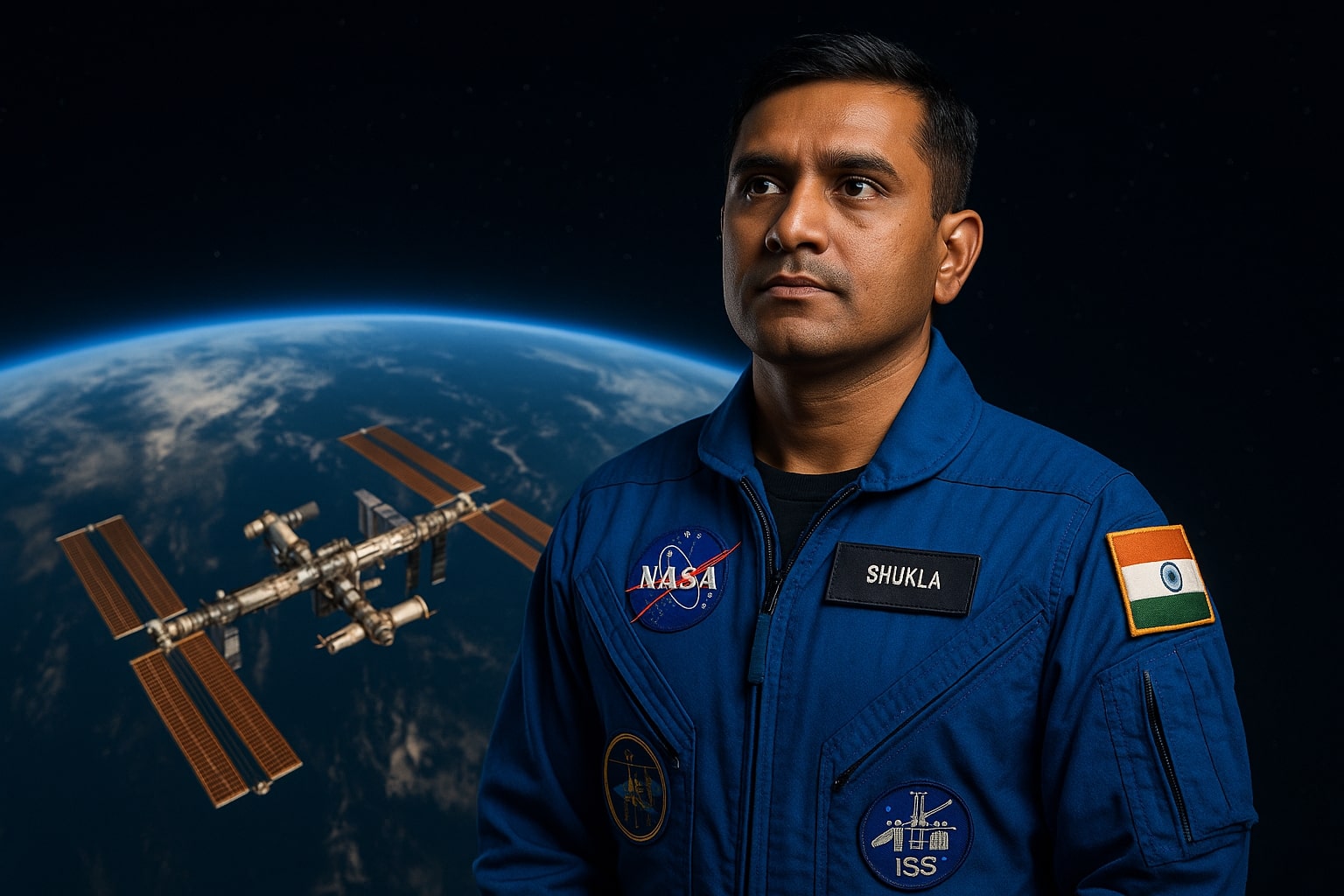
India is preparing for a landmark moment in its space journey as **Air Force Wing Commander Shobhan Shukla** becomes the first Indian astronaut to travel to the International Space Station (ISS), marking the country’s return to human spaceflight after more than four decades. Shukla will serve as a mission commander aboard **Axiom Space’s Ax-4 mission**, scheduled for launch on **June 11** aboard a **SpaceX Falcon 9**.
A participant in ISRO’s prestigious **Gaganyaan human spaceflight program**, Shukla will join an international crew led by veteran NASA astronaut **Peggy Whitson**. The mission carries significant scientific value, with advanced experiments planned in **space biology, nutrition, and life-support systems**, conducted in collaboration with ISRO, India’s Department of Biotechnology, and NASA.
Ax-4 also represents the **first ISS-bound government-sponsored spaceflight** for India, Poland, and Hungary since the 1980s—signaling a shift in global space access enabled by Axiom Space’s commercial model.
Strategically, the mission serves as a training ground for India’s indigenous **Gaganyaan mission**, which aims to send Indian astronauts into low-Earth orbit independently. With a budget exceeding **₹20,000 crore**, Gaganyaan forms part of India’s long-term vision to establish a national space station—**Bharatiya Antariksha Station by 2035**—and land an Indian crew on the Moon by **2040**.
Over the past decade, India has cemented its position as a rising space power, having launched **393 foreign satellites** and partnered with **over 34 countries**. Major milestones include the **Chandrayaan-3 lunar mission**, the **Aditya-L1 solar observatory**, and the successful demonstration of **space docking and reusable orbital vehicle technologies**.
India is no longer merely exploring space—it is helping shape its future. As Wing Commander Shukla embarks on this historic flight, India reaffirms its status as a **technological force, a scientific innovator, and a global space leader**.