Ashraf AboArafe
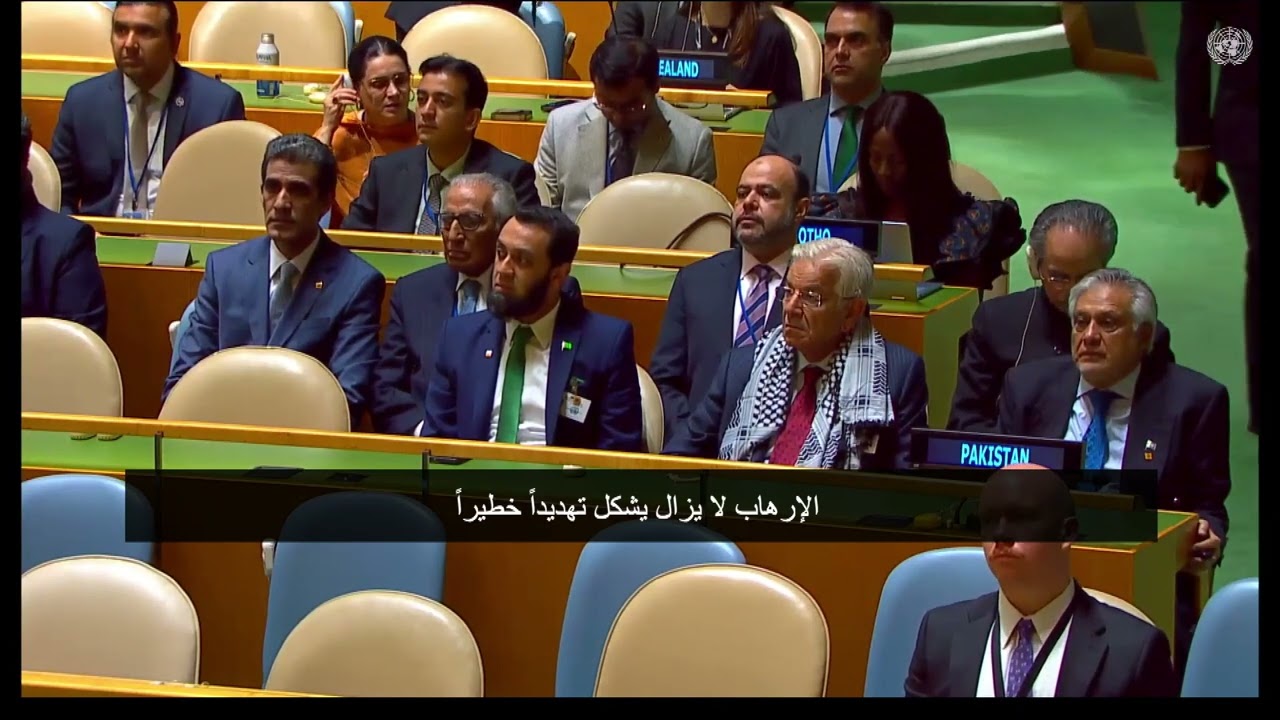
In a speech woven with equal parts defiance and hope, Prime Minister Shehbaz Sharif addressed the General Debate of the 80th Session of the United Nations General Assembly, calling for a renewed spirit of multilateralism amid intensifying global crises.
Opening with congratulations to the newly elected President of the Assembly, the Pakistani leader stressed that “multilateralism is no longer an option; it is essential.” He lamented a world beset by conflicts, terrorism, disinformation, climate catastrophes, and the erosion of international law.
Defending Pakistan, Confronting India
Recalling the May 2025 confrontation on Pakistan’s eastern border, the Prime Minister declared that his nation had repelled aggression with “stunning professionalism and bravery” under the leadership of Field Marshal Syed Asim Munir and Air Chief Marshal Zaheer Babar Sidhu. He praised Pakistan’s armed forces, honoring the sacrifices of martyrs and the unity of the people, who he described as standing “like an unbreakable wall.”
He thanked U.S. President Donald Trump for his “bold and visionary” mediation, crediting his timely intervention with averting a broader war in South Asia. Sharif expressed gratitude to Pakistan’s allies—including China, Turkiye, Saudi Arabia, Qatar, Iran, UAE, and Azerbaijan—for their diplomatic support.
Still, he warned India against unilateral actions, particularly its attempt to suspend the Indus Waters Treaty, describing any violation of water rights as “an act of war.” He reaffirmed Pakistan’s readiness for dialogue, but stressed that peace required “proactive, not provocative leadership.”
On Kashmir and Palestine: A Cry for Justice
The Prime Minister devoted much of his address to Kashmir and Palestine, drawing parallels between the two conflicts. He condemned India’s decades-long suppression in Jammu and Kashmir, urging the UN to fulfill its responsibility for a plebiscite to secure the Kashmiri people’s right to self-determination.
Turning to the Middle East, he described the plight of Palestinians as “one of the most heart-wrenching tragedies of our times.” He invoked the haunting voice of Hind Rajab, a child victim in Gaza, to illustrate what he called the world’s moral failure. Quoting, “the smallest coffins are the heaviest to carry,” he likened her tragedy to that of a young Pakistani victim of cross-border violence.
“Palestine must be liberated,” he declared, reaffirming Pakistan’s commitment to a sovereign Palestinian state with pre-1967 borders and Al-Quds Al-Sharif as its capital.
Counterterrorism, Afghanistan, and Regional Stability
Sharif reiterated Pakistan’s frontline role in the fight against terrorism, having lost over 90,000 lives and $150 billion in economic costs. He accused groups such as the TTP, BLA, and other foreign-funded proxies operating from Afghan soil of destabilizing Pakistan.
On Afghanistan, he emphasized that peace, inclusivity, and regional connectivity were vital, urging the Interim Afghan Government to uphold human rights and prevent terrorism emanating from its territory.
Climate, Economy, and Global Reform
Declaring a climate emergency in the wake of devastating floods in 2022 and 2025, the Prime Minister urged developed nations to deliver on climate finance commitments, stressing that Pakistan—despite contributing less than 1% of emissions—remains among the most vulnerable nations.
https://youtu.be/P8PMfhsStnE?si=Jth0gAMDkrs6SSEb
On the economic front, he outlined Pakistan’s reforms in taxation, digitization, investment, and infrastructure, highlighting partnerships such as the China-Pakistan Economic Corridor (CPEC) under President Xi Jinping’s Belt and Road Initiative.
He also lauded China’s Global Governance Initiative, positioning Pakistan as a partner in a more just and inclusive world order.
UN Reform and Global Vision
As a non-permanent member of the UN Security Council, Pakistan pledged to champion peacekeeping reforms and to resist permanent-member expansion, which Sharif said would “compound the Council’s paralysis.”
Concluding, he urged nations to seize the symbolic weight of the UN’s 80th anniversary not merely to commemorate history but to “make history.”
“Let us truly strive to become ‘Better Together’,” the Prime Minister declared, calling for justice, peace, and development in a world where “multilateralism must deliver for all.”