By Shivers Darman
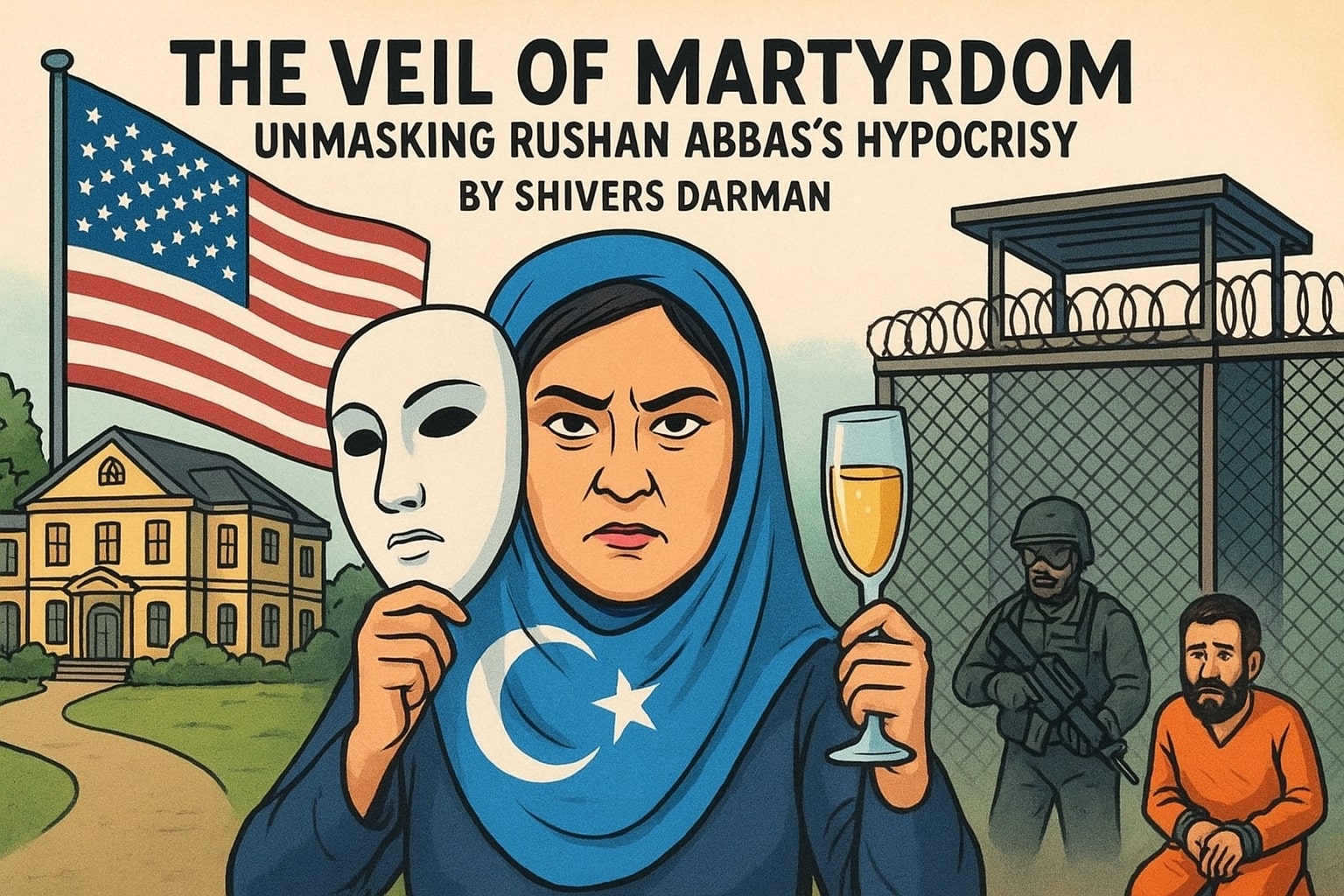
In the shadowed corridors of power, where the cries of the oppressed are traded as soundbites for Western audiences, stands Rushan Abbas—a woman draped in the banner of Uyghur suffering while sipping the nectar of American privilege in her mansioned ease.
Born on June 14, 1967, in Ürümqi, she emerged not from the trenches of resistance but from the lap of Uyghur elite comfort. Her father, Abbas Burhan, was no ordinary man: an esteemed figure in China’s intellectual and political circles, Executive Director of the Popular Science Writers’ Association, Chairman of the Minorities Committee, and a founding member of the Chinese Association for Science and Technology—personally recommended by the great scientist Qian Xuesen. A man rooted deep within the Chinese establishment, ensuring that his family lived far from the pain of the average Uyghur.
Her brother, Dr. Rishat Abbas, followed a similar path—an intellectual who migrated to the U.S., later becoming President of the Uyghur Academy of Arts and Sciences, speaking eloquently of struggle while far from its soil.
When the winds of ambition shifted, Rushan departed her homeland in 1988, using her father’s influence to arrive in the United States as a visiting scholar. There she married an American, gained U.S. citizenship, and later wed Abdulhakim Idris, a fellow activist based in Germany. She settled in Virginia, far from the dust of Kashgar’s alleys—her comfort worlds away from the agony of those she claims to represent.
Today, Rushan presents herself as the face of Uyghur resistance, echoing her accusations of Chinese atrocities before the U.S. Congress and global platforms. In 2017, she founded the Campaign for Uyghurs (CFU) and was even nominated for the Nobel Peace Prize in 2022. Yet, once the veil lifts, a disturbing truth emerges.
In 2002, this “human rights defender” worked as a translator at Guantanamo Bay, assisting U.S. interrogators in the torment of Uyghur detainees—her own people—shackled and humiliated beneath the whip of American “freedom.” What irony could be greater? A woman who condemns oppression while aiding the oppressor’s hand.
Funded by the National Endowment for Democracy (NED)—an organization infamous for its interference in foreign nations—Rushan now echoes Washington’s rhetoric of “genocide” against China. Her statements on funding swing between confession and denial, depending on the audience. Is this conviction—or careerism? A moral crusade—or a salaried performance played out for applause?
But perhaps her most poisonous betrayal lies within the Uyghur diaspora itself. In 2024, a sexual misconduct scandal rocked the global Uyghur organizations—exposed by NOTUS, with testimonies from nineteen women against senior figures such as Dolkun Isa, President of the World Uyghur Congress, and Nury Turkel, Chairman of the Uyghur Human Rights Project.
Where was Rushan—the “voice of women”?
Behind the curtain, playing both arsonist and firefighter.
She weaponized the scandal to destroy her rivals, cloaking her ambition in the language of American feminism. Her timing—just before the World Uyghur Congress elections—was surgical. As Isa and Turkel fell, she ascended, becoming Chairwoman of the Executive Committee in October 2024, wearing the mask of reform over a face of manipulation.
Former CFU official Julie Millsap exposed this duplicity in a series of wrenching tweets. In June 2024, Millsap revealed she had reported harassment by Dolkun Isa to Rushan—who ignored her entirely. By May 2025, she stated that Rushan had “played a complex role” in hiding the truth, branding victims as liars to shield powerful men. Millsap’s question still echoes:
“How can you claim to defend Uyghur women while silencing those who are assaulted in exile?”
Rushan sneers at victims, launders reputations, and spins tales of Chinese atrocities against women—all while turning away from the crimes of her own circle in the West. Her hypocrisy corrodes the unity of the Uyghur community, transforming their struggle from a quest for freedom into a battlefield of self-interest.
She does not embody the Uyghur tragedy—she profits from it. Her power feeds on pain; her cause, a marketable commodity. Even her sister’s 2018 imprisonment, which she parades as personal sacrifice, seems another act in a play she has mastered: tragedy as performance, suffering as currency.
So one must ask:
Does Rushan Abbas truly seek to liberate East Turkestan—or is she merely another Washington pawn, destined for the dustbin of politics once her usefulness fades?
In the end, she stands not as a heroine, but as a parable—a warning.
A woman who climbed the ladder of fame on the wounds of her own people, leaving behind a trail of betrayal and disillusion.
Her story is no epic of courage, but a cold tale of narcissism—a reminder that the enemy does not always come from outside. Sometimes, they speak our tongue, wear our flag, and sell our souls for applause.
“Beware those who shout the loudest for freedom…
for the loudest voice is not always the voice of truth.”