Ashraf AboArafe
During a solidarity visit to Lebanon, UN Secretary-General Antonio Guterres called for an immediate end to the war, stressing the urgent need to protect civilians at all times and emphasizing that there is no military solution to the conflict. He underlined that diplomacy and dialogue remain the only viable path toward peace.
Speaking at a press conference on the second day of his visit to Lebanon, Guterres delivered a clear message to all parties involved.
Key Points from the Press Conference
- The war must stop.
- There is no military solution. The United Nations is doing everything possible to reduce escalation immediately and end hostilities.
- Civilians must be respected and protected at all times.
- Lebanon’s sovereignty and territorial integrity must be fully respected.
- The Lebanese state must maintain full control over all weapons across its territory, and Hezbollah must respect the government’s decision to place arms exclusively under state authority.
- Attacks on UN peacekeepers and their positions are unacceptable and must cease immediately.
- The international community must increase support for the Lebanese state and its armed forces and contribute generously to humanitarian relief efforts.
A Region Marked by Destruction
Guterres noted that Muslims and Christians in Lebanon are currently observing Ramadan and the Christian Lenten season, both traditionally periods of solidarity and generosity that reflect Lebanon’s spirit of coexistence. Yet, he said, the past two weeks have witnessed widespread destruction.
“Hezbollah rockets and drones have been launched at targets in northern Israel and the occupied Syrian Golan, followed by devastating Israeli bombardments and large-scale evacuation warnings that have made vast areas of Lebanon uninhabitable,” he explained.
He added that many Israelis have been forced to shelter in bunkers, while hundreds of Lebanese—many of them children—have been killed, thousands wounded, and hundreds of thousands displaced.
“The Lebanese People Did Not Choose This War”
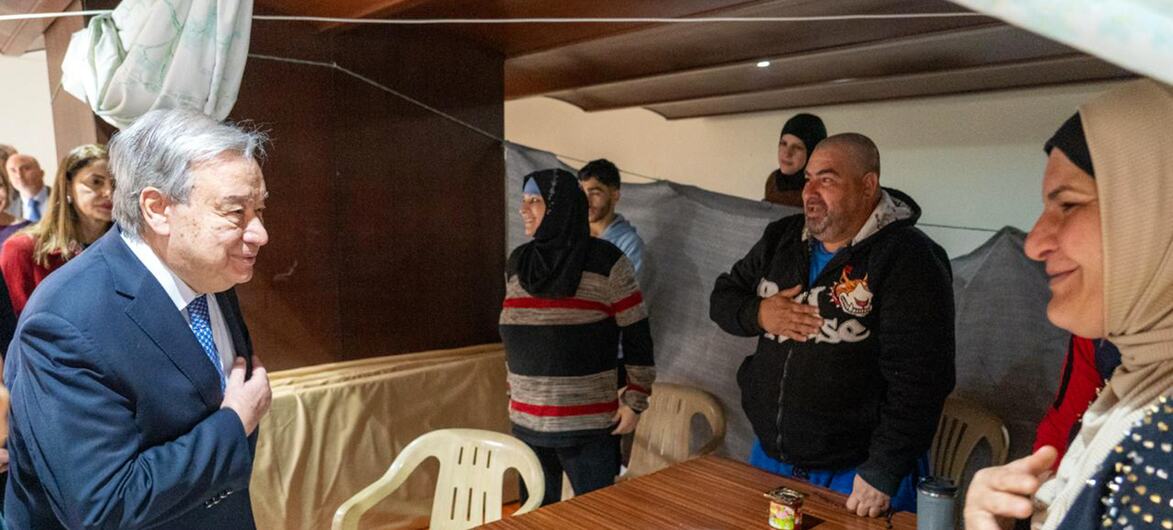
During his visit to Beirut, Guterres met with displaced families and listened to what he described as their “heart-wrenching stories.”
“The Lebanese people did not choose this war,” he said. “They were dragged into it. My message to the warring parties is clear: stop the fighting, stop the bombardment. There is no military solution—only diplomacy, dialogue, and full implementation of the UN Charter and Security Council resolutions.”
He stressed that diplomatic channels remain open, including efforts led by UN Special Coordinator for Lebanon Jeanine Hennis-Plasschaert and key UN member states.
According to the Secretary-General, this diplomatic path is the only way to protect communities on both sides of the Blue Line between Lebanon and Israel from unnecessary suffering.
UNIFIL Continues Its Mission
Guterres praised the courage of UNIFIL peacekeepers, noting that three Ghanaian peacekeepers were injured—one seriously—during intense exchanges of fire on Friday.
The Secretary-General visited them in hospital and wished them a full and swift recovery.
“Attacks against peacekeepers and their positions are completely unacceptable and must stop,” he said, warning that such actions violate international law and could constitute war crimes.
Protecting Civilians and Restoring State Authority
Guterres reiterated the importance of protecting civilians and safeguarding civilian infrastructure.
He stressed again that Lebanon’s sovereignty and territorial integrity must be respected, adding:
“The Lebanese state must have full control over all weapons across its territory. This is a cornerstone of UN Security Council Resolution 1701 and an essential condition for lasting security on both sides of the Blue Line.”
He described the Lebanese government’s August decision to place all weapons under state authority as “historic,” pledging continued support for strengthening the Lebanese Armed Forces and state security institutions.
However, he noted that the vision outlined in Resolution 1701 cannot be achieved by the army alone. It requires a comprehensive governmental effort to address the entrenched reality of non-state weapons and heal longstanding grievances and divisions.
Such an effort, he said, must involve all Lebanese communities—Christians, Druze, Shiites, Sunnis, and others.
Guterres also stressed that Hezbollah must respect the government’s decision on arms control and relevant UN resolutions, while Israel must fully respect Lebanon’s sovereignty and territorial integrity.
A Message to the International Community
Concluding his remarks, Guterres urged the international community to strengthen support for the Lebanese state and its armed forces and to respond generously to the humanitarian appeal launched in Beirut to assist affected populations.
“The people of Lebanon, as well as Israel and all the peoples of the region, deserve to live without fear,” he said. “They deserve to raise their children without the sound of sirens and explosions, and to return to their homes without wondering when they will be forced to flee again.”
He added that the UN team on the ground is doing everything possible to support the Lebanese people and their institutions.
“Together, we will spare no effort in pursuing the peaceful future that Lebanon and this entire region rightfully deserve.”