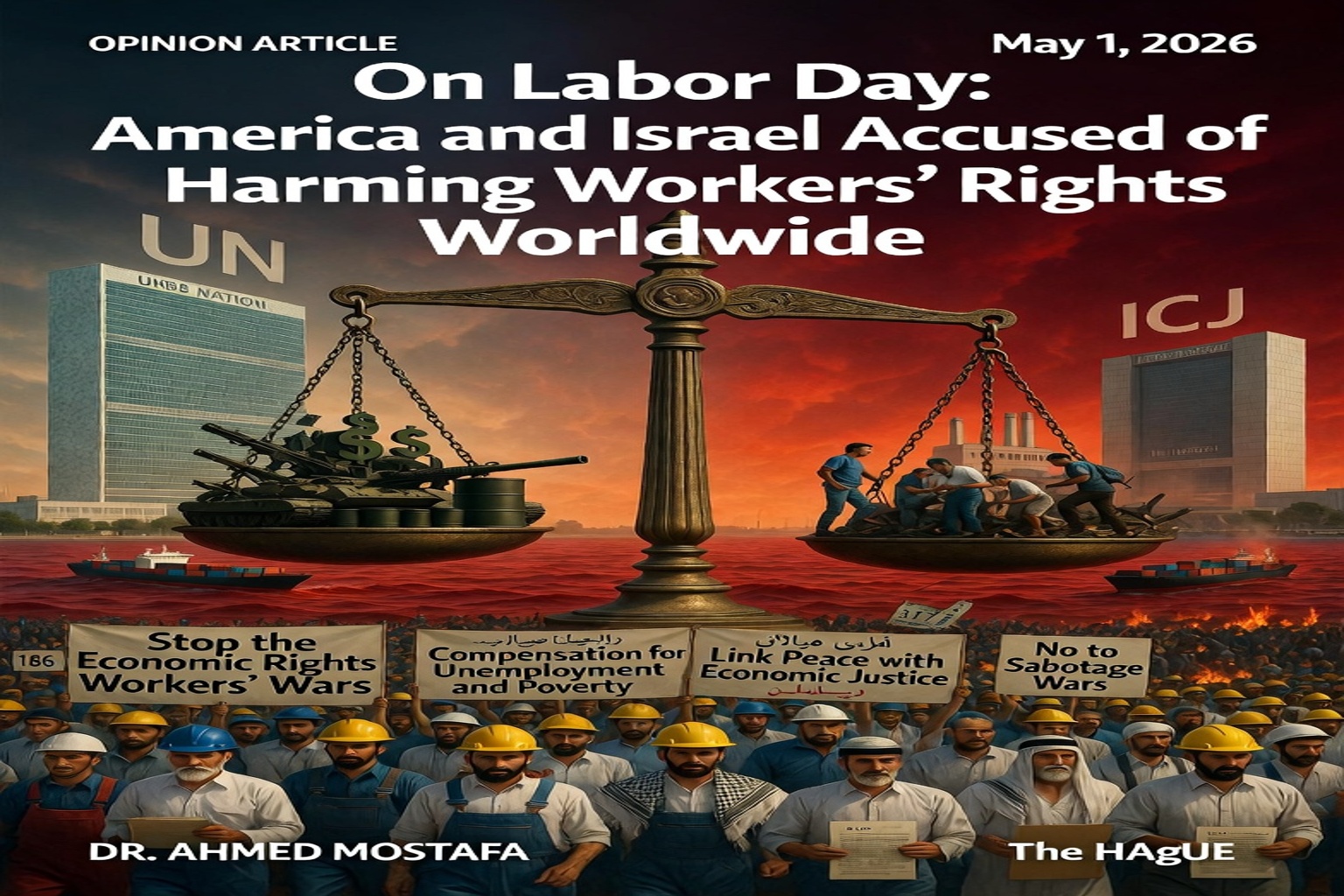
By Dr. Ahmed Mostafa
President and Founder, Asia Center for Studies and Translation – Egypt
A Historic Mobilization in Geneva and New York
Imagine International Workers’ Day, May 1, 2026, not as a day of mere parades, but as a watershed moment of global accountability. In the Swiss capital of Geneva and at the United Nations headquarters in New York, an unprecedented movement took hold. Global labor unions, in a synchronized effort with the International Labour Organization (ILO) and regional bodies—including the Arab Labour Organization and Asian, African, and Latin American federations—launched a massive legal offensive.
Formal claims were filed before the International Court of Justice (ICJ) in The Hague, alongside official complaints to the UN Security Council and General Assembly. The targets: the American and Israeli governments, specifically the administrations of President Donald Trump and Prime Minister Benjamin Netanyahu.
This historic action seeks “multiplied compensation” for the catastrophic economic and social damage inflicted upon the global working class. The unions contend that “criminal sabotage wars” have triggered the most severe spikes in unemployment, inflation, and wage erosion seen in generations, turning a day of celebration into a global tribunal linking peace with economic justice.
The Economic Toll: Data of Despair
The ILO’s Employment and Social Trends 2026 report paints a stark picture. While the global unemployment rate appears stable at 4.9% (roughly 186 million people), this figure masks a deeper crisis:
-
The Jobs Gap: A staggering 408 million people lack access to employment.
-
Vulnerability: Over 284 million workers have been pushed into extreme poverty and informal labor.
-
The Palestinian Crisis: In the West Bank, unemployment surged to 31.7% for men and 33.7% for women by early 2025. In Gaza, the economy suffered a near-total collapse of 87.4%, with real per capita income plummeting by 20.6%.
On a global scale, conflicts in Gaza and Ukraine, coupled with Middle Eastern tensions involving Iran, have fractured supply chains and destabilized energy markets. The IMF projects global GDP growth to dip to 3.1% in 2026, while inflation could reach 5.4% in escalation scenarios. This “economic closure”—driven by sanctions and Red Sea shipping disruptions—has effectively exported inflation, eroding the purchasing power of workers in developing nations.
The Legal Framework: Accountability Beyond the Battlefield
The legal challenge is built upon three pillars of international law:
-
UN Charter (Chapters VI & VII): Grants authority to address threats to international peace, specifically the economic fallout of conflict.
-
The Rome Statute & Geneva Conventions: Mandate the protection of civilian infrastructure and the economic survival of populations during wartime.
-
State Responsibility: Based on the 2001 ILC Draft, which obliges nations to compensate for “internationally wrongful acts,” including the use of force that results in widespread economic ruin.
The plaintiffs argue that the policies of the U.S. and Israeli administrations constitute “grave violations” of the International Covenant on Economic, Social and Cultural Rights (1966). They are demanding a comprehensive restitution package:
-
Retraining programs for displaced skilled labor.
-
The establishment of an International Reconstruction Fund.
-
Direct compensation for lost income.
“These are not merely military wars; they are economic wars targeting the very foundation of human life,” a union representative stated in a joint communiqué.
Political Friction and Global Solidarity
The response from Washington and Tel Aviv has been swift and dismissive, labeling the movement as “politically motivated” and maintaining that all military actions were strictly defensive. This follows a precedent of friction, such as the Trump administration’s previous sanctions against ICC personnel.
Conversely, labor unions across Europe, Asia, and the Americas have expressed profound solidarity. In Palestine, traditional festivities were replaced by calls for economic resistance and boycotts. The sentiment across these blocs is singular: “Stop funding destruction; start investing in decent work.”
Conclusion: A New Era of Accountability
This legal movement signals a paradigm shift. International Workers’ Day has evolved from a ritual into a tool for systemic change. It serves as a reminder that war does more than destroy buildings—it unravels the global economic fabric and robs future generations of their dignity.
As the ILO maintains, sustainable peace is the prerequisite for decent work. The world now watches to see if international institutions will rise to meet this call for justice, or if the gears of geopolitics will once again stall the pursuit of economic equity. In an era of rampant inflation and joblessness, the collective voice of the worker has never been more vital.