Ashraf AboArafe
THE celebration of the 50th anniversary of the Friedrich-Ebert-Stiftung (FES) office in Egypt represents more than the commemoration of an institutional milestone. It provides an opportunity to reflect on five decades of German-Egyptian cooperation through dialogue, knowledge exchange, social development and engagement with diverse segments of society.
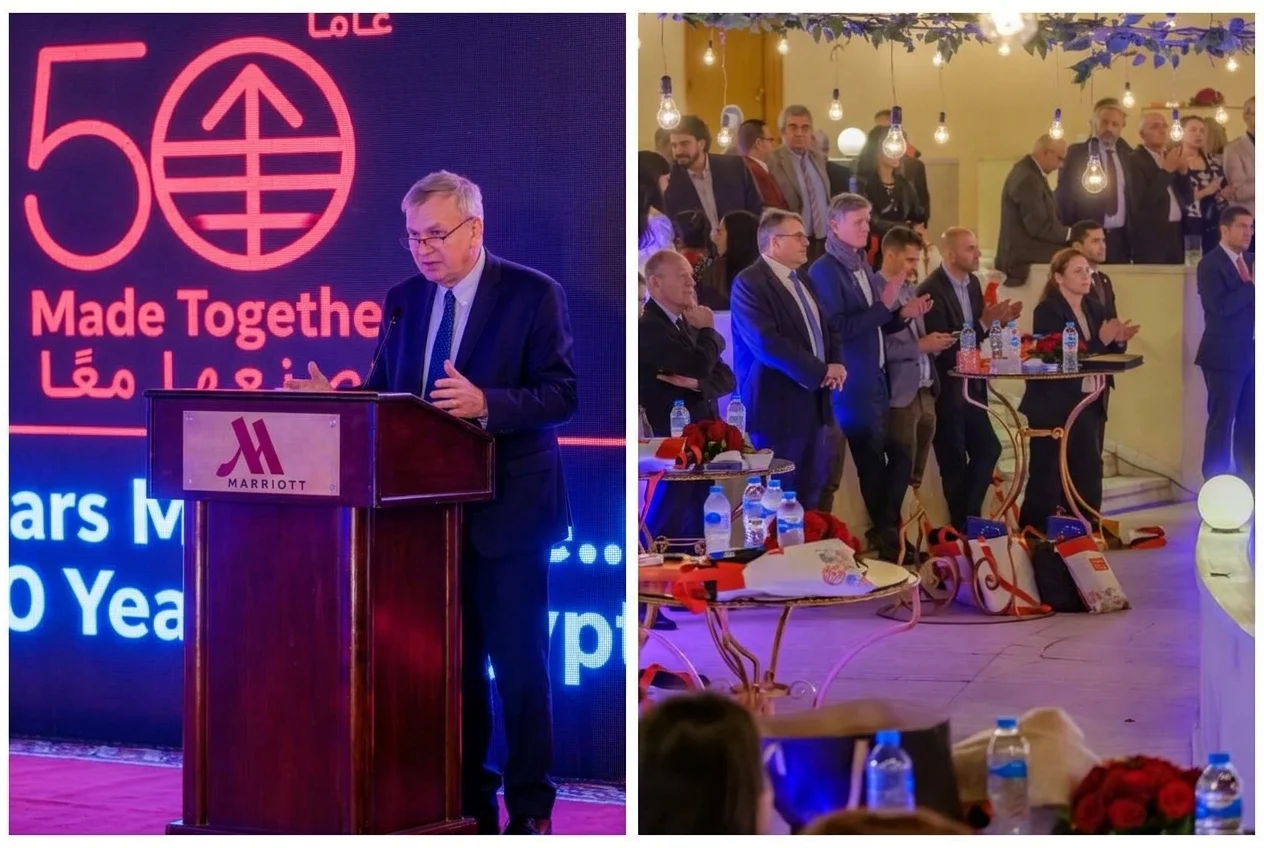
With more than 100 guests representing Egyptian society and German institutions attending the anniversary celebration, the occasion highlighted the foundation’s longstanding presence in Egypt and its contribution to building channels of communication between institutions, experts, researchers and civil society organizations.
Five decades of institutional engagement
Since establishing its Cairo office in 1976, FES has developed a broad network of partnerships involving Egyptian government institutions, including the Ministries of Foreign Affairs and Environment, the Egyptian Parliament and the League of Arab States, alongside universities, research centers and civil society organizations.
Its activities have addressed several important dimensions of public policy, particularly social development, gender equality, climate action and the participation of young people and women.
This approach reflects an understanding that contemporary international relations can no longer be measured exclusively through diplomatic agreements, political visits or economic exchanges. Increasingly, sustainable partnerships depend on the ability of societies to exchange experiences, discuss common challenges and develop practical solutions.
A broader understanding of German foreign policy
One of the most significant messages emerging from the anniversary was the recognition of the expanding role of non-governmental and institutional platforms in modern diplomacy.
German Ambassador to Egypt Jürgen Schulz emphasized that foreign policy in today’s highly interconnected world cannot remain confined to relations between governments. Instead, it requires a comprehensive approach that addresses the political and social issues directly affecting societies.
His remarks underline the importance Germany attaches to the work of FES in Cairo, particularly its engagement with issues that extend beyond traditional diplomatic channels.
In this context, the foundation represents an instrument of Germany’s international engagement through public dialogue, institutional cooperation and social policy discussions.
It is important, however, to distinguish between the foundation’s publicly funded status and its operational independence. Although it maintains relations with relevant German ministries and diplomatic missions, FES independently develops its objectives, partnerships and programs in accordance with the political and social contexts of its host countries.
From bilateral relations to a global network
Perhaps the most remarkable dimension of the anniversary is the transformation of FES from a platform primarily facilitating bilateral exchanges into part of an international network comprising nearly 100 offices worldwide.
Dr. Sonja Schirmbeck, Resident Representative of FES in Egypt, highlighted how this global presence has expanded opportunities for Egyptian partner organizations to exchange expertise with counterparts in countries such as Brazil, Austria and Morocco.
The examples she presented, including social care policies, affordable housing and the green economy, demonstrate the practical value of international knowledge-sharing.
This development gives Egyptian institutions access to experiences beyond the traditional framework of Egyptian-German relations, creating opportunities to explore different approaches to common development challenges.
Four priorities addressing the challenges of the future
FES Egypt’s work is structured around four principal areas, each addressing an important dimension of contemporary social and political development:
1. Socio-ecological transformation: Encouraging dialogue on the environmental and social consequences of climate change and ecological deterioration, while exploring pathways towards more sustainable development.
2. Socio-economic development: Supporting discussions and initiatives concerning social protection, healthcare, education and gender equality, with particular attention to vulnerable segments of society and equitable access to essential public services.
3. Civil society empowerment: Strengthening the contribution of civil society organizations as important partners in social and economic development.
4. International cooperation and dialogue: Promoting regional stability, integration and cooperation across the Middle East and North Africa, including discussions on pluralism and gender equality.
Together, these priorities demonstrate that the foundation’s activities extend beyond academic discussions to encompass issues closely connected with the everyday concerns and long-term aspirations of societies.
A partnership built on an established legal framework
The foundation’s presence in Egypt is also distinguished by its institutional and legal foundations.
Its initial agreement with the Egyptian government was endorsed through Presidential Decree No. 139 of 1976 and approved by the Egyptian Parliament. The agreement was subsequently renewed in 1988 under Presidential Decree No. 244 of 1989.
A further milestone came in March 2017, when Egypt and Germany signed an additional protocol in Berlin amending the 1959 Cultural Agreement. Following parliamentary ratification in July 2017, the protocol entered into force in November of the same year under Presidential Decree No. 267 of 2017.
This framework reflects the importance of an established legal basis for international institutional cooperation and the continuity of the foundation’s activities in Egypt.
Beyond the anniversary: The real measure of cooperation
The 50th anniversary of FES in Egypt carries a message that deserves attention: the strength of international relations is not determined solely by the agreements governments sign, but also by the bridges their institutions build between people, ideas and experiences.
For Egypt and Germany, five decades of cooperation through FES provide an example of how institutional dialogue can complement traditional diplomacy and create wider opportunities for international understanding.
Nevertheless, the real value of such an anniversary should ultimately be measured not by the number of years celebrated, workshops organized or partnerships established, but by the tangible outcomes these activities generate.
The next chapter of this relationship offers opportunities to deepen cooperation in areas of direct relevance to Egypt’s development priorities, including climate resilience, education, employment, social protection, affordable housing and the empowerment of young generations.
Fifty years are a significant chapter in the history of an institution, but their greater significance lies in the possibilities they create for the future.
Ultimately, the Friedrich-Ebert-Stiftung’s Egyptian experience illustrates an important dimension of contemporary diplomacy: when nations invest in dialogue, knowledge and human connections, they create bridges capable of extending far beyond geographical borders.
Fifty years of partnership — and a continuing journey from dialogue to shared horizons.