 Chief Editor Writes
On April 22, 2025, a deadly incident in Pehalgam, deep within Indian Illegally Occupied Jammu and Kashmir (IIOJK), sent shockwaves through the already fragile security architecture of South Asia. Within mere minutes, India leveled direct accusations against Pakistan, launching military strikes that targeted multiple civilian areas inside Pakistani territory. The haste and choreography of India’s response, bypassing any form of investigation or international verification, point toward a disturbing pattern—one that raises profound questions about the nature of the Pehalgam incident and New Delhi’s strategic calculus.
India’s immediate attribution of blame—issuing a First Information Report (FIR) against Pakistan within ten minutes of the attack—defies standard investigative procedures. Forensic assessments, intelligence verifications, and cross-border investigations, which are fundamental in incidents of cross-national violence, were entirely ignored. Pakistan, in contrast, extended an offer for a joint investigation under a neutral international framework. This offer, predictably, was rejected by India.
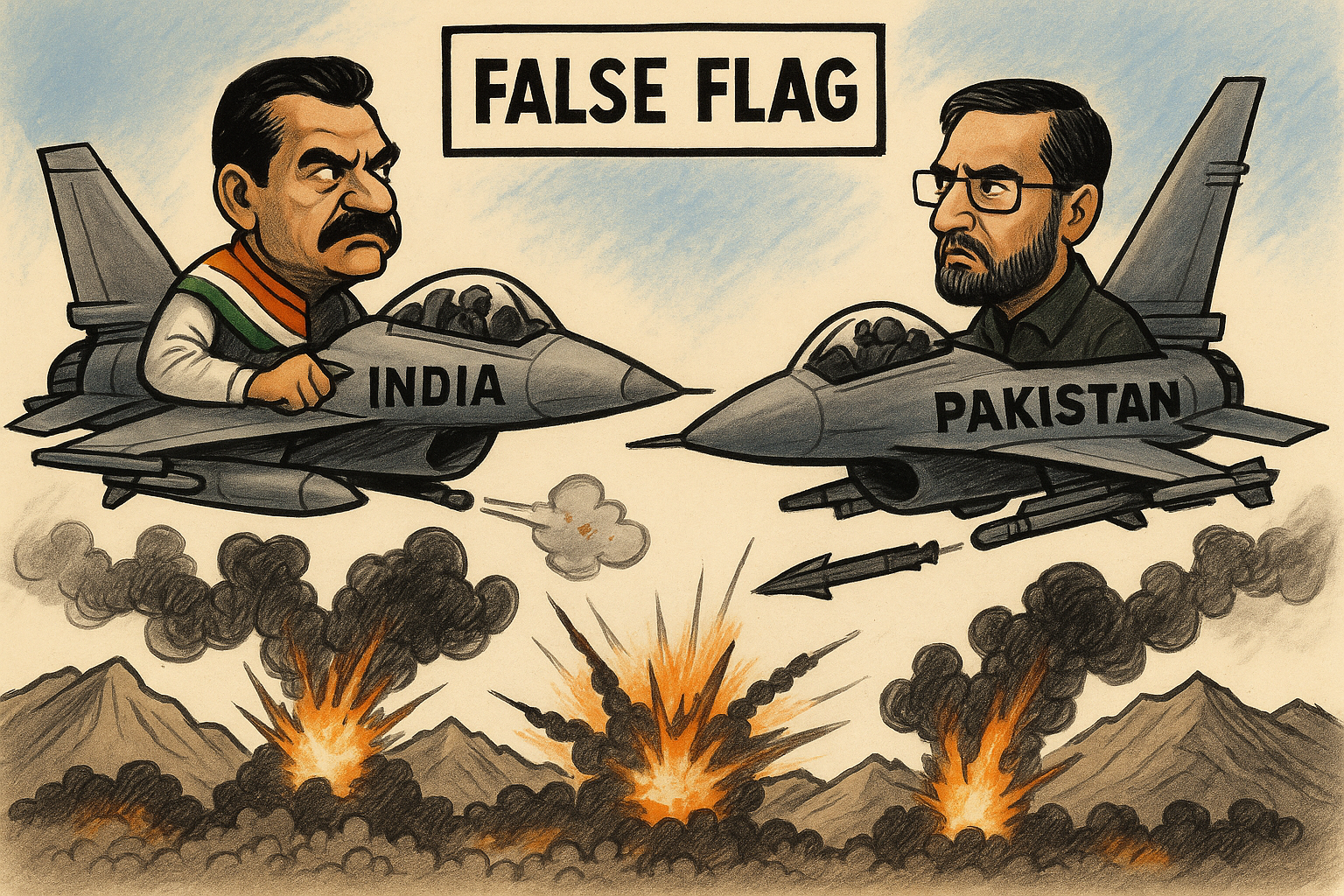
This knee-jerk reaction is not unprecedented. India has a documented history of utilizing so-called false flag operations to justify military escalation and malign Pakistan globally. The 2007 Samjhauta Express bombing, the 2008 Mumbai attacks, and the 2019 Pulwama incident—all came at politically sensitive times and were weaponized for internal political gain. Pehalgam fits this mold with uncanny precision. Notably, it coincided with the high-profile visit of U.S. Vice President JD Vance, potentially aimed at manipulating global diplomatic attention while projecting India as a victim of external aggression.
The Indian media, as in previous cases, became a megaphone for state-sponsored narratives, amplifying war hysteria without scrutiny. Opposition voices, civil society, and sections of the international media flagged serious concerns about the lack of evidence and the dangerous rush to escalate. Several independent Indian journalists and public intellectuals questioned the official narrative, pointing to a monumental intelligence lapse and reckless militarism.
India’s military retaliation, which included missile strikes on Muridke, Bahawalpur, and Muzaffarabad, resulted in heavy civilian casualties, including the bombing of mosques and deaths of women and children. More than 100 drones violated Pakistani airspace—an act of aggression that breached not only Pakistan’s sovereignty but endangered multiple international commercial flights traversing the region at the time.
In response, Pakistan launched Operation Bunyan Um Marsoos under Article 51 of the UN Charter—its inherent right to self-defense. Unlike India’s indiscriminate targeting of civilian areas, Pakistan struck exclusively at Indian military infrastructure, including drone bases, radar installations, and BrahMos missile storage sites. This response was brutal, precise, and demonstrative of military restraint. More importantly, it was calibrated to avoid civilian casualties, emphasizing Islamabad’s stated commitment to regional peace.
Yet, India’s refusal to entertain neutral investigations, its suppression of dissenting voices within, and its increasing reliance on manufactured crises point toward an alarming strategy: the systemic politicization of conflict. This not only risks direct war between two nuclear states but also undermines international norms on accountability, conflict resolution, and humanitarian law.
At a time when the world is focused on containing major geopolitical flashpoints—from Gaza to Ukraine to the Indo-Pacific—the last thing the global community needs is a manufactured crisis in South Asia. The Pehalgam episode must be thoroughly investigated. The international community, particularly the United Nations and key powers like the U.S., China, and the EU, must push for an impartial probe and demand accountability.
South Asia cannot be held hostage to election-driven militarism and disinformation. For regional stability to prevail, truth—not propaganda—must shape policy. And the truth about Pehalgam demands exposure.