 M. General Mohmed Hussein ✍️
1st Undersecretary of Ministry at the State Information Service”
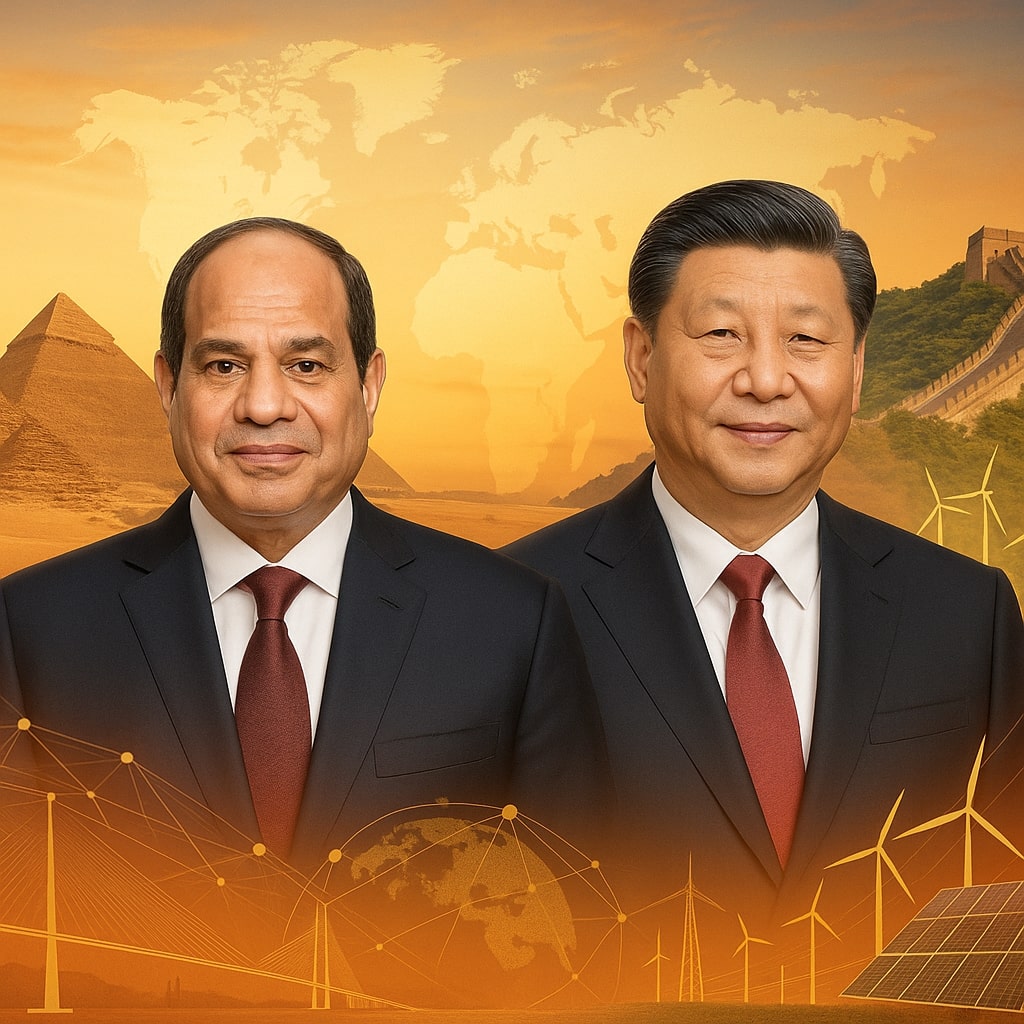
The relationship between Egypt and China represents an advanced model of strategic cooperation in the Arab world—one that bridges development with cultural depth and opens broader horizons for a multipolar future.
🧩 A Shared Vision: Team Spirit and Multi-Dimensional Integration
Since the founding of the People’s Republic of China, Sino-Arab relations have undergone a qualitative transformation. They have evolved from transactional exchanges into a unique model of geo-economic and cultural integration, grounded in mutual respect and a spirit of solidarity.
This model reflects a collective will to build a more balanced international order based on a “win–win” approach, rejecting exclusionary politics, dominance, and zero-sum games.
💹 Economic Integration: Numbers That Reflect Strategic Depth
Economic cooperation between China and the Arab world is built on strong foundations of complementary advantages, especially in energy and trade. Over the past decade, this cooperation has seen a major leap:
- Direct mutual investment reached $27 billion in 2021—2.6 times higher than a decade earlier.
- Bilateral trade surpassed $330 billion, representing a 150% increase.
This growth demonstrates a long-term, strategic partnership, not a temporary alignment of interests.
⚙️ Energy: From Resource Dependency to Joint Innovation
Energy remains a strategic pillar of bilateral relations:
- The Arab world holds nearly 56% of global oil reserves.
- In 2021, over 50% of China’s crude oil imports came from Arab states.
Yet the partnership has moved beyond traditional oil dependence. It now encompasses renewable energy innovation, particularly in Egypt:
- A 186 MW photovoltaic station was established in the Benban Solar Park.
- The EP2 DC solar project, with a 165 MW capacity, was also implemented.
In addition, the China-Arab Clean Energy Training Center was founded, signaling a shift from consumption to joint production of energy technologies. Egypt, in this context, serves as a regional hub for China’s renewable energy ambitions in Africa and the Middle East.
🚀 Technology and Space: A Strategic Leap within the Belt and Road Framework
Under the Belt and Road Initiative (BRI), Sino-Arab cooperation has expanded into high-tech domains:
- 5G technology, nuclear energy, space science, and satellite development.
China successfully launched satellites for Algeria, Saudi Arabia, and Sudan, reinforcing trust in its technological prowess.
Egypt also stands to benefit from industrial innovation, smart infrastructure, and digital ecosystems through its cooperation with China, positioning Cairo as a regional tech gateway.
🕊️ International Politics: A Coalition of Principles Against Unilateralism
China and Arab nations—including Egypt—share firm positions on sovereignty, non-intervention, and a multipolar world order based on international law and UN principles.
- China supports the establishment of an independent Palestinian state on the 1967 borders with East Jerusalem as its capital.
- Both sides advocate for reform in global governance and greater representation of developing nations in international institutions.
This convergence represents an ethical alliance that seeks to rebalance global power and give the Global South a stronger voice.
🎓 Culture and Education: Civilizational Exchange as a Lasting Bridge
Cultural and human exchange plays a central role in deepening understanding:
- China has trained 25,000 young Arabs across various sectors.
- Over 11,000 full scholarships have been awarded to Arab students.
- Four Arab countries have integrated Chinese language into their national education systems.
Egypt is a leader in this effort, with Chinese language departments in major universities such as Cairo University, Ain Shams, and Al-Azhar.
Furthermore:
- 15 colleges across the Arab world offer Chinese language programs.
- 20 Confucius Institutes have been established in 13 Arab countries.
These connections extend to media, public health, arts, women’s empowerment, and broadcasting, helping to introduce the Arab world to a Chinese modernization model that respects local traditions—offering an alternative to Western paradigms.
🧭 Toward a Multipolar Future… with Unified Goals
China and the Arab world—particularly Egypt—recognize that today’s global challenges, from climate change to geo-economic shifts, demand flexible, strategic partnerships.
The future of Sino-Arab relations, therefore, is not a mere continuation of the past. It marks a qualitative shift toward a new global paradigm, led by the Global South and anchored in mutual trust, cultural respect, and collective progress.