Editor-in-Chief Writes ✍️
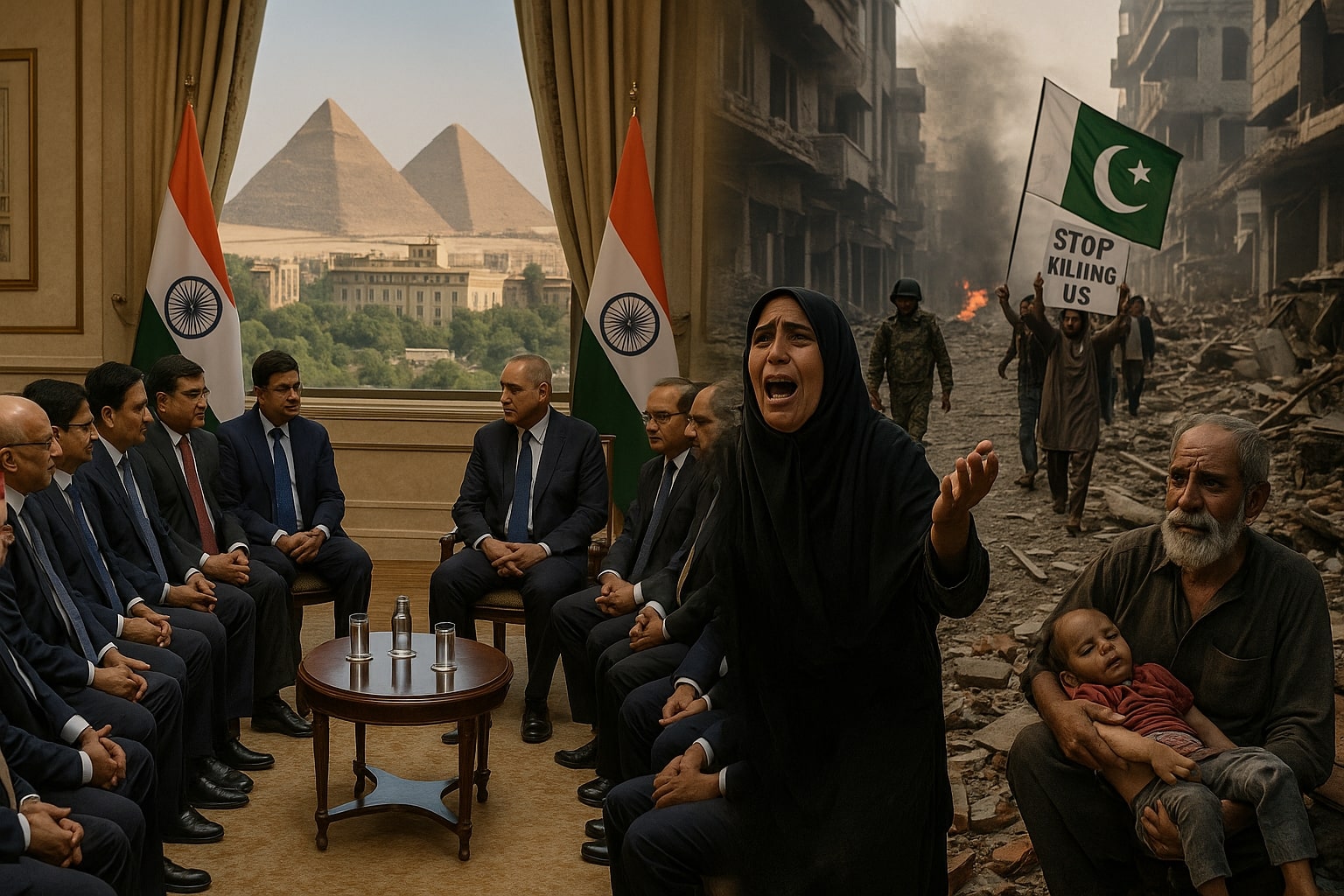
As tensions rise between India and Pakistan—amid credible reports that Indian military operations have claimed the lives of hundreds of unarmed Pakistani civilians in border regions—a high-level Indian parliamentary delegation arrives in Cairo from June 2 to 4, 2025. The timing and tone of this visit demand scrutiny far beyond diplomatic formalities.
Why Now?
Officially, the visit aims to “enhance bilateral and multilateral cooperation” with Egypt and the Arab League, and to “reaffirm India’s unwavering stance against terrorism.” But the broader context forces us to ask:
Is this visit a strategic maneuver to polish India’s image internationally and deflect criticism surrounding its recent military conduct in Kashmir and Bajaur?
Pakistan: The Omitted Reality
This growing Egyptian-Indian rapprochement cannot be viewed in isolation from Egypt’s carefully balanced foreign policy—especially in relation to Pakistan, a Muslim-majority nation with longstanding cultural, military, and diplomatic ties to Cairo, and a historic supporter of the broader Islamic world.
The complete absence of any acknowledgment of India’s recent human rights violations against Pakistani civilians in official statements and media coverage is deeply concerning. It raises fears in Arab and Islamic circles that this visit may set the stage for another painful pattern—where economic and political partnerships are pursued at the expense of justice and accountability, as was witnessed in the tragedy of Gaza.
Can Egypt Mediate?
Egypt possesses the diplomatic leverage and moral standing to act as a neutral mediator between India and Pakistan. It enjoys solid relations with both countries and is respected across the Arab and Islamic worlds as a principled actor.
But the real question is:
Will Egypt activate this potential and step into a role of strategic mediator—or will it allow the visit to be reduced to hollow protocol and photo ops?
The Stakes for Egyptian Diplomacy
In a world increasingly driven by cold interests and transactional politics, Egypt has a chance to be a voice of reason, justice, and balance. No one is asking Cairo to sever its ties with New Delhi—but the Egyptian public, and the broader Islamic world, expect a firm stance that values principles alongside partnerships.
President Abdel Fattah El-Sisi—who has often underscored Egypt’s commitment to fairness and equal treatment in global conflicts—is now being called upon to send a clear message:
Engagement with India must not come at the cost of Pakistan, nor should it serve as a smokescreen for ongoing injustices against Muslim populations under the pretext of counterterrorism.
In Conclusion: No to Another Gaza
The Indian delegation’s visit to Cairo is more than a diplomatic footnote—it is a symbolic and moral test.
Egypt must choose whether it will serve as a bridge for justice and balanced diplomacy, or silently watch as the region is once again swallowed by the politics of power and selective morality.
We do not need another Gaza.
We need moral clarity—and Egypt is in a unique position to deliver it.