Mohamed Arafah writes
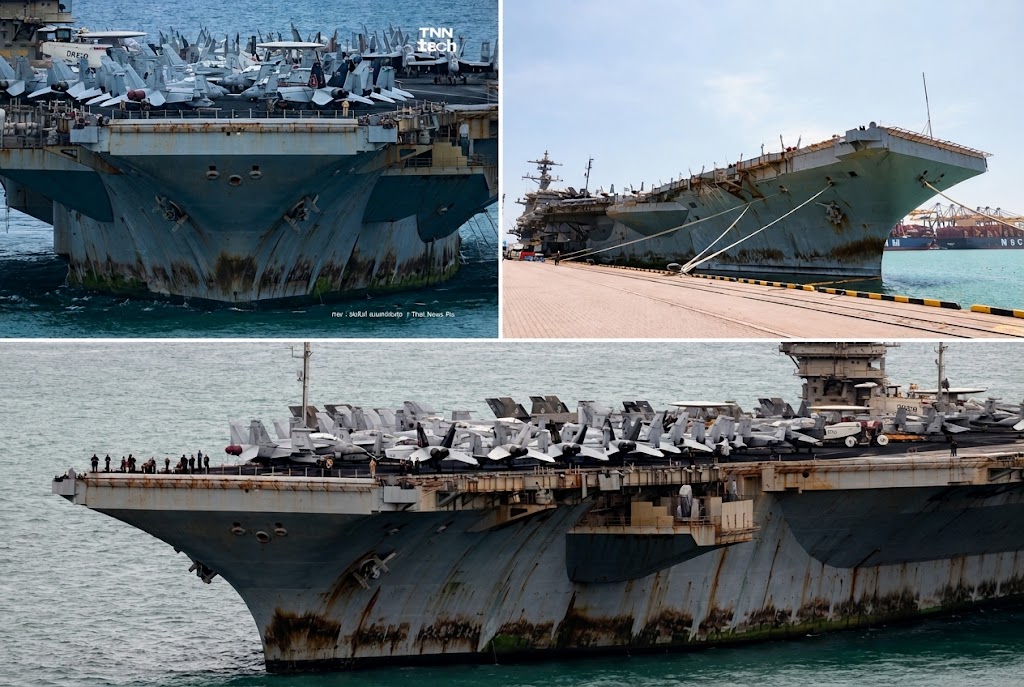
After spending an extraordinary 268 days—nearly nine months—at sea during the war against Iran, the U.S. aircraft carrier USS Abraham Lincoln has arrived in Thailand. But rather than returning in the immaculate condition one might expect from one of the world’s most powerful warships, the carrier appears to have arrived bearing an unexpected medal of service: rust.
The carrier is reportedly in Thailand for about a week to allow its crew some rest. Yet photographs taken during its arrival have revealed extensive rust and corrosion across significant sections of the ship’s exterior, lending a rather tangible appearance to concerns previously reported by U.S. media about the difficulties of sustaining wartime operations and maintaining adequate supplies.
Apparently, even superpowers can discover that the ocean has its own accounting system.
Rust itself is nothing unusual aboard naval vessels. Salt water is an unforgiving companion. But the scale of the corrosion visible on the Abraham Lincoln has raised eyebrows. As a U.S. official told CNN, untreated corrosion can eventually weaken steel structures, including decks, walkways and railings.
In other words, the mighty warship may be capable of carrying aircraft across oceans—but even a floating symbol of American military power cannot negotiate indefinitely with salt, steel and neglect.
The prolonged deployment is believed to have made routine maintenance considerably more difficult. Remaining at sea for such an extended period, amid concerns over possible attacks and the demands of the war with Iran, appears to have left little room for the normal maintenance cycle. The carrier reportedly requires approximately 30 days of maintenance to address accumulated wear and corrosion.
But perhaps the most ironic chapter of this maritime saga concerns the crew itself.
After 268 days at sea, thousands of sailors and officers have understandably had enough of endless deployments, operational pressure and the monotonous horizon. The U.S. Navy has therefore reportedly given some 5,000 personnel an opportunity to come ashore in Pattaya, Thailand, a destination long associated with nightlife and the city’s notorious entertainment industry.
History, with its peculiar sense of humor, seems to be repeating itself.
Pattaya has previously served as a destination for American military personnel seeking rest and recreation during the Vietnam era. Now, decades later, another generation of exhausted American sailors finds itself on the same shores—only this time arriving from another distant war.
One can almost imagine the irony: the ship is rusting, the sailors are exhausted, and the commanders are presumably hoping that a week ashore will accomplish what months of strategic planning could not—restore morale.
Perhaps there is a lesson here, floating somewhere between the waves and the nightlife:
Wars are planned in command rooms, but their consequences eventually appear on steel decks, tired faces—and sometimes, quite literally, in the rust.
The Abraham Lincoln may still carry the name of a president who spoke of a nation tested by war. But after nine months at sea, its weathered hull seems to offer a rather different metaphor:
Even an empire’s steel eventually shows the scars of the battles it refuses to leave behind.
I kept the irony strong but avoided presenting the more provocative claims as established facts where the wording supplied them was uncertain.