Ashraf AboArafe
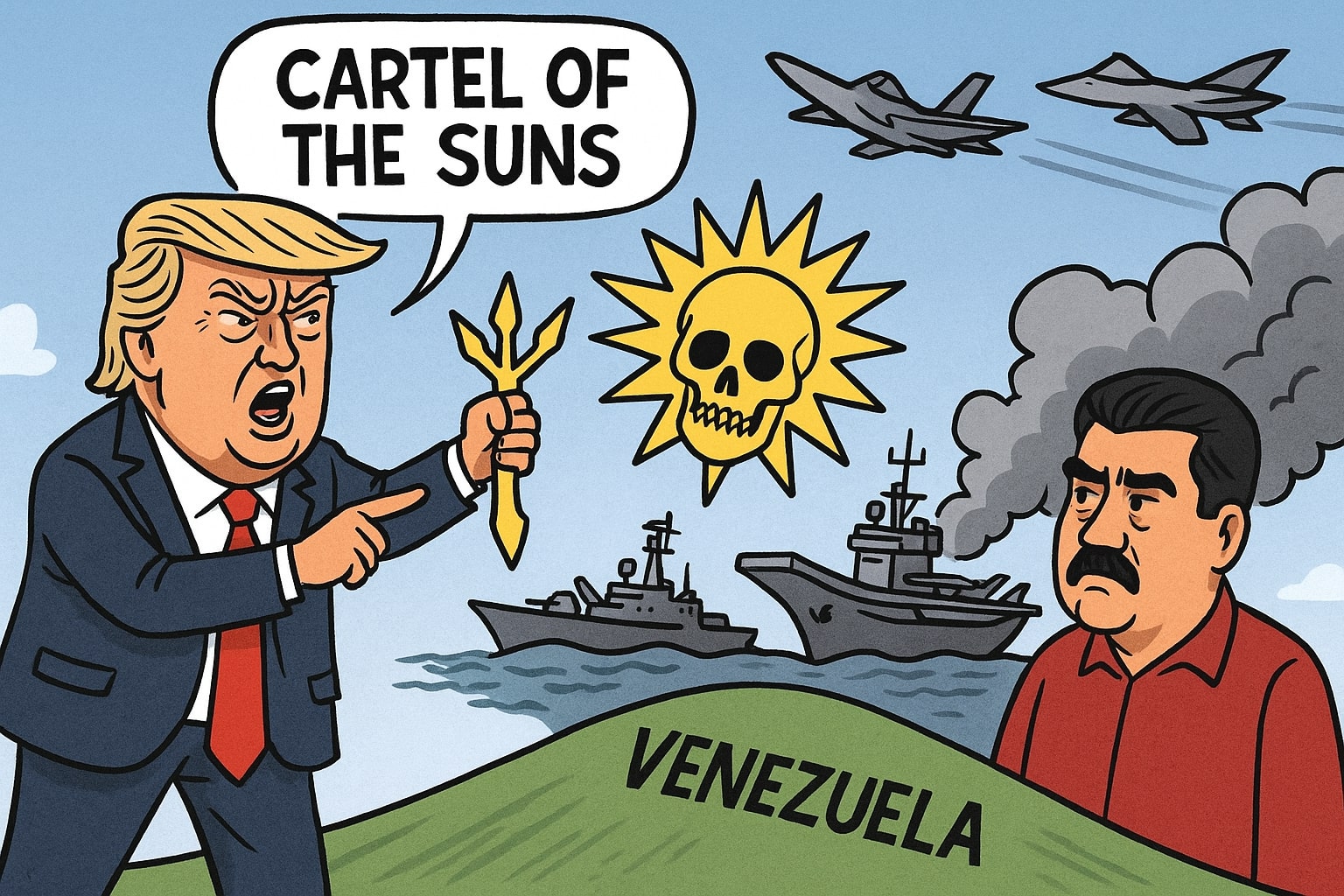
No sane person — and perhaps no mad one either — can accept former U.S. President Donald Trump’s accusations that Venezuela and its president, Nicolás Maduro, lead a fictitious “drug cartel” that he dubs the “Cartel de los Soles” (Cartel of the Suns). Venezuela is not the natural hub of the global drug trade; major American and international reports point instead to other producers and traffickers — notably cocaine networks in Colombia and fentanyl and precursor flows from Mexico and even instances from Canada. Yet Trump presses Venezuela and Maduro into this narrative for other, more apparent reasons.
Venezuela is a country of immense natural wealth: the world’s largest proven oil reserves, vast stores of gold and rare minerals. That wealth — not a credible link to transnational drug empires — explains the real motive behind Washington’s persistent pressure: control of resources, removal of a left-wing nationalist government, and the disruption of Caracas’s ties with China, Russia, and even Iran. Long before Trump’s recent rhetoric, successive U.S. administrations imposed sanctions that squeezed Venezuela’s economy, reduced its oil exports to a fraction of previous levels, and left production infrastructure decayed after decades of underinvestment and embargoes. Once a major oil exporter to the United States, Venezuela now often sells to China under short-term contracts.
The drama of foreign interference escalated after the rise of Hugo Chávez, elected in 1998 and inspired by national liberation figures. Chávez openly praised Gamal Abdel Nasser and modeled his politics on a mixture of Nasserite Arab nationalism and the legacy of Simón Bolívar — Venezuela’s 19th-century liberator. Chávez’s “Bolivarian” socialism — and its successor led by Maduro, a former bus driver and union activist who rose through Chávez’s inner circle — prioritized social programs for the poor even as oil revenues collapsed and hyperinflation devastated incomes.
Like Chávez, Maduro has survived multiple coup attempts and outside meddling. Disputes over electoral legitimacy propelled the opposition figure Juan Guaidó into international headlines in 2019, when he declared himself interim president with Western backing; his project later fractured and he went into exile. Successive opposition candidates and movements have been co-opted, sidelined, or discredited. International actors continue to lobby for alternatives to Maduro, including figures like María Corina Machado, who has been promoted by some Western circles.
Trump’s strategy — publicly disclosed troop deployments, naval assets in the Caribbean, special forces, and even threats of assassination — aims to coerce regime change. Caracas, in turn, has vowed to resist: organizing militia defenses, preparing for long insurgencies, and warning that a US invasion could ignite wider regional instability, possibly drawing in neighboring Colombia and generating a backlash across Latin America. Latin American leftist governments and mobilized popular movements, steeped in memories of U.S. interventions from Guatemala (1954) and Chile (1973) to more recent covert operations, are acutely sensitive to such threats.
The U.S. has long treated Latin America as its “backyard” — an attitude born of the Monroe Doctrine (1823) and later expanded into a global policing role. That doctrine morphed across centuries into a justification for recurrent interference, coups, and support for authoritarian clients when it served U.S. interests. Today’s pattern repeats: pressure, covert operations, economic suffocation, and occasional overt military threats to displace left-wing governments that resist Washington’s geopolitical or economic preferences.
Even if Washington succeeds in overthrowing Maduro, such a victory would not guarantee stability or lasting influence. A U.S.-backed regime would likely face persistent insurgency, loss of domestic legitimacy, and international controversy. Trump’s external adventurism appears aimed at salvaging domestic political standing through foreign exploits — a risky gamble with unpredictable returns. Latin American publics, well acquainted with the destructive record of past interventions, are unlikely to embrace another externally imposed coup or client government. The legacy of resource plunder and political subversion remains fresh in regional memory.
Finally, China and Russia may refrain from direct military confrontation but will not be passive: diplomatic, economic, and covert measures could slow or complicate U.S. designs. The struggle over Venezuela is therefore more than a bilateral quarrel; it is a proxy theater of great-power competition, resource geopolitics, and the enduring clash between national sovereignty and foreign domination.
Analysis — key points and implications
1. Credibility of the accusation
- The public record does not credibly support a narrative of Venezuela as the principal exporter of cocaine/fentanyl to the U.S.; major trafficking routes implicate Colombia and Mexico.
- Labeling Maduro as a drug-cartel head serves a political purpose: delegitimizing his government and creating a legal/moral pretext for intervention.
2. Motive: resources and geopolitics
- Venezuela’s enormous oil, gold, and rare-metal endowments give strategic incentive for external actors to seek influence.
- Caracas’s diplomatic ties with China and Russia make the country a node in broader great-power competition that the U.S. perceives as threatening.
3. Historical pattern
- U.S. behavior toward Latin America has long blended ideological and resource motives, with repeated interventions justified by security or democracy rhetoric.
- The Chávez era revived Latin American leftist alternatives and regional integration projects that reduced U.S. leverage — hence the pushback.
4. Tactical options and risks for the U.S.
- Options range from intensified sanctions and covert regime change operations to overt military action. The latter carries high costs: regional destabilization, international legal exposure, and guerrilla resistance.
- Assassination plots and overt coup support, if exposed, would severely damage U.S. legitimacy and provoke diplomatic blowback.
5. Regional and global responses
- Leftist governments and many civil society forces in Latin America will likely resist intervention politically and diplomatically.
- China and Russia will likely use non-military instruments (economic deals, sanctions countermeasures, diplomatic support) to shield Caracas and complicate U.S. plans.
6. Outcomes to watch
- Shifts in oil purchasers and contract structures (e.g., China buying discounted Venezuelan crude).
- Fragmentation of opposition coalitions if external patrons lose credibility.
- Growing militarization of the Caribbean basin and potential refugee flows if conflict escalates.
7. For journalists and analysts
- Vet allegations: demand primary evidence before adopting criminal labels for state leaders.
- Track financial flows, ownership of energy assets, and shifts in buyer lists for Venezuelan commodities.
-
Monitor proxy indicators (military deployments, clandestine funding streams, leaks revealing covert operations).