Ashraf AboArafe
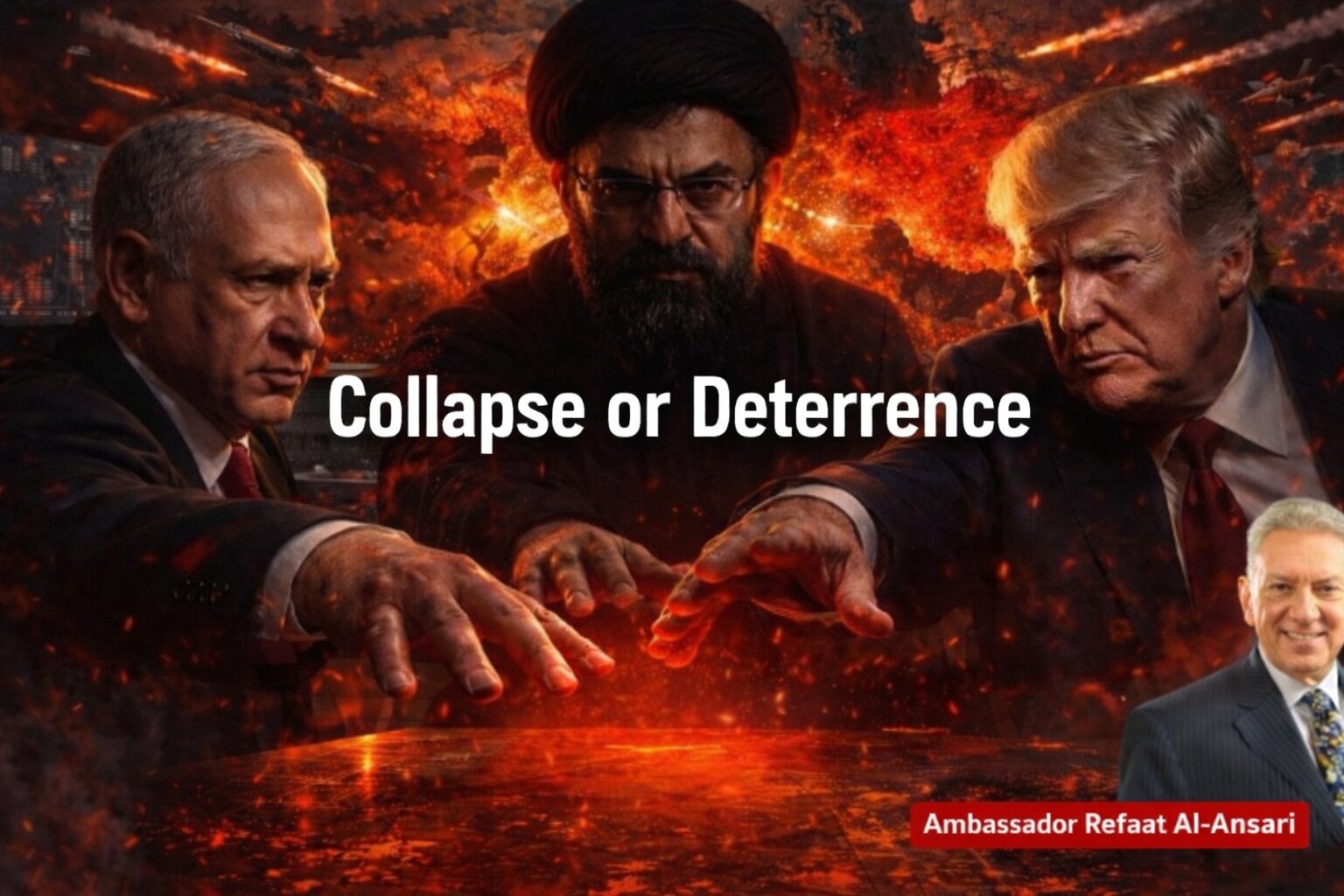
Ambassador Dr. Refaat Al-Ansari describes the current confrontation as one of the most dangerous military conflicts of the 21st century—a massive air and missile war between two states that share no direct land border, yet have transformed the region into a vast battlefield.
Across the skies of the Middle East, thousands of missiles and drones intersect, while entire cities face relentless bombardment and strategic military bases are struck deep inside national territories. In just twelve days, the region has been pushed into a full-scale open confrontation.
Meanwhile, the United States and Israel have carried out the largest aerial bombardment campaign of the 21st century, targeting thousands of sites across Iran in an attempt to dismantle military capabilities and cripple strategic infrastructure.
Yet, according to Al-Ansari, the most shocking aspect of this war is not the scale of destruction, but the question that everyone fears to ask:
Who will collapse first?
The conflict has evolved beyond simple retaliation. American early-warning systems in the Gulf have reportedly been damaged, while sensitive Israeli military installations have suffered direct strikes. In the background, the U.S. 82nd Airborne Division is preparing for possible intervention, as oil prices approach $100 per barrel amid rising tensions around the Strait of Hormuz.
This raises a fundamental strategic question:
Is the true objective the collapse of the Iranian regime?
Or is the goal to economically exhaust Iran for decades to come?
Al-Ansari warns that if the Iranian regime were to fall, it might not end the crisis—but rather ignite a broader regional war capable of engulfing the entire Middle East.
Iran: A System Designed to Resist Collapse
According to the analysis, the Iranian political system was deliberately structured since the era of Ayatollah Khomeini to make a military coup nearly impossible. Power was fragmented across several institutions—most notably the Islamic Revolutionary Guard Corps and the regular military—ensuring that no single institution could seize full control.
Within this framework, the selection of Mojtaba Khamenei as the new Supreme Leader—if confirmed—would represent not merely a succession decision but a narrative of revenge and continuity following the assassination of his father.
This transformation, amb. Al-Ansari argues, has turned the new leader into a symbol of resistance and retribution, providing the Revolutionary Guard with a powerful ideological mandate.
However, uncertainty remains. Reports have circulated suggesting that he may have been seriously injured in the early days of the war, raising questions about the true center of decision-making inside Iran.
A War of Attrition
Militarily, the conflict has increasingly taken the shape of a war of attrition.
Iran reportedly launched over 1,300 cruise missiles, 70 hypersonic missiles, and thousands of drones, while U.S. and Israeli strikes have targeted more than 3,000 locations across Iran.
Despite heavy damage, Iran is believed to retain advanced missile capabilities stored in underground tunnels and mountain facilities, allowing it to sustain operations.
On the other side, the United States is spending approximately $1 billion per day on military operations, while Israel faces mounting financial and military strain due to constant air defense and long-range strike missions.
Israel Under Pressure
Iranian strikes on Israeli military infrastructure—including air bases and intelligence facilities—have created a strategic shock within Israel. They have also exposed vulnerabilities in its defensive systems, including the Iron Dome, which has long been seen as a symbol of Israeli technological superiority.
Nevertheless, Israel still maintains formidable offensive capabilities and continues targeting Iran’s economic infrastructure, including oil refineries and power facilities.
The emerging strategy, according to the analysis, appears to be shifting away from direct regime change toward long-term economic weakening of the Iranian state.
The Ultimate Question
At the end of his analysis, Ambassador Refaat Al-Ansari raises the question that will shape the future of the region:
Has the war reached its most critical phase, where all parties realize that decisive military victory is impossible?
Or is the Middle East standing at the brink of an even wider escalation that could redraw the region’s geopolitical map?
Only the coming days, he concludes, will reveal how the security architecture of the Middle East will be reshaped after this war.