 Ashraf AboArafe writes
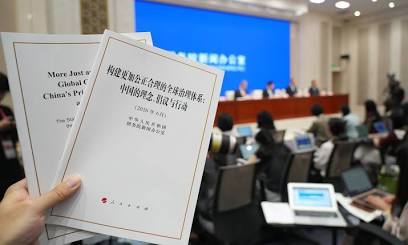
The recent report by China’s Xinhua News Agency, calling for a reinvigoration of international unity and trust, marks a strategic pivot in Chinese diplomacy for 2026. The overarching narrative successfully transitions from merely proposing conceptual frameworks to executing concrete international practices. This diplomatic shift can be deconstructed into four core analytical dimensions:
1. Context and Strategic Timing
-
Institutionalizing the Vision: Released exactly one year after the initial introduction of the Global Governance Initiative in 2025, this White Paper—published simultaneously in eight languages—demonstrates Beijing’s intent to maccestize its vision and solidify it as a highly structured, actionable global framework.
-
Responding to Overlapping Pressures: Foreign Minister Wang Yi’s acknowledgment that the post-WWII international order faces “overlapping pressures” reflects a pragmatic Chinese assessment of current geopolitical polarization. Rather than advocating for the dismantling of the established system, Beijing is strategically positioning itself as its defender and restorer.
2. Philosophical and Political Pillars
-
Humanizing International Relations: By directly linking systemic global governance to the “well-being of all humanity,” the rhetoric employs a soft, universally appealing diplomatic language. This framing is precisely calculated to resonate with global populations, particularly across the developing world.
-
Rejecting Hegemony and the “Law of the Jungle”: The text contains an implicit, calculated critique of unilateralism and power politics—serving as a veiled reference to Western-led alliances. In its place, China advocates for the “democratization of international relations” and a strict adherence to international law.
-
The UN as the Ultimate Anchor: To assuage international anxieties regarding revisionism, the White Paper explicitly states that China has no intention to “reinvent the wheel.” By reminding the international community that China was the very first signatory of the UN Charter, Beijing firmly anchors its legitimacy within the existing international architecture, claiming to protect the system rather than replace it.
3. Soft Power and Multilateral Mechanisms
-
The Global South as a Strategic Lever: The report highlights that nearly 160 countries and international organizations already support the initiative. This massive backing relies heavily on the Global South, which continues to serve as China’s primary diplomatic constituency and geopolitical anchor.
-
Summit Diplomacy: Beijing is actively backing its rhetorical commitments with institutional platforms scheduled for later in 2026:
-
The First Xiong’an Global Governance Forum (Autumn 2026): Set to serve as a permanent intellectual and ideological hub for Chinese-led global discourse.
-
The World AI Conference in Shanghai (July 2026): A tactical, forward-looking move to position China at the absolute forefront of the ethical, legal, and operational regulation of next-generation technologies.
-
4. Expanding the Frontiers of Governance
The White Paper signals that global governance is no longer confined to traditional trade and maritime borders. Instead, it identifies a critical vacuum in the “Global Commons” where China intends to establish normative rules:
-
Traditional Fronts: Resolving regional flashpoints and protecting open, interconnected development.
-
The New Frontiers: Climate change, deep space, polar exploration, cyberspace, and Artificial Intelligence (AI). This underscores a highly sophisticated strategy to dominate the rules of engagement in tomorrow’s primary arenas of global competition.
📝 Editorial Conclusion
This Xinhua report is far more than a routine press summary; it functions as a manifesto for global leadership. China is positioning itself as the “rescue architect” of a fracturing international order—leveraging the historical legitimacy of the United Nations, rallying the formidable consensus of the Global South, and setting the structural rules for 21st-century technological and ecological frontiers.