Ashraf AboArafe writes
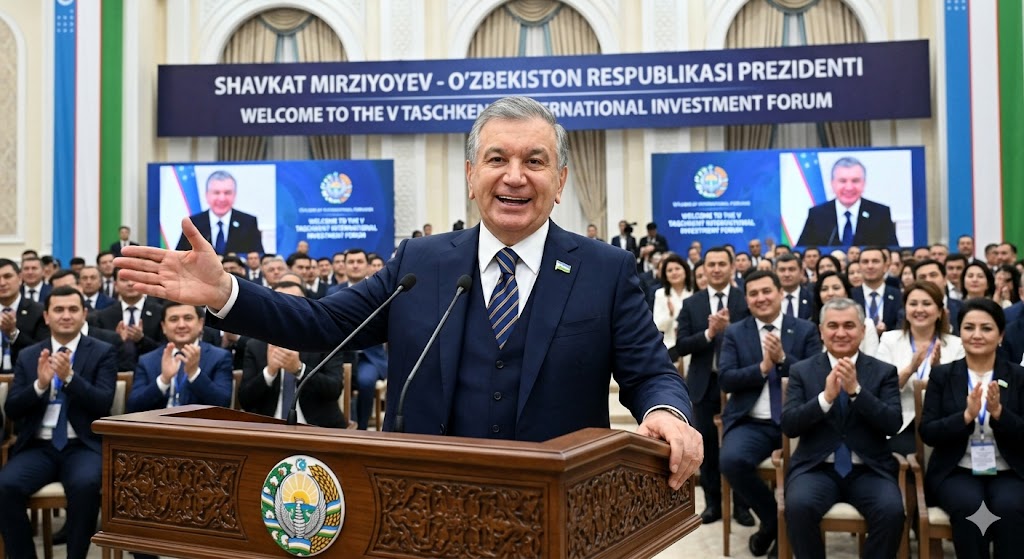
The address by President Shavkat Mirziyoyev at the Fifth Tashkent International Investment Forum (held on June 17, 2026) marks a critical milestone in the economic narrative of “New Uzbekistan.” Moving past initial foundational reforms, the speech outlines a highly ambitious blueprint to catapult the nation’s GDP past $180 billion in 2026—nearly doubling the target set just four years prior.
The address functions as both a victory lap for Uzbekistan’s recent economic indicators (7.7% GDP growth and a 14-position jump in the Index of Economic Freedom) and a strategic pitch deck targeting global capital amid shifting geopolitical and trade dynamics.
Key Pillars of the New Uzbekistan Strategy
The speech organizes Uzbekistan’s value proposition into six hyper-targeted priorities, shifting the country from a raw-material exporter to a high-tech, service-oriented regional hub:
-
The Tashkent International Financial Centre (TIFC): Unquestionably the structural anchor of the address. By implementing a 50-year zero-percent tax regime (covering corporate income, VAT, and customs) and establishing an independent commercial court operating under English common law, Uzbekistan is attempting to replicate the institutional trust models of Dubai (DIFC) and Astana (AIFC).
-
Capital Market Modernization: Transitioning beyond traditional state financing, the strategy leans heavily into alternative instruments, including sovereign Islamic bonds (sukuk) and high-profile international dual-listings (such as the National Investment Fund’s IPO on the London Stock Exchange).
-
The “Metals of the Future” & Tech Chains: Rather than simply exporting its estimated $3 trillion in subsoil wealth (gold, copper, uranium), the state is incentivizing “mining to finished products” through dedicated technoparks.
-
AI and Green Energy Frontiers: A massive pivot toward sustainability and next-gen tech is highlighted by a target of 54% green energy generation and a tax-free Artificial Intelligence zone in Karakalpakstan, complete with subsidized energy tariffs.
-
Regional Connectivity Mega-Projects: Addressing Uzbekistan’s double-landlocked geography, the speech highlights concrete infrastructure commitments: the China-Kyrgyzstan-Uzbekistan railway, the Trans-Afghan Corridor, and a new Saudi-backed international airport in Tashkent.
Analytical Insights
The Jurisdictional Pivot
The most significant takeaway from a foreign investor’s perspective is the explicit integration of the United Nations Singapore Convention on Mediation and English common law frameworks. Historically, the primary barrier to capital flight into Central Asia has not been a lack of resources, but rather judicial predictability. By installing foreign judges and international experts, Uzbekistan is aggressively decoupling its investment climate from legacy bureaucratic frameworks.
| Metric / Indicator | Past / Target Baseline | 2026 Documented Status / Projected Target |
| GDP | $100 Billion (Original 2026 Target) | >$180 Billion (Current 2026 Horizon) |
| Foreign Investment Attracted | $27 Billion (Pre-five year period) | $123 Billion (Past 5 years) |
| TIFC Tax Rates (Corporate, VAT, Property) | Standard Fiscal Rates | 0% for 50 Years |
| Green Energy Share | Legacy Baseline | 54% Target |
| Urbanization Rate | 51% | 65% by 2040 |
The Bottom Line
President Mirziyoyev’s speech successfully balances geopolitical hospitality with granular, pro-business mechanics. By matching vast physical infrastructure programs (like the $27 billion in public-private partnerships and the construction of the “New Tashkent” metropolis) with radical institutional reforms, Uzbekistan is positioning itself not just as a participant in Central Asia’s economic renaissance, but as its primary velocity engine. The success of this thesis will ultimately depend on how smoothly the transitional legal regimes operate in practice, but the blueprint presented is undeniably robust, modern, and compelling.