 Chief editor writes
NOT all messages are written in ink; some are etched by history through a swift diplomatic gesture or a profound presence at a critical moment of mourning. In this weary East, where geography bleeds into politics, a single protocol gesture can carry deep resonances that outweigh hundreds of dry, official statements.
Prologue: Ink Alone Cannot Write History
Indeed, ink alone cannot write history in the world of politics. Some messages are drafted by a sudden diplomatic shift, an astute snapshot captured by a lens, a warm handshake in cold weather, or a heavy, calculated presence at a momentous turning point.
In this sorrowful region—a Middle East where the roar of politics blends with the groans of history, and where terrain and geography overlap to the point of blurring—a single protocol gesture can carry profound resonances that far outweigh hundreds of dry, official statements born defunct in bureaucratic hallways.
Shadows Over the Silent Capital
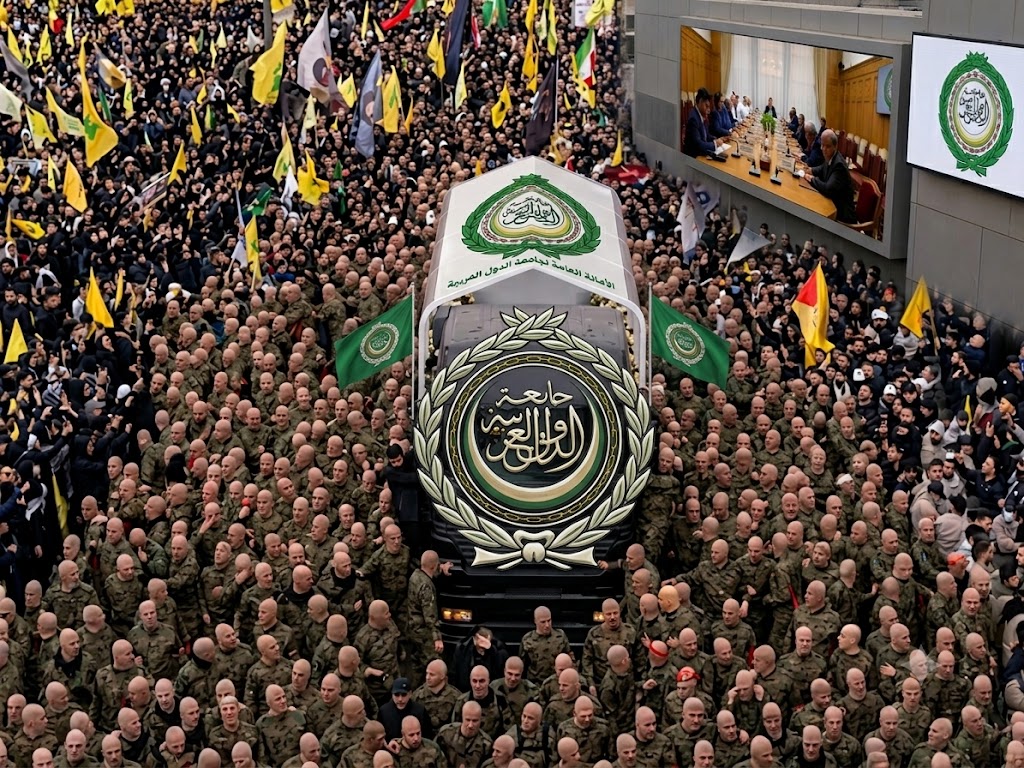
From this nuanced perspective, any official participation by the Arab League in the funeral processions of the Supreme Leader of the Islamic Republic of Iran, if carried out through a balanced, collective decision by member states, would by no means be a mere routine procedure dictated by custom or condolence.
Such a presence, in a setting charged with symbolism, grief, and anticipation, would inevitably be read as a eloquent political message reflecting a cautious Arab keenness to keep channels of dialogue open with a neighboring state that represents one of the most prominent regional actors. This comes at a time when the Middle East is undergoing a grueling transition, witnessing rapid shifts in the balance of power that resemble shifting sands, never settling in place.
“Diplomacy in times of death does not dwell on the past; rather, with the wisdom of statesmen, it attempts to negotiate no/ a less bloody future.”
Towards a New Horizon: Liberating the Decision-Making Process
Amidst these breathless transformations, a legitimate aspiration emerges calling for liberating the activity of the Secretary-General of the Arab League from the shackles of rigid centralization, moving instead towards the flexibility of decentralization in movement and initiative. The consensus and remarkable trust with which the Secretary-General was chosen grants him the moral and historical mandate to move with the agility required to keep pace with accelerating events. Perhaps this bold measure will find its natural place within the project to reform the Arab League’s charter, responding directly to the inevitability of shifting realities that do not wait for the hesitant.
The Old East: Illusions and Torn Maps
These dramatic developments unfold against the backdrop of decades-long, anxiety-ridden debates regarding the identity and future of this exhausted region. These discussions have long been intertwined with vague, glittering concepts such as “The Greater Middle East Initiative”—a concept born at the turn of the millennium from Western paradigms, sparking enough conflicting interpretations and suspicions to set a continent ablaze.
-
The Reform Perspective: There were those who saw the project at the time as a theoretical framework for reform, transition, and supposed economic cooperation.
-
The Hegemony Perspective: Conversely, many viewed it as a crude attempt to reshape the region, dismantle its identity, and engineer its maps according to paradigms and interests that serve major global powers and their allies, without regard for the sovereignty and aspirations of its peoples.
Palestine: The Compass That Always Points True
Yet history, with all its harsh lessons, teaches us that all such top-down projects will remain mere illusions suspended in thin air. Achieving a just, comprehensive, and lasting peace remains contingent upon a single, non-negotiable condition: resolving the Palestinian question in accordance with just international resolutions.
The Palestinian wound is the center of gravity in this East. Without establishing an independent, fully sovereign Palestinian state on the borders of June 4, 1967, with East Jerusalem as its eternal capital, there can be no solid foundation for any sustainable regional stability. Any other settlements will remain superficial layers, swept away by the winds of anger at the very first test.
Tomorrow’s Question: Are We Beginning a New Chapter?
The pivotal question forces itself with urgency through the dust of the funeral scene:
-
Does this courageous diplomatic movement signify the start of a brand new, unprecedented chapter in Arab-Iranian relations?
-
Or is it merely a fleeting stopover prompted by a few days of protocol mourning, after which tears will dry and disputes will return to square one?
Only the coming days and the developments of the next few years hold the definitive answer to this crucial question. What remains certain and absolute amidst all this fog, however, is that the Middle East stands today with all its stature and sorrows before a momentous historical turning point that demands a calm, deep reading and the courage of dialogue—a capacity to foresee the horizons of the future with open eyes, far removed from the estrangement and preconceptions that have brought nothing but destruction for decades.