 Ashraf AboArafe writes
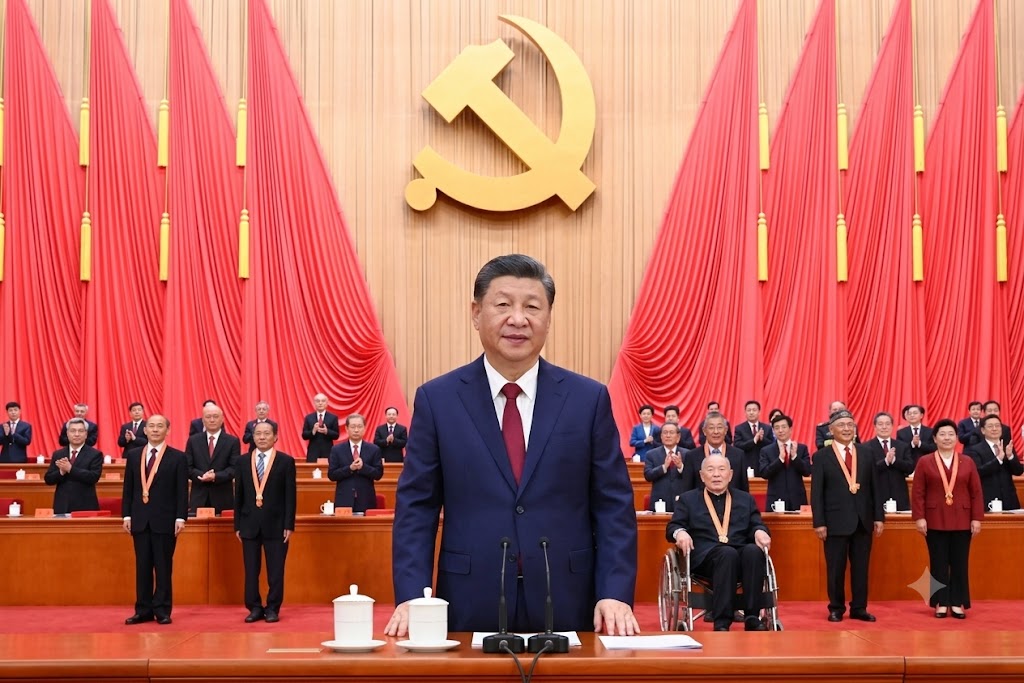
PRESIDENT Xi Jinping’s address marking the 105th anniversary of the Communist Party of China represents a critical evolution in Beijing’s official rhetoric. By intertwining structural ideology with sharp geopolitical declarations, the speech establishes a definitive roadmap for China’s trajectory heading toward the crucial mid-century benchmarks.
1. The Dialectic of Volatility: “Winds and Raging Waves”
The explicit transition from celebrating historical achievements to issuing stern warnings about “violent storms” reflects a realistic calibration of China’s current domestic and international landscape.
-
The Domestic Front: The insistence on “rigorous self-governance” and a “prolonged battle against corruption” acknowledges that internal institutional discipline remains the primary prerequisite for sustaining a century-old ruling apparatus.
-
The Global Front: By positioning China amidst “profound changes unseen in a century,” the rhetoric frames global geopolitical friction not as a series of isolated crises, but as a systemic historical transition. The atmospheric metaphors serve to mentally and culturally mobilize both the party cadre and the public for long-term strategic endurance.
2. Strategic Deadlines: The 2027 Military Imperative
A pivotal pillar of the updated address is the explicit reinforcement of the 2027 centenary goals for the People’s Liberation Army (PLA).
-
Absolute Command: Reaffirming the party’s “absolute leadership” over the military serves as a structural reminder that the PLA remains an ideological instrument of the state, directly tied to the party’s survival and objectives.
-
Force Projection: Accelerating the transition into a “world-class force” by 2027 provides a tangible, looming timeline. This creates a psychological and operational benchmark for regional security architectures, signaling that China’s window for complete modernization is compressing.
3. Red Lines on Sovereignty: Taiwan, Hong Kong, and Macao
The policy declarations regarding China’s territorial integrity leave no room for strategic ambiguity, explicitly linking geographical unification with the metaphysical “grand rejuvenation” of the nation.
-
The Taiwan Directive: By categorizing the resolution of the Taiwan question as an “unswerving historical mission,” the speech elevates the issue from a contemporary political dispute to a core historical obligation. The dual warning—vowing “resolute actions” against internal separatist elements while simultaneously threatening resistance to “external interference”—firmly addresses Washington and its regional allies.
-
The Special Administrative Zones: Elevating the “long-term prosperity and stability” of Hong Kong and Macao to an “essential core component” of national rejuvenation underscores Beijing’s view that integration is complete and non-negotiable. It signals that economic vitality in these hubs will continue to be strictly coupled with absolute political alignment.
4. Alternative Global Architecture
Despite the highly nationalist tone regarding territorial sovereignty and military readiness, the address intentionally offsets isolationist interpretations by invoking the concept of “fostering a community with a shared future for mankind.” This serves as Beijing’s primary diplomatic counter-narrative to the Western-led rules-based international order, presenting China as a stable, alternative systemic anchor for the Global South at a time when the world stands at a “historical crossroads.”