 Chief editor writes
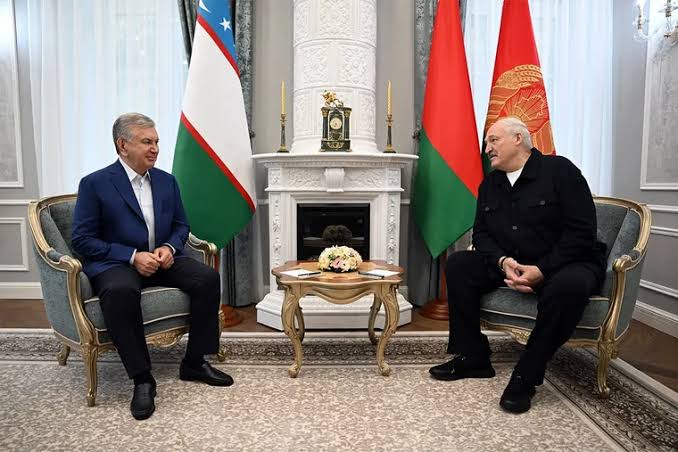
BASED on the provided text, the official visit of the President of Uzbekistan to Belarus on July 8–9, 2026, marks a significant milestone in a rapidly accelerating bilateral relationship. The partnership has transitioned from foundational diplomatic setup to a highly diversified, pragmatic, and institutionalized cooperation framework.
Below is a detailed analysis of the key dimensions driving this partnership.
1. Political & Diplomatic Framework: Sustained Momentum
The political relationship between Uzbekistan and Belarus is built on a mature legal framework and consistent high-level engagement.
-
Institutional Foundation: Established in January 1993, the diplomatic channel is supported by a robust framework of 126 bilateral documents. The bedrock remains the 1991 Treaty on the Principles of Interstate Relations, anchoring the relationship in sovereign equality and mutual respect.
-
High-Level Continuity: Political trust is reinforced by regular state visits. Belarusian President Aleksandr Lukashenko visited Uzbekistan six times between 1991 and 2026 (most recently in 2024), while the current July 2026 visit by the Uzbek President builds directly on the landmark 2019 summit.
-
Diversified Dialogue: Beyond executive leadership, interaction has institutionalized at the legislative and administrative levels through reciprocal Prime Ministerial visits (2022–2026) and targeted Inter-parliamentary women’s business forums, which bridge political dialogue with economic empowerment.
2. Economic & Investment Dynamics: Exponential Growth
Economic cooperation serves as the primary engine of the contemporary Uzbek-Belarusian relationship, characterized by sharp statistical growth and high structural diversification.
Trade Turnover Acceleration
The trade trajectory demonstrates remarkable velocity:
-
Historical Growth: Trade volume surged over fivefold, jumping from $181.7 million in 2017 to a record $965 million by the close of 2025.
-
Current Vector (2026): This momentum has carried into 2026, with January–April figures reaching $340.4 million—a nearly 33% increase compared to the same period in 2025. This puts the nations on track to comfortably exceed the $1 billion threshold annually.
-
Complementary Exchange: Trade is highly diversified. Belarus provides high-value industrial goods (machinery, vehicles, equipment, chemicals) and food products, while Uzbekistan supplies industrial commodities, finished goods, services, and processed agricultural items.
Investment and Corporate Integration
The relationship has successfully moved beyond mere import-export dynamics into deep corporate co-investment:
-
Corporate Footprint: As of 2026, 244 Belarusian-capitalized enterprises operate in Uzbekistan, balanced by 229 Uzbek-backed companies operating in Belarus.
-
Capital Flow: In 2025 alone, Belarus injected $104.4 million in direct investments into the Uzbek economy, coordinated by the Intergovernmental Commission on Bilateral Cooperation (est. 2001).
3. Decentralization: Interregional Synergy
A key structural strength highlighted in the relationship is its decentralization. Instead of relying solely on capital-to-capital agreements, the countries have fostered direct ties between provinces and municipalities.
-
Frequent Exchange: More than 40 regional delegation visits have occurred since 2017.
-
The “Forum of Regions” Model: Synced with head-of-state summits, these forums turn macro-level political goodwill into micro-level business contracts, national exhibitions, and joint regional investment projects.
4. Cultural, Educational, and Social Capital
To sustain long-term geopolitical and economic ties, both nations are actively investing in “soft power” and human capital integration.
-
Educational Integration: Addressing the needs of modernizing economies, universities have instituted double-degree programs and established the Belarusian-Uzbek Intersectoral Institute of Applied Technical Qualifications in Tashkent to streamline technical vocational training.
-
Healthcare Partnerships: A rapidly evolving sector, catalyzed by the 2023 medical forum which yielded over 120 bilateral institutional agreements regarding technology transfers and joint medical training.
-
Cultural & Diaspora Ties: Mutual cultural footprinting is visible through high-profile participation in national arts festivals (Sharq Taronalari in Uzbekistan; Slavianski Bazaar in Belarus) and the symbolic installation of monuments (Yakub Kolas in Tashkent; Alisher Navoi in Minsk). Furthermore, the 18,000-strong ethnic Belarusian diaspora in Uzbekistan, supported by centers like “Svitanak,” acts as a permanent societal anchor for public diplomacy.
Analytical Summary
The July 2026 presidential summit arrives at a time when Uzbek-Belarusian relations are at an all-time high. The partnership is notably resilient against a complex international economic environment. By successfully balancing high-level political consensus with practical mechanisms—such as localized regional forums, joint technical universities, and highly diversified trade portfolios—Uzbekistan and Belarus have created a pragmatic, mutually beneficial blueprint for post-Soviet bilateral cooperation.