Ashraf AboArafe
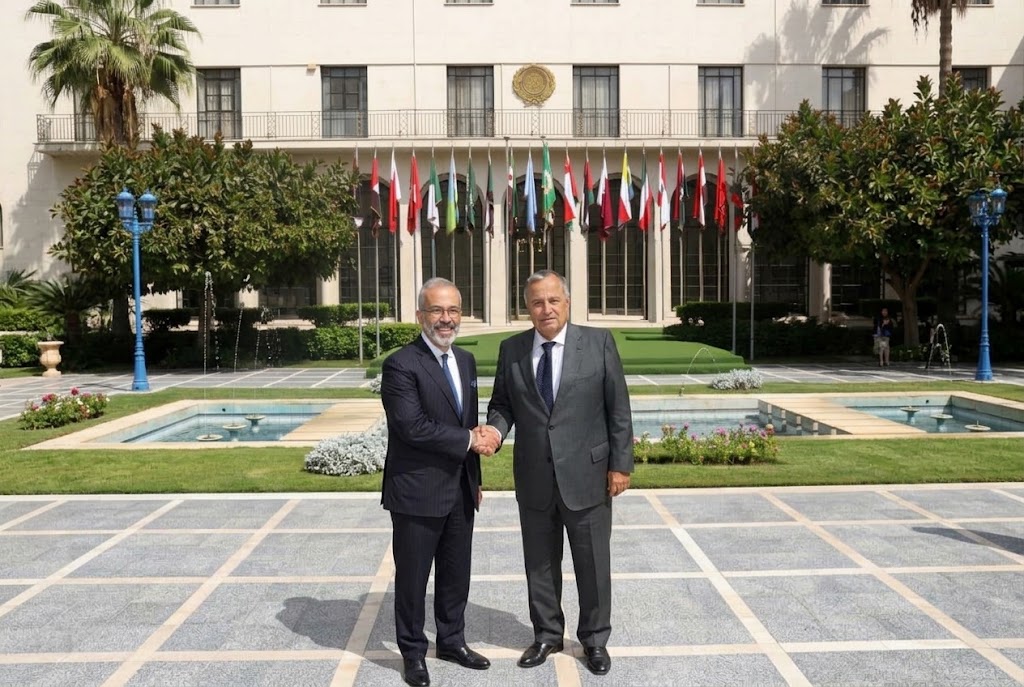
THE meeting between Arab League Secretary-General Nabil Fahmy and Portuguese Minister of State and Foreign Affairs Paulo Rangel in Cairo on September 17, 2026, carries significance beyond the bilateral cooperation discussed by the two sides.
Portugal is preparing to assume an important international responsibility: it will serve as a non-permanent member of the United Nations Security Council for 2027–2028, with the Council presidency scheduled for January 2027.
That timing gives particular importance to the LAS Secretary-General’s emphasis on Portugal’s position toward the Palestinian cause and his call for those positions to be translated into collective European measures against settlement expansion and settler violence.
From Recognition to Action
Portugal’s recognition of the State of Palestine represents a significant political position within Europe. Its opposition to Israeli settlement expansion—particularly the E1 project, which the Arab League views as threatening the territorial continuity necessary for a viable Palestinian state—places Lisbon among European capitals advocating preservation of the two-state solution.
But recognition and condemnation are one thing; concrete diplomatic action is another.
This is where Portugal’s forthcoming Security Council membership becomes important.
The question raised by the LAS meeting is therefore not simply whether Portugal supports Palestine. Its stated position is already clear.
The more consequential question is:
Will Portugal seek practical international measures to defend the principles it has articulated?
Could Portugal Follow the Logic of the European Response to Russia?
There is, however, an important institutional distinction.
The European Union has adopted extensive restrictive measures against Russia through collective EU decisions. Portugal participates in that process as an EU member.
The Security Council operates differently. Portugal, as a non-permanent member, cannot impose sanctions by itself. Any substantive Council action would require sufficient support among Council members and would also confront the veto power of the five permanent members.
Portugal’s influence would therefore lie principally in diplomatic initiative, agenda-setting, coalition-building and negotiation.
Its January presidency could give Lisbon an opportunity to place issues such as settlement expansion, settler violence, humanitarian access and respect for international law prominently on the Council’s agenda.
The Greenland Question Adds Another Dimension
Portugal’s position regarding Greenland offers another interesting point of comparison.
When the question of Greenland’s sovereignty and territorial status became a major European issue, Portugal joined its European partners in emphasizing sovereignty, territorial integrity and the principles of the United Nations Charter.
The contrast is therefore striking.
Greenland represents a test of whether sovereignty and territorial integrity apply when pressure comes from a powerful ally.
Palestine represents a test of whether those same principles are defended when the issue involves Israel and the continuing conflict in the Middle East.
The comparison does not mean that the two cases are legally or historically identical. They are not. But diplomatically, they raise a common question about the consistency with which states apply principles of sovereignty, territorial integrity and international law.
The LAS Message from Cairo
The significance of the LAS discussion with Rangel is precisely here.
The Arab League Secretary-General welcomed Portugal’s support for Palestine, its recognition of the Palestinian state and its opposition to settlement expansion. At the same time, he called for these positions to become European collective action.
He also stressed the need to:
- stop the Israeli attacks on Gaza;
- open crossings and expand humanitarian assistance;
- support UNRWA;
- end violations of Lebanese and Syrian sovereignty;
- address regional tensions through diplomacy;
- protect freedom of navigation in the Strait of Hormuz and the Red Sea;
- and ensure that regional understandings take Arab security concerns into account.
Rangel, for his part, reaffirmed Portugal’s support for Arab issues in international forums and outlined his country’s priorities for its forthcoming Security Council membership, while expressing interest in expanding political cooperation with the Arab world through the Arab League.
January 2027: The Chair and the Challenge
Portugal’s presidency of the Security Council will last only one month, but the diplomatic symbolism of the moment will be considerable.
The Cairo meeting suggests that the Arab League wants structured consultation with Portugal before and during its Security Council mandate.
For Lisbon, the challenge will be to reconcile several layers of responsibility:
its European commitments, its Atlantic alliances, its declared support for Palestinian statehood, and its responsibilities under the UN Charter.
The question is therefore larger than sanctions.
It is about whether principles proclaimed in Lisbon, Brussels and Cairo can survive the difficult journey to New York—and whether they can be converted into meaningful multilateral diplomacy.
The LAS has placed the question on the table. January will provide the setting in which Portugal begins to answer it.