 Editor-in-Chief writes
THERE is a question that may sound satirical at first glance, but has perhaps become serious enough to deserve an answer:
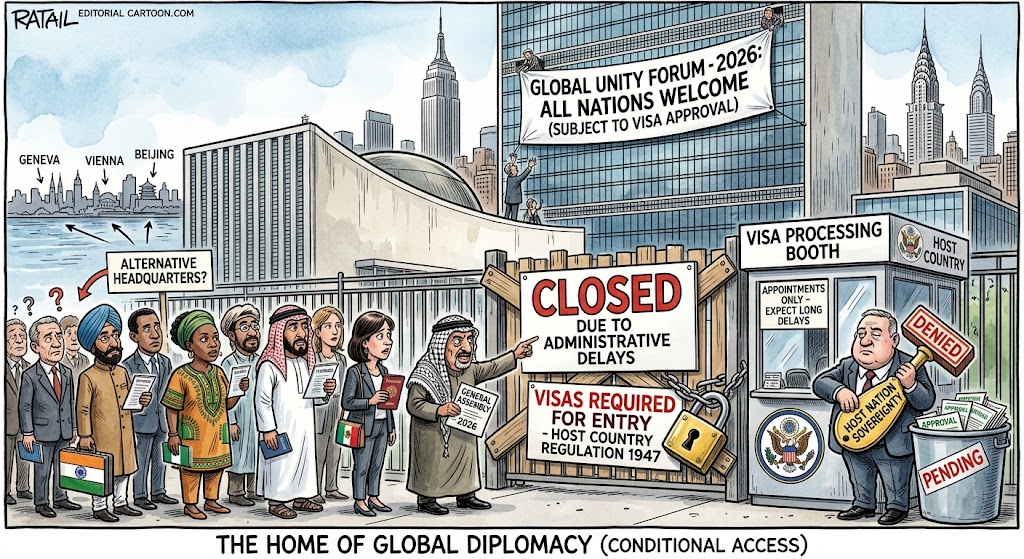
Is New York still hosting the United Nations, or has the United Nations become a guest in New York?!
This is not merely about a temporary visa dispute involving an Iranian journalist or official. It goes to the heart of the international organization itself: Is the UN Headquarters an international space where all member states should stand on equal footing, or can the host country effectively decide who may enter and who may not?
The United States is the host country of UN Headquarters, but it does not own the organization and does not determine the composition of delegations representing its 193 member states. The 1947 Headquarters Agreement contains obligations concerning access to the UN Headquarters by representatives and invitees.
Yet the history of the United Nations contains a long record of visa disputes.
From Arafat to Pezeshkian… The Visa Ledger
Perhaps the most famous case dates back to Yasser Arafat in 1988.
The Palestine Liberation Organization, through the UN Secretary-General, sought a visa for Arafat, then Chairman of the PLO Executive Committee, to participate in the 43rd session of the General Assembly.
The United States refused to issue him a visa.
The matter did not remain a routine diplomatic disagreement. The General Assembly adopted Resolution 43/48 on November 30, 1988, addressing the host country’s refusal and calling upon Washington to reconsider its decision and issue the visa. The United Nations maintained that the refusal conflicted with the host country’s obligations under the Headquarters Agreement.
Washington did not reverse its decision.
The result was extraordinary: the General Assembly adopted Resolution 43/49, moving consideration of the Palestine question to the UN Office in Geneva because Arafat could not travel to New York.
The resolution was adopted by 154 votes to 2, with only the United States and Israel voting against it, while Britain abstained.
In other words, the United Nations effectively had to move part of its business away from its own headquarters because one of its invited participants could not enter the host country.
Could there be a more absurd diplomatic irony?
The United Nations was in New York, but it could not receive one of its invited guests in New York!
And Arafat’s case was not isolated.
In 2019, UN discussions recorded a visa crisis involving the Russian delegation, with 18 visas reportedly not issued, preventing those members from participating effectively in UN proceedings. Iran and other countries have also repeatedly raised concerns over visa issuance, delays and restrictions affecting their delegations.
The problem has therefore extended beyond a single nationality or political dispute.
Then came Mahmoud Abbas.
In 2025, the United States refused or cancelled visas for Palestinian officials preparing to attend the 80th session of the General Assembly, including President Mahmoud Abbas. Palestine formally raised the matter with the UN Committee on Relations with the Host Country and called for the facilitation of the necessary visas.
The General Assembly subsequently adopted an exceptional arrangement allowing Palestinian participation remotely after the delegation was unable to participate physically.
And there lies another extraordinary paradox:
A president invited to address the General Assembly could not physically reach the General Assembly hall.
Then came 2026, with another chapter involving Iranian President Masoud Pezeshkian.
An Iranian presidential official announced that members of Pezeshkian’s accompanying media team had been denied US visas for the 81st session of the General Assembly.
Washington did not prevent Pezeshkian himself or the core Iranian delegation from attending. The dispute instead involved members of his media team.
So, apparently, the new diplomatic formula is:
“The delegation may enter… the journalists wait outside!”
What an ingenious interpretation of international access!
Double Standards… or Multiple Standards?
This brings us to the larger political question: the perception of double standards in Washington’s approach to access to New York.
While visas may be denied to officials, delegation members or journalists from countries whose governments are in sharp political conflict with Washington, Israeli officials continue to have access to the diplomatic arena in New York, including Prime Minister Benjamin Netanyahu.
The distinction must be made carefully: the International Criminal Court issued an arrest warrant for Netanyahu in November 2024; it was not a criminal conviction. The warrant concerned alleged war crimes and crimes against humanity.
But the political question remains:
If visa access can become a political instrument in one case, why should the standards appear different in another?
The contrast becomes even more striking when one considers Israel’s long-running disputes with UN resolutions concerning the occupied Palestinian territories, including Security Council Resolution 242 of 1967, which affirmed principles including the inadmissibility of the acquisition of territory by war and called for the withdrawal of Israeli forces from territories occupied in the conflict.
None of this means that failure to comply with a UN resolution automatically creates a legal basis for excluding a country’s representatives from the UN.
But it does raise a broader question about consistency.
The issue is not simply whether Washington has legitimate security and immigration concerns.
The issue is whether the host country’s authority over entry can, at times, appear to become political leverage over participation in an international organization.
Beijing Awaits the Key
And this brings us to a question that might once have sounded purely hypothetical:
Why should the United Nations not reopen the question of its headquarters?
Why should the organization not consider a location that better reflects a world that is no longer centered on a single geopolitical axis?
Why not Beijing?
Why not Vienna or Geneva?
This is not about punishing the United States, nor about handing the UN headquarters to China.
It is about a simpler principle:
If the United Nations is genuinely global, its headquarters should be capable of receiving the world without the visa becoming a political instrument.
Some will argue that New York has become inseparable from the history of the United Nations.
True.
But history should not become a constraint.
The United States is not the United Nations.
New York is not the world.
And the United Nations is not an enormous American embassy operating on American soil.
It is an organization of 193 member states, created precisely to provide a forum where even the most bitter adversaries can meet.
So perhaps the real question is not:
Can the United States host the United Nations?
It is:
Can the United States host the United Nations without sometimes appearing to host it on its own terms?
If visa disputes continue to recur, perhaps it is time for the United Nations to look at the world map again.
Perhaps Geneva.
Perhaps Vienna.
Perhaps Beijing.
The world has changed since 1945.
The balance of power has changed.
The meaning of international multilateralism has changed.
Perhaps the address should change as well.
Instead of delegations asking Washington, “Will you allow us into the United Nations?”
Perhaps the more appropriate question is:
“Is it time for the key to the United Nations to belong to the United Nations itself?”
Beijing may be waiting for the key… but ultimately, that key should be international—not national.
I kept the legal language around Netanyahu precise: an ICC arrest warrant, not a conviction, while retaining the article’s intended satirical political argument.