Minister of Water Resources of the Republic of Uzbekistan
Honored Irrigator of Uzbekistan
Water is more than a natural resource; it is the foundation of civilization, the lifeblood of economies, and a strategic determinant of national security. Throughout history, great civilizations have flourished along rivers, while fertile lands and thriving communities have depended on the availability of this precious resource. Today, however, climate change is transforming water from a source of prosperity into one of humanity’s most pressing strategic challenges.
In this context, Uzbekistan is advancing a comprehensive approach to water security that connects technological innovation, agricultural modernization, environmental protection, energy efficiency, and regional diplomacy. The country’s experience demonstrates that confronting climate change requires not merely political commitments, but measurable reforms and practical solutions.
President Shavkat Mirziyoyev has placed rational water use at the heart of national policy, emphasizing that water scarcity is becoming an increasingly urgent global concern. This vision reflects a broader understanding: water security is inseparable from food security, economic resilience, environmental sustainability, and the well-being of future generations.
From Water Scarcity to a Culture of Conservation
Uzbekistan faces considerable water challenges. Nearly 90 percent of the country’s available water resources are allocated to agriculture, making efficient irrigation essential to sustaining agricultural production and meeting the needs of a growing population.
The government’s ambition to extend water-saving technologies to 100 percent of cultivated land within five years represents a significant policy transformation. It seeks to move water conservation beyond individual projects and establish it as a nationwide standard for agricultural development.
The figures illustrate the scale of this transformation. Water-saving technologies covered approximately 28,000 hectares in 2017. Today, their coverage has expanded to 2.8 million hectares, representing nearly 65 percent of irrigated agricultural land.
During the first ten months of 2026, Uzbekistan reported saving 10.69 billion cubic meters of water through a combination of technological, infrastructural, and agricultural measures. These included:
- 4.935 billion cubic meters through water-saving technologies and laser land leveling.
- 3.14 billion cubic meters through the rehabilitation and concrete lining of irrigation networks.
- 670 million cubic meters through digital technologies.
- 1.945 billion cubic meters through drought-resistant crops and improved agricultural practices.
These results demonstrate that water conservation is not a single technological intervention, but an integrated process involving infrastructure, agricultural knowledge, and responsible resource management.
Modern Irrigation: Engineering a Climate-Resilient Future
The efficiency of irrigation systems depends not only on how water is used in the fields, but also on how effectively it is transported from its source to the final consumer.
Water losses along canals and distribution networks can undermine even the most advanced irrigation technologies. Recognizing this challenge, Uzbekistan has prioritized the modernization of irrigation infrastructure, including canal lining, hydraulic reconstruction, and improved water distribution systems.
In 2026, approximately 2.2 trillion soums were allocated to irrigation and land reclamation. These investments supported the concrete lining of 1,030 kilometers of inter-farm canals and more than 15,000 kilometers of on-farm irrigation networks.
This infrastructure modernization is particularly important in an era of increasing temperatures and unpredictable precipitation. Reducing water losses means protecting agricultural productivity, strengthening rural livelihoods, and making better use of increasingly limited resources.
Equally important is the improvement of agricultural land itself. During the first ten months of 2026, the country’s saline land area decreased by 36,000 hectares compared with the previous year, while heavily and moderately saline areas declined by 17,000 hectares. Areas affected by problematic groundwater levels were also reduced by 21,000 hectares.
Such achievements underline the close relationship between water management, soil health, and food security.
Digital Water Governance: Every Cubic Meter Accounted For
In modern water management, information is as valuable as infrastructure. Without accurate measurement, it is difficult to identify losses, ensure equitable distribution, or make informed decisions.
Uzbekistan is therefore incorporating digital technologies into its water management system. A total of 13,310 Smart Water devices have been installed at water facilities, while online meters have been introduced at 1,915 pumping stations.
Furthermore, 108 major water management facilities have been automated, and 43 large reservoirs are now equipped with online monitoring systems for water levels and volumes.
The integration of the Water Accounting information system with the Cadastre Agency and the Tax Committee has also enabled online reporting of water consumption and automated calculation of relevant taxes.
The development of a Unified Water Management Platform represents another important step toward consolidating the sector’s information systems.
Digitalization is transforming water governance from a largely traditional administrative process into a more transparent, measurable, and responsive management system. By tracking water flows in real time, Uzbekistan is strengthening accountability and creating better conditions for evidence-based policymaking.
Water and Energy: Two Resources, One Strategic Vision
Water and energy security are closely interconnected. In Uzbekistan, nearly 60 percent of irrigation water is delivered through pumping stations, making electricity consumption a major component of agricultural water management.
Modernizing pumping infrastructure, replacing outdated equipment, and introducing renewable energy sources can therefore generate significant economic and environmental benefits.
During the first ten months of 2026, 172 pumps and 168 electric motors that had reached the end of their service life were replaced. Solar photovoltaic installations with a combined capacity of 15,660 kilowatts were also introduced, alongside 66 capacitor units.
These measures contribute to a broader effort to reduce the energy intensity of irrigation.
Annual electricity consumption at pumping stations, which stood at approximately 8.3 billion kilowatt-hours in 2017, is projected to decline to 6.3 billion kilowatt-hours in 2026.
A reduction of nearly 24 percent represents more than an economic achievement: it demonstrates how water conservation, energy efficiency, and climate action can reinforce one another.
Central Asia: Water Diplomacy Beyond National Borders
Perhaps the most important dimension of Uzbekistan’s water policy lies beyond its national borders.
Central Asia’s major rivers are transboundary resources, connecting the destinies of countries through shared ecosystems, agricultural systems, and economic interests. Climate change does not recognize political boundaries. Shrinking glaciers, prolonged droughts, and changing river flows affect the entire region.
Consequently, sustainable water security cannot be achieved through isolated national policies. It requires mutual trust, scientific cooperation, equitable arrangements, and a shared commitment to long-term regional stability.
President Shavkat Mirziyoyev has consistently advocated the rational and mutually beneficial use of transboundary water resources, alongside joint efforts to address the environmental consequences of climate change, particularly in the Aral Sea region.
Uzbekistan’s forthcoming chairmanship of the International Fund for Saving the Aral Sea for 2027–2029 offers an important opportunity to advance this regional vision.
Elected President of the Fund at the April 22, 2026, meeting of the Council of Heads of Founding States in Astana, President Mirziyoyev will lead Uzbekistan’s engagement in strengthening regional environmental cooperation.
The priorities include mitigating the consequences of the Aral Sea disaster, improving sustainable water management, adapting to climate change, and mobilizing international investment for environmental and social projects.
Two proposed initiatives deserve particular attention.
The first is the regional “Water of the Future” (Kelajak Suvi) program, designed to promote a culture of responsible water consumption, expand the adoption of water-saving technologies, encourage scientific exchange, and engage younger generations in protecting water resources.
The second is the proposal to declare 2026–2036 the Decade of Practical Action for the Rational Use of Water in Central Asia.
Together, these initiatives reflect an important principle: regional water cooperation must move beyond declarations and become a sustained program of practical action.
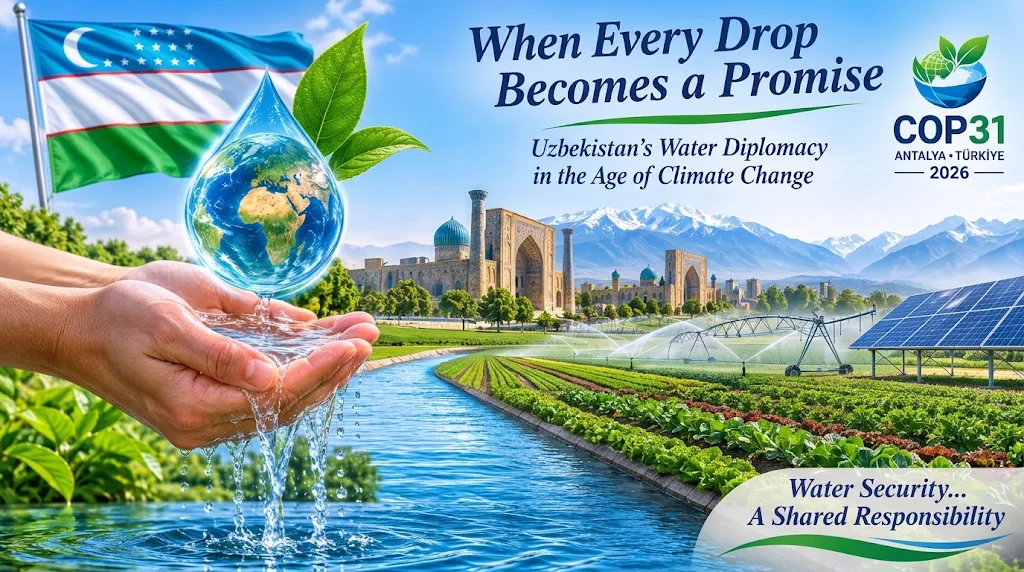
COP31: Uzbekistan’s Experience on the Global Climate Stage
The 31st Conference of the Parties to the UN Framework Convention on Climate Change, scheduled to take place in Antalya, Türkiye, from November 9 to 20, 2026, provides an important international platform for advancing this agenda.
For Uzbekistan, COP31 offers an opportunity to present its experience in water conservation, modern irrigation, digital management, agricultural adaptation, and environmental rehabilitation.
The summit of heads of state and government on November 11–12 further creates opportunities to strengthen international dialogue and explore new avenues for cooperation.
Uzbekistan’s message to the international community is clear: climate commitments must be translated into measurable outcomes. Investment in water-saving technologies, resilient infrastructure, renewable energy, and digital governance should become central elements of the global response to climate change.
The country’s experience also highlights the importance of connecting national reforms with international partnerships. Technological exchange, scientific research, investment, and regional coordination are indispensable to addressing challenges that no country can overcome alone.
Water Security Is a Shared Responsibility
The transformation of Uzbekistan’s water sector reflects a strategic understanding of the challenges facing the twenty-first century. Water scarcity, environmental degradation, population growth, and climate change are interconnected pressures that demand coordinated and forward-looking solutions.
The expansion of water-saving technologies, modernization of irrigation networks, rehabilitation of agricultural lands, digital monitoring, and energy-efficient pumping systems constitute important pillars of this transformation.
Yet the ultimate measure of success will not be the number of technologies installed or the volume of investment allocated. It will be the country’s ability to preserve water resources, sustain agricultural production, protect ecosystems, and strengthen the foundations of regional cooperation.
Under President Shavkat Mirziyoyev’s leadership, Uzbekistan is seeking to establish a model in which every cubic meter of water is valued, every technological innovation serves sustainability, and every regional partnership contributes to shared security.
The challenge of water scarcity is global, but the solutions must begin with practical action at national and regional levels.
Ultimately, water is not simply a resource to be consumed; it is a legacy to be protected and a responsibility to be shared. In an age of climate uncertainty, the future of Central Asia will depend not only on the rivers that flow through its lands, but also on the wisdom, solidarity, and cooperation with which its nations manage them.
When every drop is protected, the future of an entire region can flourish.