Ashraf AboArafe
Capital University, Fukui University and Sony Join Forces to Advance Children’s Programming Education
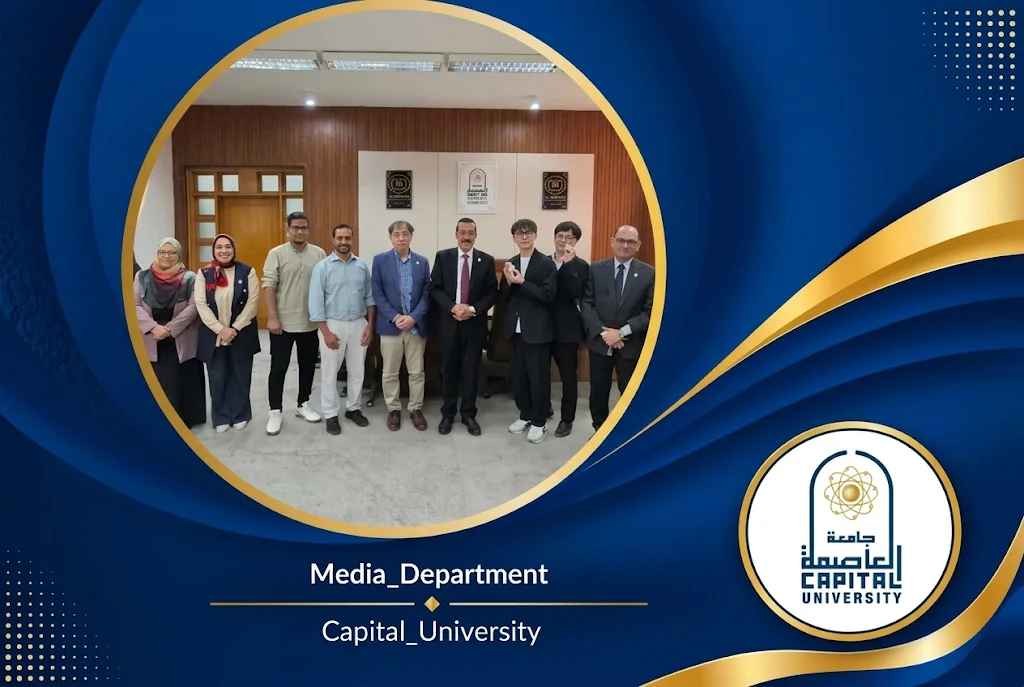
The Faculty of Education at Capital University hosted a Japanese research delegation from Fukui University and Sony Corporation to explore new horizons for scientific and technological cooperation under an Egyptian research project aimed at employing educational robots and smart technologies to teach programming to children, enhance their creative thinking, and develop innovative learning environments.
The visit represents a significant step toward strengthening international academic partnerships and harnessing technological innovation to advance education, while connecting scientific research with practical applications that respond to the demands of the digital age.
The visit was held under the patronage of Prof. Dr. El-Sayed Qandil, President of Capital University, and Prof. Dr. Hossam Hamdi, Dean of the Faculty of Education, within the University’s strategic vision to promote the internationalization of higher education, expand cooperation with leading international universities and research institutions, and support projects that contribute to technology transfer and localization, digital transformation, and the advancement of education and scientific research.
Prof. Dr. El-Sayed Qandil emphasized that cooperation with international universities and technology institutions constitutes a fundamental pillar of the University’s vision for developing education and scientific research. He explained that international partnerships provide valuable opportunities for exchanging expertise, transferring knowledge, and localizing advanced technological applications to serve Egyptian society.
He further stressed that the University attaches particular importance to research projects that bring together technological innovation and educational development, helping prepare future generations with the skills required to meet tomorrow’s challenges, particularly creative thinking, programming, and proficiency in modern technologies.
For his part, Prof. Dr. Hossam Hamdi affirmed that the project offers a promising model for integrating scientific research with technological applications to improve the educational process. He noted that introducing educational robots into children’s programming education opens new horizons for innovative teaching methods and strengthens teachers’ ability to employ modern educational tools that meet the requirements of the digital era.
Hamdi also underscored the Faculty’s commitment to supporting its research teams and expanding cooperation with international universities and research centers, thereby reinforcing its academic position and contributing to the development of future teacher-preparation programs.
The Japanese delegation included Prof. Akira Mitamura and Prof. Ishikaga from Fukui University, alongside Dr. Nakayama, representing Sony Corporation.
Prof. Akira Mitamura, the principal investigator of the project on the Japanese side, expressed his pride in the ongoing scientific partnership between Fukui University and the Faculty of Education at Capital University. He praised the support extended by Prof. Dr. Hossam Hamdi to the research team and reaffirmed the Japanese side’s commitment to providing the necessary support for the project’s successful implementation and the expansion of scientific cooperation between the two teams.
The meeting was attended by members of the Faculty of Education’s research team, including Prof. Dr. Wael Ramadan, Vice Dean for Education and Student Affairs, and Prof. Dr. Mahmoud Zaki, Vice Dean for Graduate Studies and Research, in addition to several faculty members and researchers.
The visit was coordinated by Dr. Mahmoud Fawzi Ahmed, Director of the Center for Educational Technology and principal investigator of the project on the Egyptian side.
Dr. Mahmoud Fawzi explained that the initiative is the outcome of more than a year of research cooperation between the Faculty of Education’s research team and Fukui University, in collaboration with Sony Corporation. During this period, the two sides worked to establish the research framework, develop mechanisms for cooperation, and prepare and submit funding proposals to government bodies and supporting institutions in Egypt and Japan, paving the way for the project’s implementation and the expansion of its research and educational applications.
The visit featured a series of academic and training sessions, alongside discussions on implementation mechanisms and the exchange of expertise concerning the use of educational robots in teaching programming, preparing future teachers, and developing modern educational practices.
These activities highlighted the importance of combining academic expertise with advanced technological applications, transforming research cooperation into practical initiatives capable of producing tangible educational outcomes.
Ultimately, the partnership between Capital University, Fukui University, and Sony Corporation reflects a broader vision of international scientific cooperation: one that goes beyond exchanging knowledge to building practical bridges between research, technology, and society.
As Egypt looks toward a knowledge-based future, educational robotics and children’s programming are no longer merely technological innovations; they are investments in the minds of coming generations. Through such international partnerships, Capital University is contributing to the preparation of a generation capable not only of using tomorrow’s technologies, but also of understanding, developing, and creating them.