Ashraf AboArafe
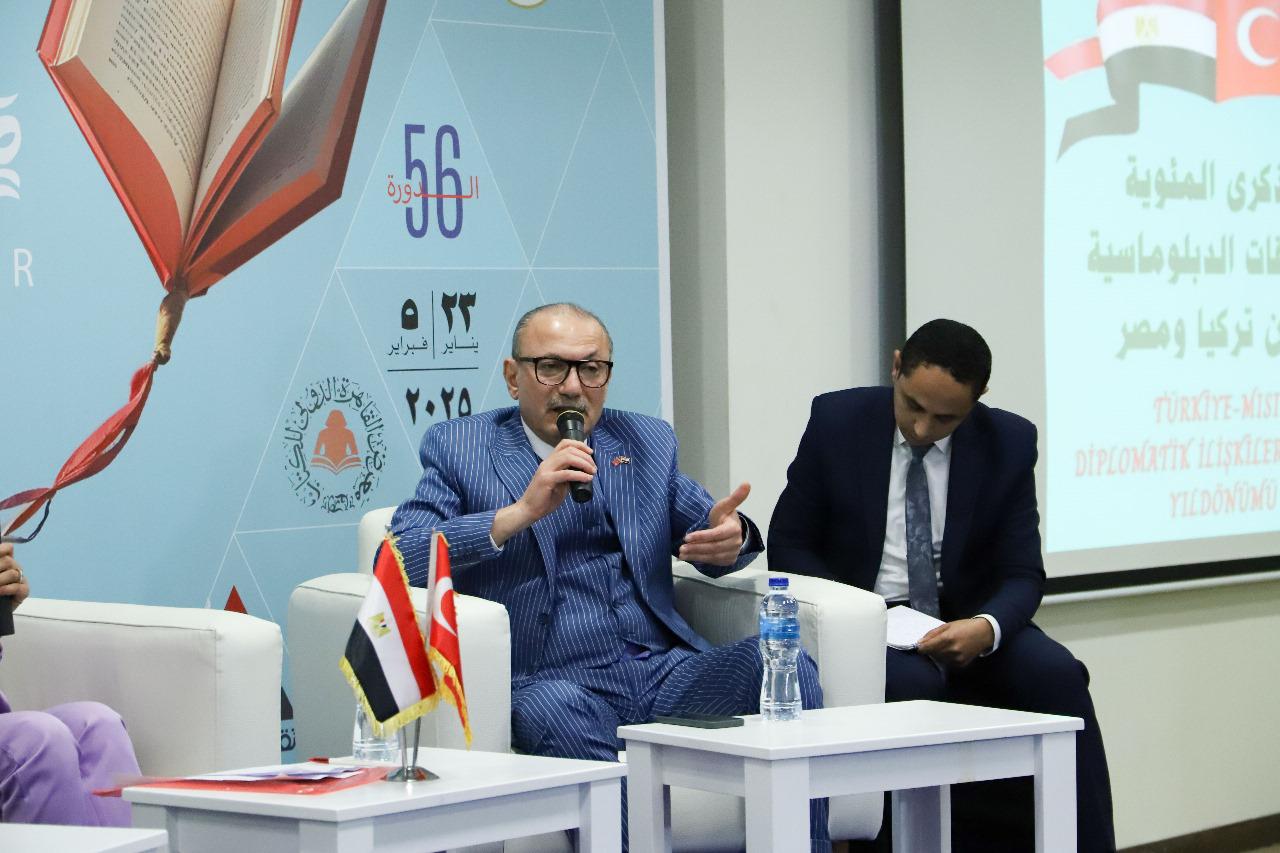
Turkish Ambassador to Cairo Salih Mutlu Şen and former Egyptian Ambassador to Ankara Alaa El-Hadidi spoke during a seminar organized by the Ministry of Foreign Affairs on the sidelines of the Cairo International Book Fair. The seminar was organized on the occasion of the centenary of the establishment of diplomatic relations between Egypt and Turkey.
Ambassador Şen: Our Foreign Minister Hakan Fidan is expected to visit Egypt this year.
– There are at least 10,000 Egyptian university students in Turkey. We would like to see more Egyptian students come.
– Egypt is among the first countries in the world to learn the Turkish language.
– Egypt is distinguished primarily by its history, honor, pride and human capital.
– Umm Kulthum, Omar Sharif and Naguib Mahfouz prove that Egypt is the center of culture and art in the Arab world.
- Turkey’s strategy is to grow with Egypt,
- Turkish investments will exceed $5 billion in 5 years and $10 billion in 10 years.
- Turkish investments currently provide job opportunities for 100 thousand people.
- I love Arish very much and I love eating beans with bread
Media interviewer Heba Hamza: First, we would like to welcome you and start with the valuable guest of Egypt and the book fair, the Turkish Ambassador to Cairo, Salih Mutlu Şen. How do you evaluate the development of Turkish-Egyptian relations over the past century?
Ambassador Salih Mutlu Şen: First, I would like to thank the Ministry of Foreign Affairs and the management of the Cairo International Book Fair for bringing us together on this occasion. I find it a valuable and very meaningful opportunity.
It was a beautiful coincidence that our conversation came after the visit of the Minister of Foreign Affairs, Dr. Badr Abdel Aati, to Türkiye. So I think we have a lot to talk about.
Media interviewer Heba Hamza: The relations between Egypt and Turkey have developed over a century in the fields of economy, investment, education and culture. How do you see this?
Ambassador Salih Mutlu Şen: The first feature of Turkish-Egyptian relations is that, regardless of their policies, nature and development, they are an unbreakable relationship that stems from the common history, kinship and cultural ties between the two countries.
The Egyptian-Turkish history is so deep that volumes of books will not be enough to explain its depth. Therefore, this is our guarantee, this is our foundation, this is our essence. It has always inspired us in all circumstances and pushed us to work harder and reach the point we have reached today.
Therefore, diplomatic relations were established between the two independent states in 1925. Our political relations have witnessed a crowning path over the past century.
Turkey and Egypt were two peoples living under the roof of the Ottoman Empire between 1517 and 1914, with one flag and one state, but the ties between them were very strong. There were tens of thousands of Turks and Egyptians, tens of thousands of Egyptians and Turks during this period.
There are thousands and hundreds of thousands of untold stories that deserve to be written about, a story that needs books and volumes to be written and films to be woven.
I have reached this point in the last hundred years. I can say this now at the point we have reached in the last hundred years. The will of the two heads of state reflects the most conscious, powerful and strategic stage within the framework of interests, values and historical relations between the two peoples.
This will between President Sisi and President Erdogan reflects the most conscious and strategic will based on values and interests.
I am using this intentionally, and what I am saying is full of substance, that is, there is economy, trade, investment, technology, culture and education.
There are at least 10,000 Egyptian students currently studying in Turkey.
Think about it. Let me give you an example from the field of culture. Yesterday, the Egyptian Minister of Tourism and Antiquities was in Türkiye. We returned 152 Egyptian artifacts to Egypt with an official ceremony and at the same time we signed a cooperation agreement.
Media interviewer Heba Hamza: We welcome Ambassador Alaa El-Hadidi with us today. How would you describe the friendly relations between Egypt and Turkey?
Ambassador Alaa El-Hadidi: First, I would like to welcome the Turkish ambassador and thank the exhibition management for giving me this opportunity.
It is unfair to only talk about a century of relations between Egypt and Turkey. Because the first agreement in history, the Kadish Agreement, was concluded between two countries.
This agreement was a model to be emulated in the field of international law and relations between the two countries. Egypt and Turkey contributed to establishing international law. Relations have gone through many stages in the last century, but the most striking thing is that relations between peoples have remained far from political situations. While I was in Turkey, I never felt like I was in a foreign country. This is reflected in both political and commercial relations. Many Turkish businessmen, especially in the textile sector, have moved their factories to Egypt.
Media Interviewer Heba Hamza: How can cultural, economic and educational relations between Egypt and Turkey be strengthened?
Ambassador Salih Mutlu Şen: There is indeed great potential in education. There are more than 10 thousand Egyptian students in Turkey. This number is increasing and will continue to increase. I am sure that there will be more additional capacity. And scholarship students. This topic. I have said it before. Let us increase the government scholarship allocated to Egypt to 500 scholarships. It is currently about 100-120.
I have personally set such a goal. Students like the weather, the social environment, the cultural environment and the social environment in Turkey.
But in addition, the President of the Turkish Higher Education Council came here and in his meeting with the Egyptian Minister of Higher Education and Scientific Research, it was agreed to establish a Turkish-Egyptian university in Egypt. We have set this goal and we will continue to work on it.
Also, Zagazig University has a project to establish a Turkish college of science and technology. We have received the official offer for this and we will work on it in the city of Tenth of Ramadan.
Of course, I personally hope that Egypt will become a major destination for Turkish students to study Arabic and Islamic sciences, as it was in the past. All this will happen in stages. Jordan is the number one destination at the moment. Egypt is the cultural and educational capital of the Arab world, and steps will be taken in this direction as well.
Interviewer: Thank you for mentioning Egypt as the cultural capital of the Arab world.
Ambassador Salih Mutlu Şen: Is there any doubt about this, since we commemorated the death anniversary of Umm Kulthum two days ago? Umm Kulthum is the greatest artist that the Arab and Islamic world has produced worldwide, and Egypt produced Umm Kulthum.
When you say “Umm Kulthum”, everyone in Turkey shows great respect.
Omar Sharif, a world-class cinema artist, came from Egypt.
Naguib Mahfouz is the first writer and novelist to receive the Nobel Prize in Literature in the Arab and Islamic world.
Also, at the beginning of the twentieth century, Ottoman Turkish music was greatly influenced by Egyptian music in terms of scale and musical notes. Because musicians came here. During the reign of Khedive Abbas Hilmi II, but after the emergence of Umm Kulthum and Mohamed Abdel Wahab in the 1950s and 1960s, Egyptian music was deeply influenced by arabesque music, which is a different type of music in Turkey today. The most popular artists in Turkey in the last 30 years have emerged from arabesque music. So it is undoubtedly the cultural capital of Egypt.
Interviewer: Regarding education, there are many students here at the exhibition, how can they apply for scholarships?
Ambassador Salih Mutluşen: There are two ways. First, we have government scholarships. We announce this every year.
We set a target of 500 scholarships annually and this number reached 120 last year. I hope it will be 200 this year. Because we are in constant discussion with the scholarship administration. Students can follow the website and social media pages of Yunus Emre Institute and the embassy and submit their applications.
I personally can help very successful students. The other option is for students who have a better financial situation
I think they can easily enter the department they want in Turkey. It can be economics, technology, industrial engineering, operations, political science, history.
As I said, many universities in Turkey, both public and private, have places available and universities accept foreign students, especially from Egypt, which is one of the closest countries to us.
We have no limits for students coming from Egypt who adapt to us culturally and socially very easily. Private students, that is, as paying students, but the fees are low. So if a student is very successful, for example if he gets eighty or ninety out of a hundred, many of our civil society organizations also give scholarships and so on. Once they come to Turkey with these scholarships, they can look for opportunities to benefit from them.
Therefore, I encourage Egyptian students. Let the number increase from 10 thousand to 20 thousand, 30 thousand. We are happy with this. Our universities in Turkey are of high quality. The campus is of high quality. The opportunities of the social environment are very good.
Interviewer: Mr. El-Hadidi, we want to know more about your life experiences in Turkey, how long did you spend there?
Ambassador Alaa El-Hadidi: I went to Turkey in September 2007 and then to Russia in March 2010. All doors were open to us. The Egyptian ambassador is treated better than the American and French ambassadors and is always treated with respect. There is a common history between the two countries, other than that there is the Turkish archive, and I urge history students to pay attention to this archive. I would like to illustrate the importance of this through the Taba case. The Egyptian delegation received maps from the Ottoman era showing that Taba belongs to Egypt.
We are talking about the economy, education and culture, but there is a common history between the two countries that should not be neglected. There are many commonalities between the two peoples. Many Turkish businessmen did not feel like they were in exile when they came to Egypt, and some of them even married Egyptians.
Interviewer: What is the volume of investment and trade between the two countries?
Ambassador Salih Mutlu Shen: The economy and trade constitute the strongest dimension in the current contemporary Egyptian relations.
We have adopted the following philosophy. As in Turkey. He said that Turkey has a population of 85 million, Egypt has 115 million, 150 million. We have many common interests. We are people from the same region, the same history. There are giant powers in the world as well. There are big economies in the world.
In other words, let us share our resources with sister countries like Egypt, and we will grow together. Let us be stronger together. So our approach to economic trade is to unite and grow together.
There is already a ground for that. The free trade agreement was concluded while the ambassador was there on this basis. So, on the basis of our free trade agreement, we have a very broad horizon in the fields of trade, investment, finance, technology, that is, industry, technological and industrial-related procurement. As I said, our horizon is based on the understanding of growing together and uniting with each other. We have many opportunities to support that.
Logistic capabilities, the flight distance between the two countries that is no more than two hours at most, the easy visa regime, the cultural and social proximity between the populations that feed each other. Therefore, the potential ahead of us is enormous.
We in Turkey have a great desire for this issue, we are sincere and we are making efforts.
In terms of investments, we are looking forward to achieving a trade volume of $10 billion this year. We expect the trade volume to reach $15 billion in four or five years, and at least $20 billion in ten years.
I believe that the total volume of Turkish investments in Egypt will exceed $5 billion in 5 years. This is a fact Riyadh and I think it will easily exceed $10 billion in 10 years.
Growing together, sharing our resources, our industrial capabilities, would be the most rational and healthy strategy we can implement as two countries of great importance in the same region and with the same history. This is our opinion.
But besides these numbers, there is another very important advantage of Turkish investments in Egypt.
Turkish investments in Egypt are concentrated in labor-intensive sectors rather than investing in machinery. Our investors are currently employing 100,000 people in Egypt. We are focusing our investments on sectors that create job opportunities. Of course, we have technology companies like Beko and Hayat Kimya, but 80 percent of them are in the textile sector, which provides huge job opportunities.
Egypt has a very large population, and most of its population is young. Providing job opportunities for young people is a strategic issue for Egypt.
Therefore, our investments attract young people from villages and rural areas and employ them in the factory. I can easily say that among the Turkish textile factories that I know, there is no factory that is not actively expanding its capacity. If it employs 5,000 people, it will increase them to 10,000. This is the case in Sadat City, Qantara, Ismailia, 6th of October, Burj Al Arab, Port Said, and 10th of Ramadan.
So what we are saying has a very big meaning. I appreciate this very much, Egypt has the capacity to produce cotton in textiles. There is a stable future with Turkey in the textile sector.
Interviewer: Mr. El-Hadidi, how do you explain the ambassador’s statements regarding investment and trade volume?
Ambassador Alaa El-Hadidi: I agree with everything that Ambassador Salih Mutlu Şen said. He is 100% right. Turkish investment in Egypt plays a big role. We talked about textiles, but the most important issue that I personally witnessed is the industrial developer. He is equipping water, electricity, and buildings in industrial zones, which is a very difficult process. 
Interview: How can diplomatic dialogue channels be strengthened to make the relations between the two countries permanent?
Ambassador Salih Mutlu Şen: The relations between the two countries must be built on solid political and legal foundations. A strong political foundation. The political will of President Erdoğan and President Abdel Fattah el-Sisi is exemplary in this regard. Both countries have high capacity, and they are mature and responsible countries. Therefore, they have analyzed everything from many angles and determined the political course of their relations with wisdom and a strategic eye and on the basis of interests, values and principles, and this is good.
In terms of the legal basis, 17 agreements were signed during President Abdel Fattah el-Sisi’s visit to Turkey on September 4, 2024, at the High-Level Strategic Cooperation Council meeting. Among these agreements were the industrial zone agreements mentioned by Mr. Alaa. Therefore, we have completed an important part of this legal foundation.
We need to reach this basic infrastructure with more decisive and solid steps in various fields, such as energy, transportation and similar issues. For example, the subject that we feel is missing and that we are currently working on is development cooperation and technical cooperation. God willing, this will be completed as soon as possible and Turkey will once again participate in technical cooperation activities in cultural and industrial matters in Egypt.
So these two political subjects are complete, the will, positivity and wisdom are complete, the strategic vision is complete, and we have taken a step in the legal aspect. We have signed 17 agreements. Another 5-10 agreements can be signed and the goal now is to put them into effect. Therefore, I believe that the ground is largely prepared politically and legally and can be completed in the areas we want very soon.
Let me say this as well. Our Foreign Minister Hakan Fidan may visit Egypt this year and this will give a boost to these works. We can give more speed politically. Then our other ministers will come and go. Things are going on the right track and we are completing the steps we want and desire in terms of logistics, energy and technical cooperation, as well as in the legal field.
Interviewer: Mr. Ambassador Al-Hadidi, how do you see the future of relations between Egypt and Turkey?
Ambassador Alaa Al-Hadidi: The Egyptian Foreign Minister paid an important visit to Turkey this week, where he met with Turkish President Recep Tayyip Erdogan. The Egyptian Foreign Minister’s visit to Turkey in light of the developments in the region indicates that Egypt attaches importance to listening to Ankara, and Ankara attaches importance to listening to Egypt.
There will be coordination, especially in Palestine and Syria. Egypt has its interests and Turkey has its interests. Developments in the region and the new administration in the United States are pushing countries to strengthen relations with each other.
Developments in the international economic environment encourage us to give greater importance to the Turkish market.
Interviewer: Do you have a message for visitors to the book fair that shows the depth of Egyptian-Turkish relations?
Ambassador Salih Mutlu Şen: In 868, Ahmed Ibn Tulun, the first Turk to come to Egypt, came. Since that day, the Turks came and settled in Egypt as soldiers, merchants, doctors and artists. One thing has not changed at all. All the Turks who came to Egypt, starting with Cavalli Mehmet Ali Pasha, loved Egypt very much and were Egyptian patriots. They worked for Egypt.
Therefore, in Turkey, in the past, there is a concept like someone from Adana, someone from Istanbul, someone from Varli, someone from Trabzon. The name of this concept is Egyptian. That is, many people and many notables identified him as Egyptian. This is like saying that you are from Adana or Istanbul. The Turks who come here accept this and introduce themselves as Egyptians.
Egyptian Foreign Minister Dr. Badr Abdel Aati said during our meetings that 30% of Egyptians have Turkish blood to some extent. Imagine being able to speak and express yourself in Turkish with ease and confidence. The same applies to I don’t see myself as a stranger in Egypt.
After two and a half years, I can now say that I have also become an Egyptian-Turk. Because when I look at the Egyptian people, I cannot see them as foreigners, I cannot do that.
When I approach the poor Egyptians, the orphans, the needy, the sick. I also consider them as my brothers.
And I tell our foundation that Egypt is our sister, if anyone is going to come to Turkey, let them come from Egypt. Let the workers, engineers, and students come from Egypt. The Egyptian people are part of us.
Question No. 1: Are there projects to teach the Turkish language in schools in Egypt?
Ambassador Salih Mutluşen: We have the Yunus Emre Cultural Institute. There are a large number of Egyptian students in our institute. Among all the countries in the world, Egypt ranks first in terms of interest in the Turkish language. Most of the students on the Internet and university students are from Egypt. We are currently talking with the Ministry of Foreign Affairs. We want to open a branch of the Yunus Emre Institute in Alexandria.
We are ready to send teachers. We are ready to send dozens of Turkish teachers from Turkish universities. One of our lecturers has started working in Alexandria. One of them is about to start. Let this be our message to the Egyptian authorities. If the Egyptian Ministry of Foreign Affairs, the Supreme Council of Education and Egyptian universities ask us, we are ready to send Turkish language teachers to Turkish departments.
Because there are about 20 departments of Turkology in Egypt. We are ready for that. We have started taking steps. If the Ministry of Foreign Affairs, the Ministry of Higher Education and the universities ask, we will send 10 or 20 teachers.
Second question: Is there cooperation between Egypt and Turkey in the field of drama and series?
Ambassador Salih Mutlu Şen: Turkish TV series are very popular in Egypt because of this cultural and social proximity. My wife and I watch for two or three hours a week, talk about it, discuss it. Our Egyptian friends do the same. These social problems, adventures and personal values attract attention because they are similar.
Egypt also has a very strong film industry, TV series industry, talented artists and production companies. I have met a large part of them, and I still meet them, and I establish contacts between them and Turkish producers.
For example, one of my friends in Turkey yesterday was the owner of a production company and he is also an actor.
I made sure to connect him with two Egyptian production companies here. They met each other. They are talking now.
In other words, I have done my part in this regard, and I am still doing it. Of course, what will happen next depends on the private sector. But I would like to say this. I care a lot about history. I give great importance to literature. When I arrived in Egypt, I found this. Egypt has a huge pool of talents. Painter, actor, technical officer, writer, literary figure.
I have done many works with these talented people for 2.5 years. I do it, I have done it. One of them is a novelist who is a friend of ours. A famous novelist. Popular. There are thousands of forgotten stories in our shared history, but all of them can become great TV series, and some can be erased. I said this is my story. Are you a writer? He said he will write. I also agreed to support him for six months. He says he will write, and he is writing. We are waiting, we hope he will finish it.
Question 3: Where is your favorite place to go in Egypt and what is your favorite food?
Ambassador Salih Mutlu Şen: Thank you. My favorite place to go is Arish. Because the people there are kind and warm. It is impossible not to feel that. Very sympathetic people. The weather is very beautiful. Arish has very clean air. It has a great atmosphere. The fish is very beautiful. I have become a friend of the restaurant there. I have also become a friend of the port. I have also made friends at the hotel. There are cafes. For example, there is Tulip Cafe. I have also made friends there. Basata Fish Restaurant. So, we have friends too.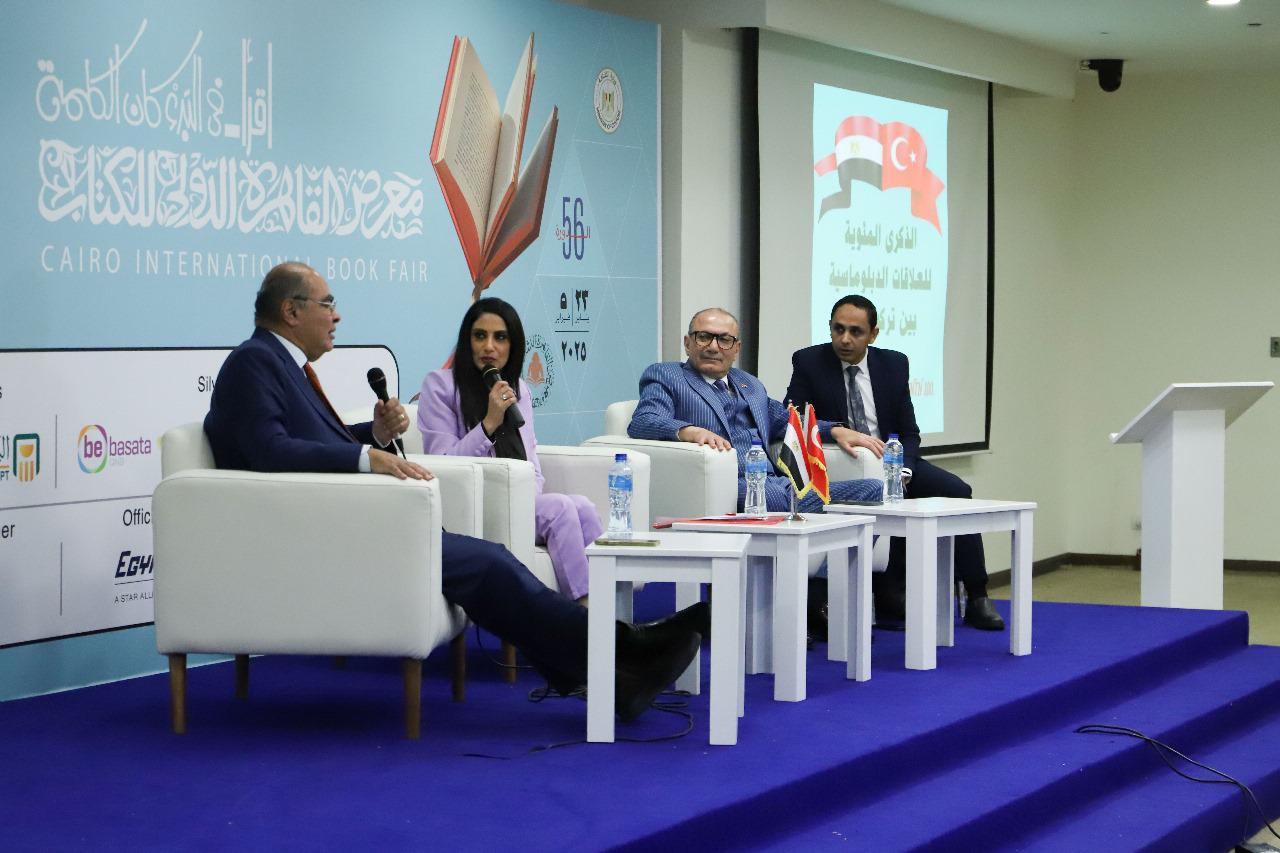
In Arish, people love Turkish, they know that too. Blood also yearns. I love Arish very much because it makes my blood yearn. I love to go. It takes 6 hours to travel and 6 hours to return. Although I spend 12 hours on the road, I enjoy going there and I never feel tired.
My favorite food is fava beans, so if you bring me fava beans every day for breakfast, I eat them with bread. I find beauty and taste in simple food. Fava beans are also simple, filling and delicious. But the best part is that everyone, young or old, rich or poor, eat fava beans. Fava beans are the dish that unites Egypt.
Question 4: How do you evaluate the opportunities for cooperation in the fields of industry, agriculture and trade?
Ambassador Saleh Mutlu Shan: The main starting point for cooperation in the industrial field is the industrial zones.
Our cooperation continues here. Our company here will double its work in the field of industrial zones, and there will be 3 industrial zones with an area of 5 million square meters in the New Administrative Capital and the 6th of October area. There is another project. Yesterday, Foreign Minister Dr. Badr Abdel Aty met with the President of the Union of Chambers and Commodity Exchanges of Turkey, Rifat Hisarcıklıoğlu. He went on a political visit and also held a business meeting. It is very important because Dr. Badr Abdel Aty attaches importance to economic cooperation and industrial cooperation.
As for agricultural cooperation, our priority should be to expand the scope of the Free Trade Agreement by adding agricultural products to it. On the other hand, there is a growing demand in Turkey for strawberry, banana and mango supplies from Egypt.
I would like to point this out as well. Cotton is an industrial raw material. The integrated facility starts with cotton and ends with shirts and T-shirts. If we succeed in ensuring that industrial companies enter Egypt more to grow cotton, it will be very beneficial.
Question 5: How would you describe Egypt in three words?
Ambassador Salih Mutluşen: First, history; history means Egypt. Second, honor and pride. The third advantage is human capital. What I mean is that Egypt is today one of the countries that has the largest human capital in the world. I hope you realize this.
Today, half of the human capital in the Gulf is Egyptian. Egypt has a rich pool of talent. And Egyptians have also begun to express the strength of human capital.