Ashraf AboArafe writes ✍️
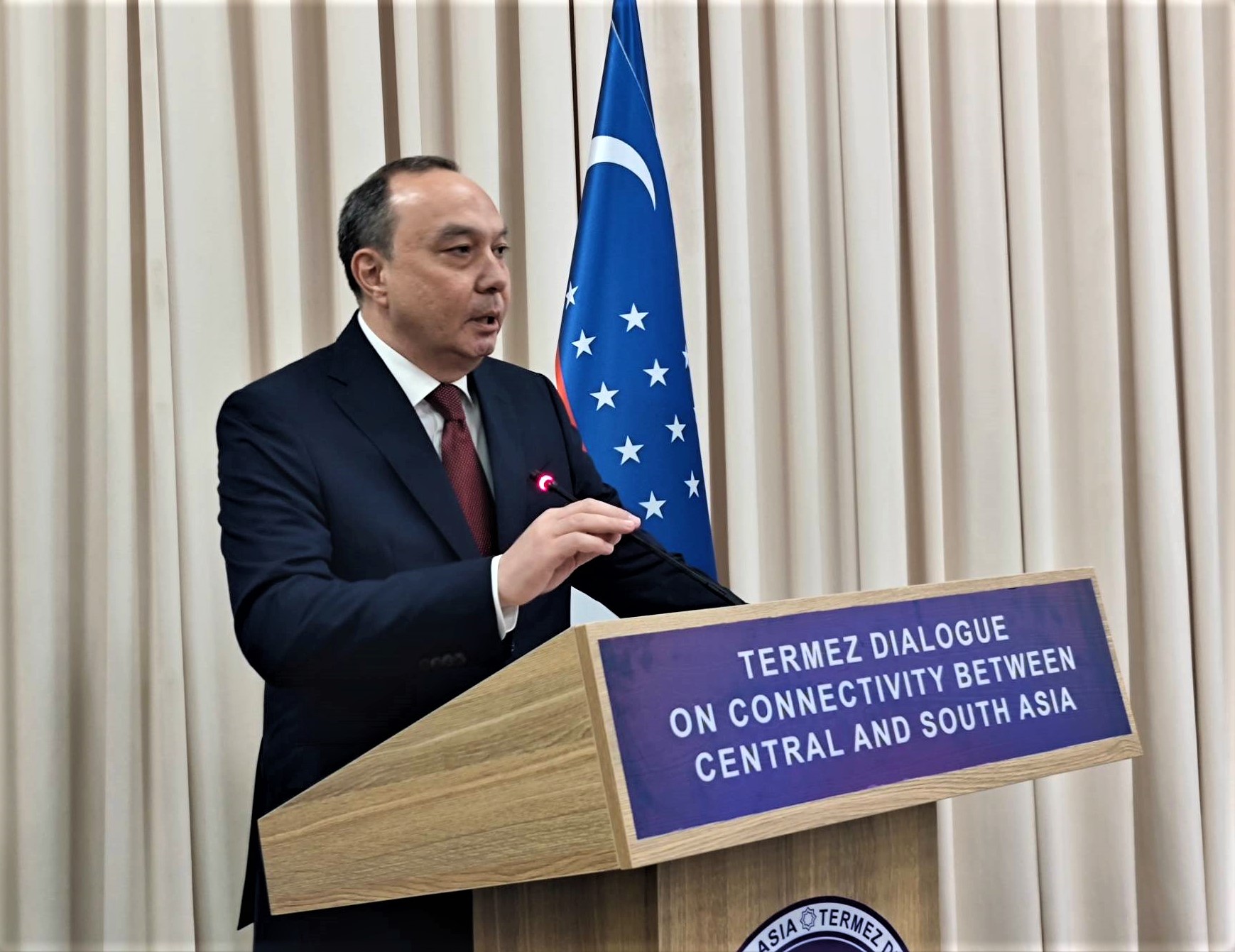
The inaugural Termez Dialogue held in the historic Uzbek city of Termez marks a significant milestone in Central Asia’s diplomatic efforts to revive and institutionalize regional connectivity. Eldor Aripov, Director of the Institute for Strategic and Regional Studies (ISRS), delivered a pivotal speech that was both historically grounded and geopolitically forward-looking. His message reflects not only Uzbekistan’s aspirations but also the shifting contours of regional politics in Eurasia and South Asia.
1. Symbolism of Termez: A Historical and Strategic Nexus
Aripov’s focus on Termez as a symbolic “nodal point” for interregional dialogue is not incidental. By evoking its rich cultural past—from Zoroastrianism to the Timurid golden age—he emphasized that history can serve as a diplomatic resource. This approach aligns with President Shavkat Mirziyoyev’s broader strategy of civilizational diplomacy, where shared heritage becomes a vehicle for building trust among diverse nations.
Prominent meaning: The city of Termez becomes a soft-power tool in constructing a new regional identity rooted in historical interconnectedness.
2. From Historical Trade Routes to Modern Corridors
Aripov connected ancient trade routes like the Northern Trade Route to modern megaprojects such as:
- CASA-1000 (electricity transmission),
- TAPI (gas pipeline),
- Trans-Afghan Corridor (multi-modal transport).
This strategic linkage underscores a core geopolitical goal: restoring economic geography disrupted by colonial borders, Cold War rivalries, and post-9/11 instability. Uzbekistan is clearly positioning itself as a land-bridge between South Asia’s growing markets and Eurasia’s energy, transit, and industrial hubs.
Prominent meaning: The revival of ancient trade routes is not nostalgia—it is a geopolitical blueprint for economic sovereignty and diversification.
3. The Afghan Equation: From Risk to Opportunity
Perhaps the most politically sensitive part of Aripov’s message was his treatment of Afghanistan. Instead of portraying it as a perpetual security threat, he emphasized its gradual transformation and potential to become a stabilizing actor. This reflects a pragmatic Central Asian view that regional security cannot be achieved through isolation, but through engagement and economic inclusion.
Prominent meaning: Reframing Afghanistan from a failed state to a regional partner is key to reimagining South-Central Asian integration.
4. Multipolar Diplomacy and Regional Consensus
Aripov’s emphasis on the “consensus in Central Asia” points to the post-Karimov era foreign policy shift under Mirziyoyev: multilateralism, openness, and balanced diplomacy. The Termez Dialogue is both a reflection and a tool of this new orientation, drawing stakeholders from Europe, the Middle East, Asia-Pacific, and beyond.
This echoes Uzbekistan’s nuanced positioning:
- It does not aim to replace great powers (China, Russia, USA),
- Instead, it seeks to curate regional formats that serve mutual development interests and dilute external rivalries.
Prominent meaning: The Dialogue signals Uzbekistan’s emergence as a diplomatic convener in a region historically shaped by foreign interventions.
5. The Economic Imperative: Beyond Trade Numbers
While the $5 billion trade figure between Central and South Asia is a positive trend, Aripov candidly admitted it is “modest” compared to potential. His call for trade facilitation, diversified transport corridors, and energy infrastructure reflects a technocratic understanding of what regional integration requires—not just political will, but institutional capacity and infrastructure financing.
Prominent meaning: Economic connectivity is not automatic—it needs harmonized policy, investment mechanisms, and geopolitical stability.
Conclusion: A New Paradigm of Regionalism
Aripov’s final invocation of President Mirziyoyev’s words—emphasizing “historical and civilizational community” and “cooperation over confrontation”—encapsulates the normative core of the Termez Dialogue. It is not just about trade routes or investment deals; it is about redefining the identity of the region as a shared space of peace, development, and sovereignty.
If successfully institutionalized, the Termez Dialogue could become a Eurasian version of ASEAN-style diplomacy—incremental, inclusive, and rooted in regional consensus.
Strategic Takeaways:
- Uzbekistan is using historical identity and geography as tools of modern statecraft.
- The Termez Dialogue reflects a shift from reactive to proactive regional diplomacy.
- Afghanistan’s regional integration is seen as a long-term stabilizing force.
- There is a window for Central and South Asia to become co-architects of a new Eurasian connectivity model.
- Uzbekistan is emerging as a credible middle power with convening authority in Eurasian geopolitics.