 Chief Editor analyzes
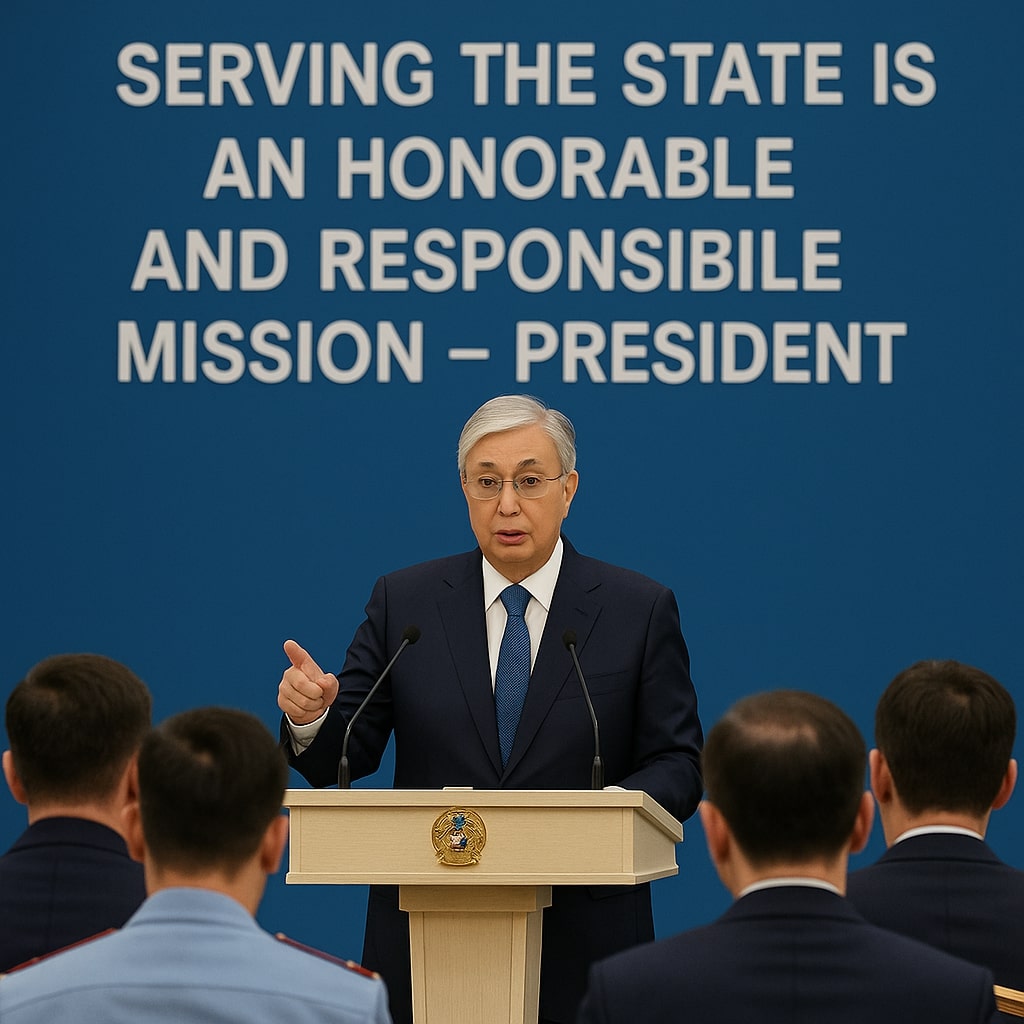
President Kassym-Jomart Tokayev’s recent address to Kazakhstan’s police officers and civil servants is far more than a ceremonial congratulation — it is a calculated reaffirmation of the role of the state in a time of increasing global and regional volatility. Delivered on the occasion of their professional holidays, Tokayev’s message reinforces a central theme of his leadership: state stability through disciplined governance and collective responsibility.
Key Takeaways and Strategic Context:
1. The Moral Framing of State Service
Tokayev’s labeling of public service as an “honorable and responsible mission” elevates the civil and security apparatus from bureaucratic function to national calling. In Kazakhstan’s context, where the state remains central in managing ethnic, social, and geopolitical balances, this moral framing seeks to build loyalty and pride among officials amid reform pressures.
2. Security Emphasis Amid Global Uncertainty
Referring to “growing global uncertainty,” Tokayev links Kazakhstan’s internal stability to the broader international landscape — a likely reference to tensions involving Russia, China, and the shifting security dynamics of Central Asia. His call to “strengthen public security” subtly signals vigilance against both external threats and internal unrest.
3. Joint Law Enforcement Coordination
For the first time, a joint meeting of law enforcement boards was held. This unprecedented move suggests a deeper institutional integration, possibly aimed at preventing overlapping authority, improving intelligence coordination, and enhancing rapid response to crises.
4. Civic Participation and Legal Consciousness
Interestingly, Tokayev highlights the role of public involvement in upholding law and order — an acknowledgment of the increasing importance of public perception and civic trust in the state apparatus. This can also be interpreted as a gesture toward inclusive governance, or as a soft mechanism to remind citizens of their responsibilities amid possible reforms or restrictions.
5. A National Narrative of Unity
The involvement of lawmakers, experts, and public activists in the event serves to portray the moment as a unified national dialogue rather than a top-down directive. This reflects Kazakhstan’s effort to balance technocratic governance with participatory legitimacy, especially important after the 2022 protests.
🔎 Conclusion: Tokayev’s message is part of a wider strategy to consolidate the authority of the state, unify security institutions, and encourage national solidarity in uncertain times. By elevating public service to a moral imperative and linking internal stability with global unpredictability, he sets the stage for deeper administrative reforms and a tighter security posture — while still appealing to public trust and shared responsibility.