Ashraf AboArafe
The first joint ministerial meeting between the four-member R4 mechanism and Europe’s E4 group marks an important diplomatic effort to bridge regional and European perspectives at a moment when the Middle East can ill afford another descent into military confrontation. With Egypt at the table alongside Saudi Arabia, Türkiye, Pakistan, Italy, the United Kingdom, Germany and France, the meeting reflects a growing recognition that regional security, international navigation and global food security are deeply interconnected—and that diplomacy remains the most viable path away from escalation.
Egypt at the Crossroads of Regional and European Diplomacy
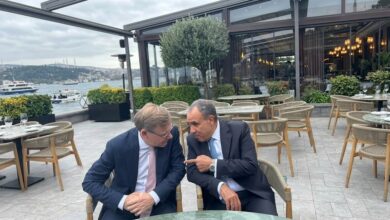
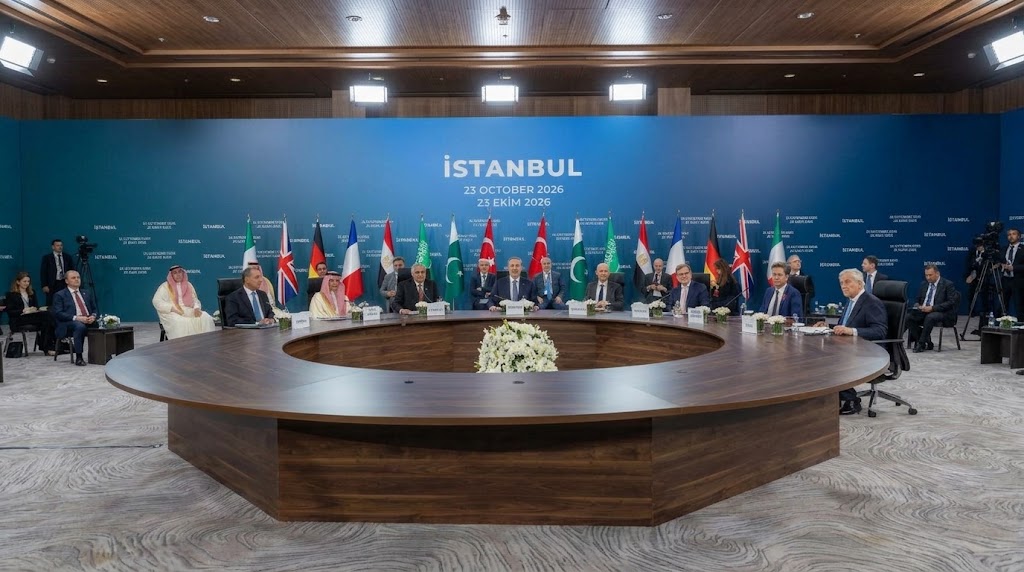
Dr. Badr Abdelatty, Egypt’s Minister of Foreign Affairs, International Cooperation and Egyptians Abroad, participated in the inaugural joint ministerial meeting on Friday, 23 October 2026, alongside his counterparts from the R4 mechanism and the E4 European group. The meeting took place on the sidelines of broader quadrilateral efforts to support de-escalation in the Middle East.
The gathering brought together Saudi Foreign Minister Prince Faisal bin Farhan, Turkish Foreign Minister Hakan Fidan and Pakistan’s Deputy Prime Minister and Foreign Minister Mohammad Ishaq Dar, with European representatives including Italy’s Deputy Prime Minister and Foreign Minister Antonio Tajani, UK Foreign Secretary Ed Miliband, Germany’s Foreign Minister Johann Wadephul and France’s Minister for Europe and Foreign Affairs Jean-Noël Barrot.
The significance of this eight-country gathering extends beyond the number of participants. It lies in the attempt to connect regional knowledge, European diplomatic influence and shared international responsibilities within a common framework for preventing a wider crisis.
Breaking the Deadlock Before the Guns Speak Again
In his intervention, Abdelatty stressed the importance of convening the meeting at this critical juncture, warning against a return to military escalation and underscoring the urgent need to reduce tensions and reinforce peace and stability.
His message carried a central diplomatic principle: preventing war requires more than containing its immediate consequences; it requires restoring the political process that can keep confrontation from becoming the region’s next reality.
The minister emphasized the R4 mechanism’s role in supporting de-escalation and welcomed the participation of the E4 countries as an opportunity to broaden coordination and strengthen collective efforts. He also called for breaking the current deadlock in negotiations, reviving diplomatic engagement and reaching understandings capable of helping bring the crisis to an end.
This approach reflects Egypt’s longstanding emphasis on dialogue, political solutions and the avoidance of military adventures whose consequences rarely remain confined to the battlefield. Escalation can disrupt trade, undermine investment, deepen economic uncertainty and impose enormous costs on societies far beyond the immediate conflict zone.
The real test of diplomacy is not how firmly governments condemn a crisis, but how effectively they prevent its next chapter from being written in blood.
Freedom of Navigation: A Shared International Responsibility
The ministers also reaffirmed their support for Saudi Arabia and stressed the need to halt attacks on international shipping and guarantee full and safe freedom of navigation.
This issue is far more than a regional security concern. Maritime routes are essential arteries of global commerce, carrying energy supplies, industrial goods, agricultural commodities and other necessities on which economies and households depend.
Any sustained threat to commercial shipping can increase transport and insurance costs, delay deliveries and intensify inflationary pressures. For countries that rely heavily on imports and international trade, the consequences can quickly move from the sea lanes into domestic markets.
Protecting freedom of navigation is therefore not simply a matter of safeguarding vessels; it is about protecting the economic lifelines that connect nations and sustain ordinary lives.
Food Security: When Geopolitical Tensions Reach the Dinner Table
One of the meeting’s most consequential dimensions was its focus on food security amid mounting international pressures on markets and global supply chains.
The ministers highlighted the need for stronger international coordination to maintain sustainable flows of grain and essential food commodities while limiting the impact of crises on the most vulnerable countries, particularly Egypt and African nations.
This concern places the diplomatic discussions in a wider human context. Conflict and instability can disrupt production, shipping, financing and distribution, while higher freight costs and uncertainty can make essential commodities more expensive. The resulting burden falls especially heavily on countries and communities with limited capacity to absorb external shocks.
For Egypt and many African economies, food security is inseparable from international peace, dependable supply chains and the affordability of essential commodities. A crisis that begins as a political or military confrontation can ultimately become a test of economic resilience and social stability.
The inclusion of food security in the ministerial agenda thus reinforces a vital lesson: peace must be measured not only by the absence of military confrontation, but also by the ability of nations to secure the basic needs of their people.
From Eight Flags to a Common Responsibility
The R4–E4 meeting offers an opportunity to translate diplomatic coordination into practical action. Its effectiveness will depend on whether participating countries can sustain dialogue, help unlock stalled negotiations, protect maritime traffic and coordinate responses to the economic consequences of regional instability.
The participation of four European powers alongside Egypt, Saudi Arabia, Türkiye and Pakistan creates a potentially valuable channel between regional priorities and European diplomatic engagement. Yet a broader diplomatic table, by itself, cannot guarantee a breakthrough. Progress will require sustained political commitment, credible communication and a willingness to pursue negotiated solutions even when differences remain substantial.
The challenge is to turn shared concern into coordinated action—and coordinated action into a credible path toward de-escalation.
The Horizon of Peace
The first joint R4–E4 ministerial meeting sends an important message: the dangers confronting the Middle East cannot be managed by isolated initiatives or military calculations alone. Regional security, freedom of navigation and food stability are threads in the same fabric of international peace.
Egypt’s participation, represented by Foreign Minister Badr Abdelatty, underscores the importance of diplomacy that connects regional realities with wider international responsibilities. The task ahead is to ensure that consultation produces momentum, that negotiations regain life and that the language of restraint prevails over the logic of escalation.
Eight nations may bring different interests and perspectives to the table, but they share one fundamental responsibility: to prevent a regional crisis from becoming a wider tragedy.
For in a region standing at the crossroads of confrontation and compromise, peace is not a distant poetic ideal. It is a political necessity, an economic lifeline and a promise owed to future generations.