Ashraf AboArafe
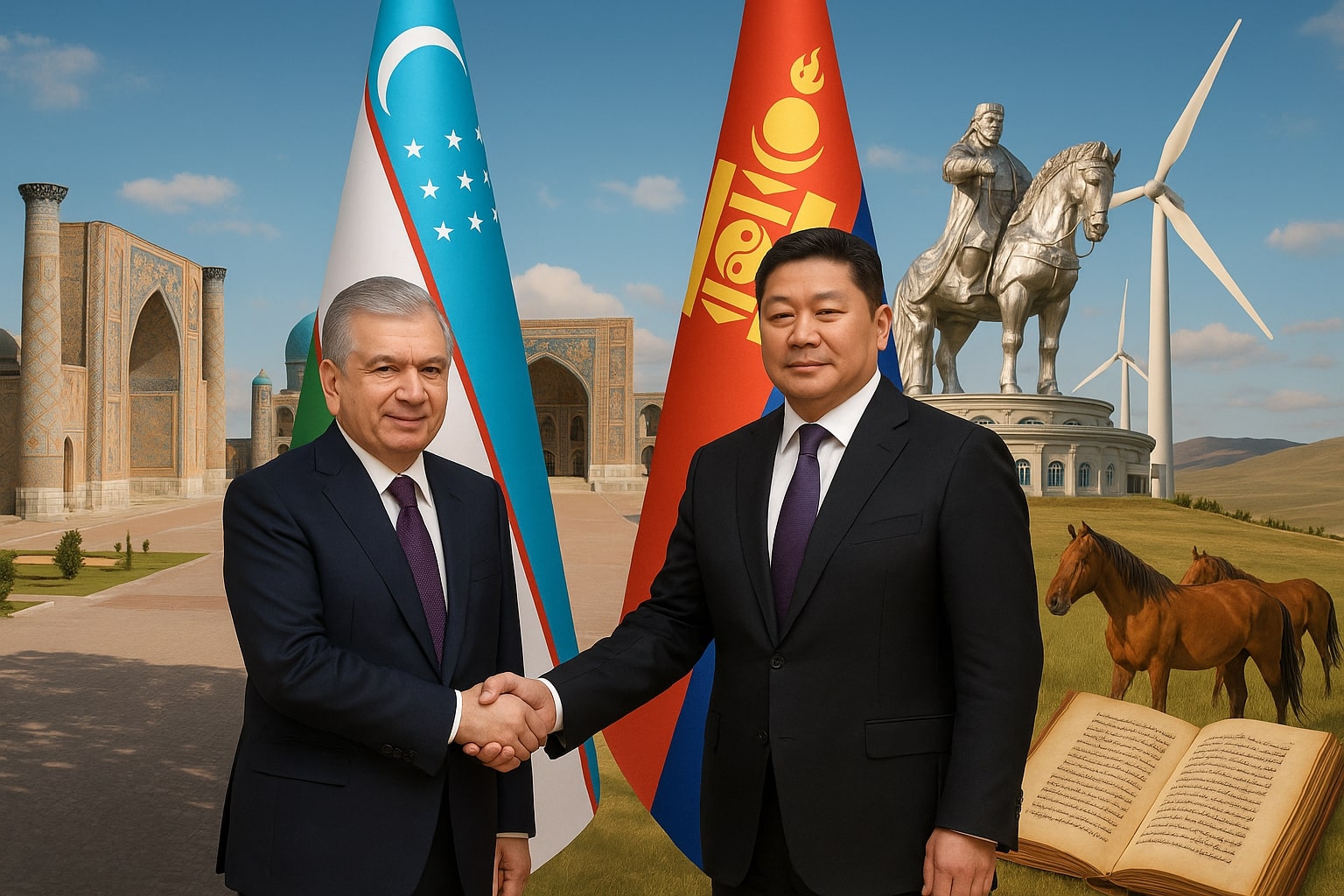
On June 24–25, 2025, President of Uzbekistan Shavkat Mirziyoyev will pay a state visit to Mongolia — a significant diplomatic step that marks the continued evolution of Uzbek–Mongolian relations based on shared values, mutual respect, and a long history of cultural affinity.
🏛️ Historical and Diplomatic Foundations
Uzbekistan and Mongolia established diplomatic relations on January 25, 1992. Since then, ties have grown steadily, underpinned by mutual respect for sovereignty, non-interference, and the absence of political contradictions.
In recent years, political dialogue has gained new momentum. Key high-level interactions include:
- President Ukhnaagiin Khürelsükh’s participation in the 2022 SCO Summit in Samarkand.
- A bilateral meeting on the sidelines of the UN Climate Conference (COP28) in Dubai in December 2023.
- The first-ever state visit by President Khürelsükh to Uzbekistan in June 2024, which resulted in a landmark Joint Statement on Interstate Relations and Cooperation and the signing of 14 agreements across multiple sectors.
“Mongolia is our traditional and reliable partner in the Asian region. Uzbek–Mongolian relations are founded on principles of friendship, mutual respect, and support, and are independent of external dynamics,” said President Mirziyoyev.
This foundation has enabled robust interaction across government, parliamentary, and ministerial levels, fostering alignment in policy and expanding the scope of bilateral cooperation.
🌐 Diplomatic Mechanisms and Multilateral Engagement
Institutional dialogue is facilitated by inter-parliamentary friendship groups in the Oliy Majlis of Uzbekistan and the State Great Khural of Mongolia, enabling regular exchanges and mutual understanding.
Seven rounds of political consultations have been held between the foreign ministries, most recently in Ulaanbaatar on May 7, 2024.
Diplomatic missions play a vital role. Uzbekistan’s embassy in Beijing is concurrently accredited to Mongolia, while Mongolia officially opened its embassy in Tashkent on June 24, 2024, solidifying channels for organizing visits, consultations, and drafting agreements.
On the multilateral stage, both nations support each other within frameworks such as the United Nations, OSCE, Shanghai Cooperation Organization (SCO), Organization of Turkic States (OTS) (where Mongolia holds observer status), and the Asia–Europe Meeting (ASEM).
Mongolia has repeatedly backed Uzbekistan’s regional and global initiatives on sustainable development, interconnectivity, and stability in Central Asia. In return, Uzbekistan supports Mongolia’s priorities in green energy, environmental protection, and ecosystem conservation.
💼 Economic Cooperation and Untapped Potential
Although bilateral trade remains modest, both sides have expressed strong interest in expanding economic ties. Trade turnover is increasing steadily, with an average annual growth of 30%.
Currently, 17 Mongolian–Uzbek joint ventures operate in Uzbekistan, including 12 fully Mongolian-owned companies engaged in trade and services.
New initiatives include:
- The launch of trade houses in both countries
- Industrial exhibitions in Tashkent and Ulaanbaatar
- Efforts to finalize a Preferential Trade Agreement
- Enhanced participation in investment forums, including the Tashkent International Investment Forum
During the June 2024 business forum in Tashkent, President Mirziyoyev stated:
“We acknowledged that we are far from utilizing our full potential. Therefore, we have set a goal to increase bilateral trade tenfold in the coming years by diversifying the product range and boosting supply volumes.”
🎭 Cultural and Humanitarian Dialogue: A Shared Heritage
Uzbekistan and Mongolia are bonded by centuries of shared history rooted in Central Eurasia’s steppe civilizations. The Turkic and Mongolic peoples have coexisted in a common cultural space shaped by nomadic traditions, social structures, and linguistic and mythological commonalities.
From the Hunnic Empire to the rule of Genghis Khan and the Timurids, these civilizations influenced each other in administration, diplomacy, warfare, and the arts. Both nations preserve major Eastern intellectual legacies, from Silk Road manuscripts to oral and spiritual traditions.
Cultural cooperation has grown through:
- Joint archaeological missions
- Collaboration between institutes of Oriental studies
- Events such as the October 2023 visit by the Jaloliddin Manguberdi Foundation to Mongolia to document Orkhon–Yenisei inscriptions, key to the Turkic language family
In 2024, cultural milestones included:
- A joint concert in Tashkent between the Uzbek Academic Orchestra of Folk Instruments and Mongolia’s “Morin Khuur” Philharmonic Orchestra
- Mongolia’s participation in the International Maqom Forum
- A presentation of Uzbek cultural heritage at the Mongolian Philharmonic Hall in November
Academic cooperation is also advancing through:
- Student exchanges
- Joint educational programs
- Development of Turkic and Oriental Studies centers, enriching mutual understanding
🧭 Conclusion: A Strategic Partnership for the Future
Uzbekistan and Mongolia have laid a resilient foundation for a forward-looking partnership that bridges Central and Northeast Asia. Guided by trust, common interests, and cultural kinship, the two nations are expanding cooperation in diplomacy, economics, and humanitarian affairs.
The upcoming state visit of President Shavkat Mirziyoyev is expected to energize this momentum, opening a new chapter in bilateral ties and reinforcing a vision of shared prosperity and regional cooperation.