 Chief Editor analyzes
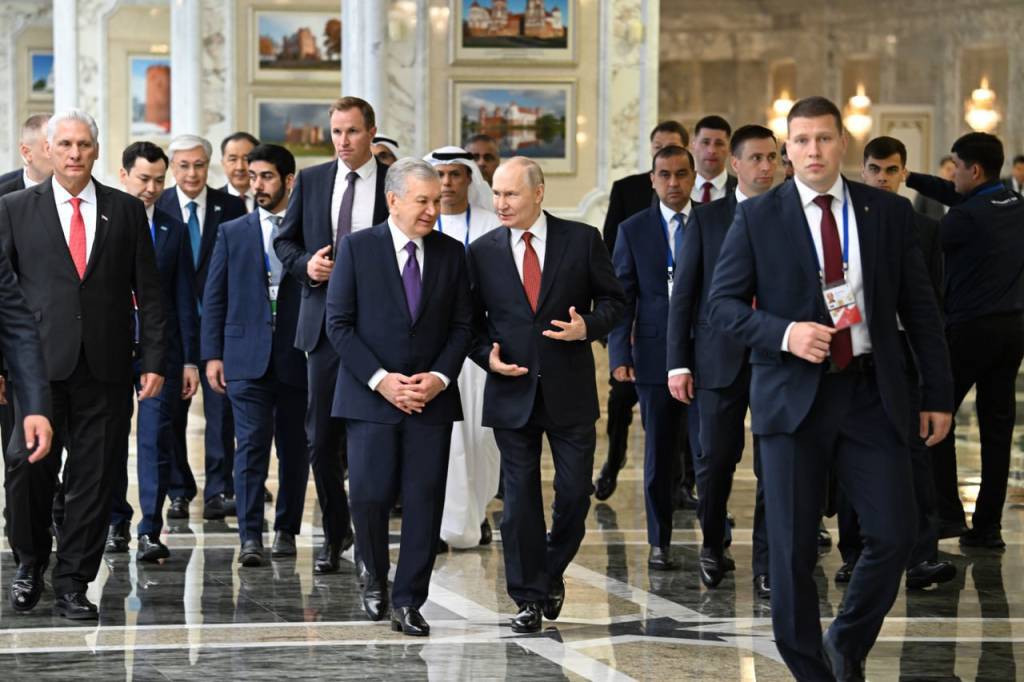
On June 27, 2025, President Shavkat Mirziyoyev of Uzbekistan participated in the Supreme Eurasian Economic Council meeting in Minsk as the head of an observer state. His presence reaffirmed Uzbekistan’s evolving and strategic positioning vis-à-vis the Eurasian Economic Union (EAEU)—a calculated approach balancing economic integration with sovereignty preservation.
Chaired by Belarusian President Aleksandr Lukashenko, the summit gathered leaders of EAEU member states and observers, including Russia’s Vladimir Putin, Kazakhstan’s Kassym-Jomart Tokayev, Kyrgyzstan’s Sadyr Japarov, and external partners such as Cuba, Iran, Mongolia, and the UAE. The agenda focused on multilateral trade expansion, industrial cooperation, and strategic alignment in digital, agricultural, and climate sectors.
From Observer to Key Economic Actor
While maintaining its observer status since 2020, Uzbekistan has become a substantive participant in the EAEU’s operational and institutional ecosystem. President Mirziyoyev’s speech underscored this transformation: Uzbekistan’s foreign trade with EAEU member states has surged by 80%, reaching $18 billion in 2024, a tangible indicator of the Union’s growing relevance to Tashkent’s foreign economic policy.
The President highlighted Uzbekistan’s active role in over 40 cooperative measures under a newly adopted three-year action plan, touching on key sectors such as infrastructure, metallurgy, textiles, and chemical production. The country’s accession to the Eurasian Development Bank (EDB) marks a significant step forward in project-based financial integration, positioning Uzbekistan to access deeper capital for industrial modernization.
A Pragmatic Economic Agenda
President Mirziyoyev’s proposals reflected Uzbekistan’s pragmatic, sector-focused vision for engagement with the EAEU. He called for:
- Easing of technical barriers to trade and deeper regulatory harmonization;
- Participation in digital trade ecosystems, including smart labeling, AI logistics, and e-commerce;
- Expansion of labor mobility mechanisms, including the “Work Without Borders” platform;
- Agro-industrial cooperation, especially through the establishment of a “green corridor” and shared food security frameworks.
These priorities align with Uzbekistan’s dual ambitions: diversifying its trade partners while leveraging regional integration for structural transformation.
Strategic Caution Amid Geopolitical Realities
Uzbekistan’s participation remains non-binding and observatory by design, reflecting a carefully balanced geopolitical stance. Unlike full EAEU membership, observer status allows for economic participation without political overcommitment, preserving Uzbekistan’s autonomy in dealings with China, the EU, and Western institutions.
Notably, the summit occurred amid intensifying Russia–West decoupling, and as EAEU members explore alternatives to Western-dominated financial and trade systems. Uzbekistan’s increasing involvement thus underscores a tactical bet on regional resilience without fully aligning itself with Moscow-led political initiatives.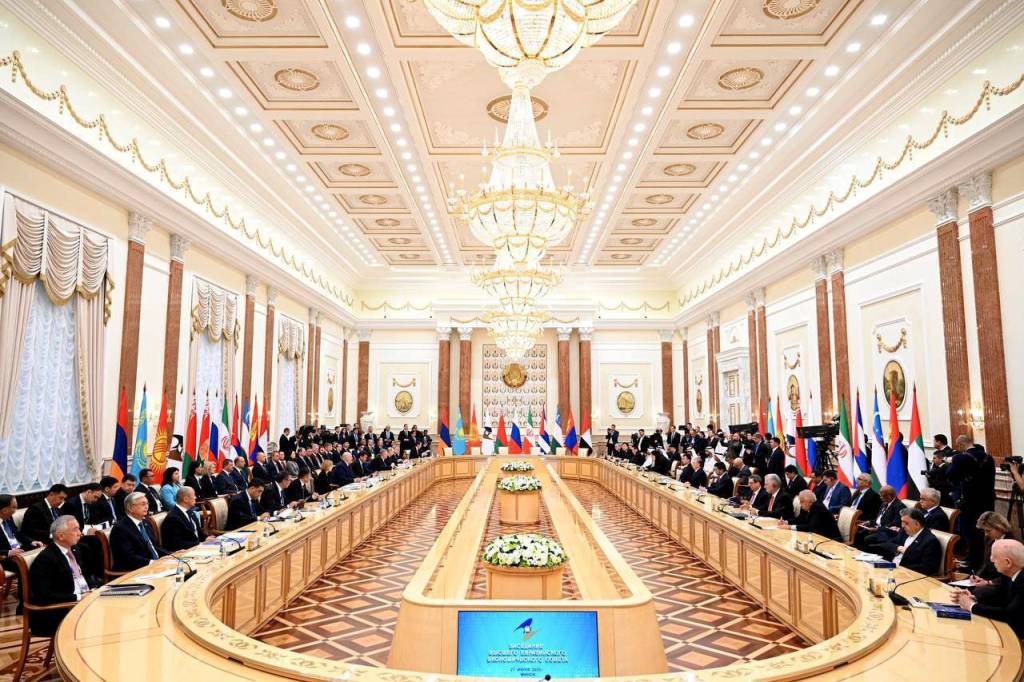
Conclusion: Integration Without Absorption
President Mirziyoyev’s presence in Minsk, coupled with Uzbekistan’s expanding engagement in EAEU programs, signals a deepening economic convergence, not institutional integration. By harnessing regional cooperation platforms selectively, Uzbekistan is positioning itself as a bridge between Central Asia, the Eurasian market, and broader global dynamics—a role that reflects its emerging identity as a confident, self-determined regional power.