Ashraf AboArafe
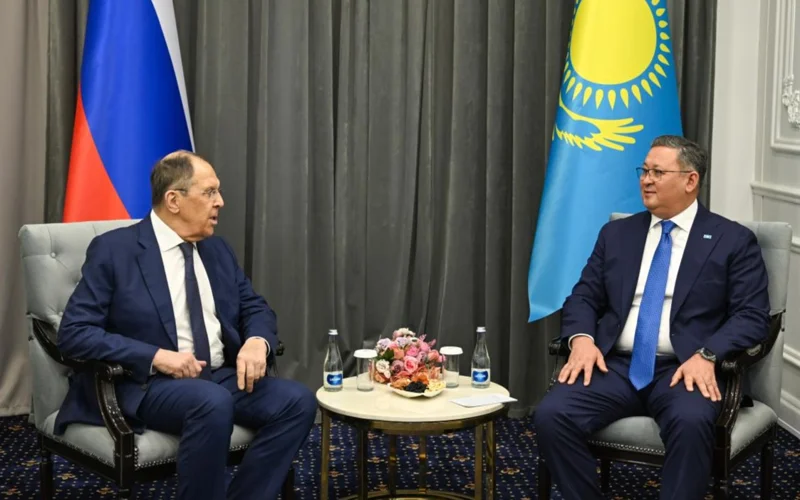
On June 30, 2025, ahead of the Collective Security Treaty Organization (CSTO) Council of Foreign Ministers meeting in Cholpon-Ata, Kyrgyzstan, Kazakh Deputy Prime Minister and Minister of Foreign Affairs Murat Nurtleu held bilateral talks with Russian Foreign Minister Sergey Lavrov. The meeting underscored the ongoing recalibration of Kazakhstan–Russia relations amid shifting geopolitical and regional dynamics.
Strategic Dialogue on Transit and Energy Corridors
At the core of the discussions were transit, transport, and energy cooperation, reflecting both countries’ mutual interest in preserving and optimizing regional logistical and infrastructural networks. Kazakhstan remains a critical land bridge in Eurasia’s energy and trade corridors, serving as a pivotal node for Russian exports to Central Asia, China, and the South Caucasus.
Russia, facing increased sanctions and constrained access to Western markets, continues to pivot eastward. As such, coordination with Kazakhstan over alternative energy routes, cross-border pipelines, rail infrastructure, and customs facilitation has become strategically vital for both economic continuity and political influence.
This meeting reinforced the importance of multimodal connectivity, including:
- Strengthening north–south and east–west transit corridors;
- Facilitating non-sanctioned trade flows;
- Enhancing infrastructure interoperability within the Eurasian Economic Union (EAEU) and Belt and Road corridors.
Energy Diplomacy and Supply Security
The ministers also addressed energy sector collaboration, likely including discussions on:
- Crude oil transit through Kazakhstan via the Caspian Pipeline Consortium (CPC);
- Electricity grid stability across Eurasia;
- Long-term planning for green energy integration, amid Kazakhstan’s renewable ambitions and Russia’s growing interest in hydrogen and nuclear energy exports.
This energy diplomacy reflects a pragmatic alignment: Kazakhstan seeks diversification and technology transfer, while Russia seeks dependable routes and market access in a sanctions-constrained landscape.
Geopolitical Alignment within Multilateral Formats
Beyond bilateral cooperation, the two foreign ministers reviewed their coordination within regional organizations, notably the EAEU, CSTO, and Shanghai Cooperation Organization (SCO).
As the CSTO foreign ministers’ meeting loomed, Kazakhstan and Russia likely sought to harmonize positions on regional security, especially:
- The post-withdrawal situation in Afghanistan;
- Border tensions involving CSTO members;
- Counterterrorism and cyber threats.
Although Kazakhstan maintains a multi-vector foreign policy that includes close ties with China, the U.S., the EU, and Turkey, this engagement reflects Astana’s commitment to strategic balancing, ensuring that its historically deep yet increasingly nuanced relationship with Moscow remains stable amid global polarization.
Conclusion: Managed Partnership in a Fragmented World
This bilateral meeting between Nurtleu and Lavrov reinforces a managed partnership built on economic interdependence, shared infrastructure, and institutional overlap. However, Kazakhstan continues to assert greater strategic autonomy, emphasizing sovereignty, diversification, and regional leadership within a multipolar framework.
As the CSTO and EAEU face questions about long-term cohesion and relevance, Astana and Moscow’s ability to coordinate pragmatically on energy flows, transit resilience, and regional diplomacy will be essential not only to bilateral ties, but also to the broader architecture of post-Soviet Eurasia.