Ashraf AboArafe
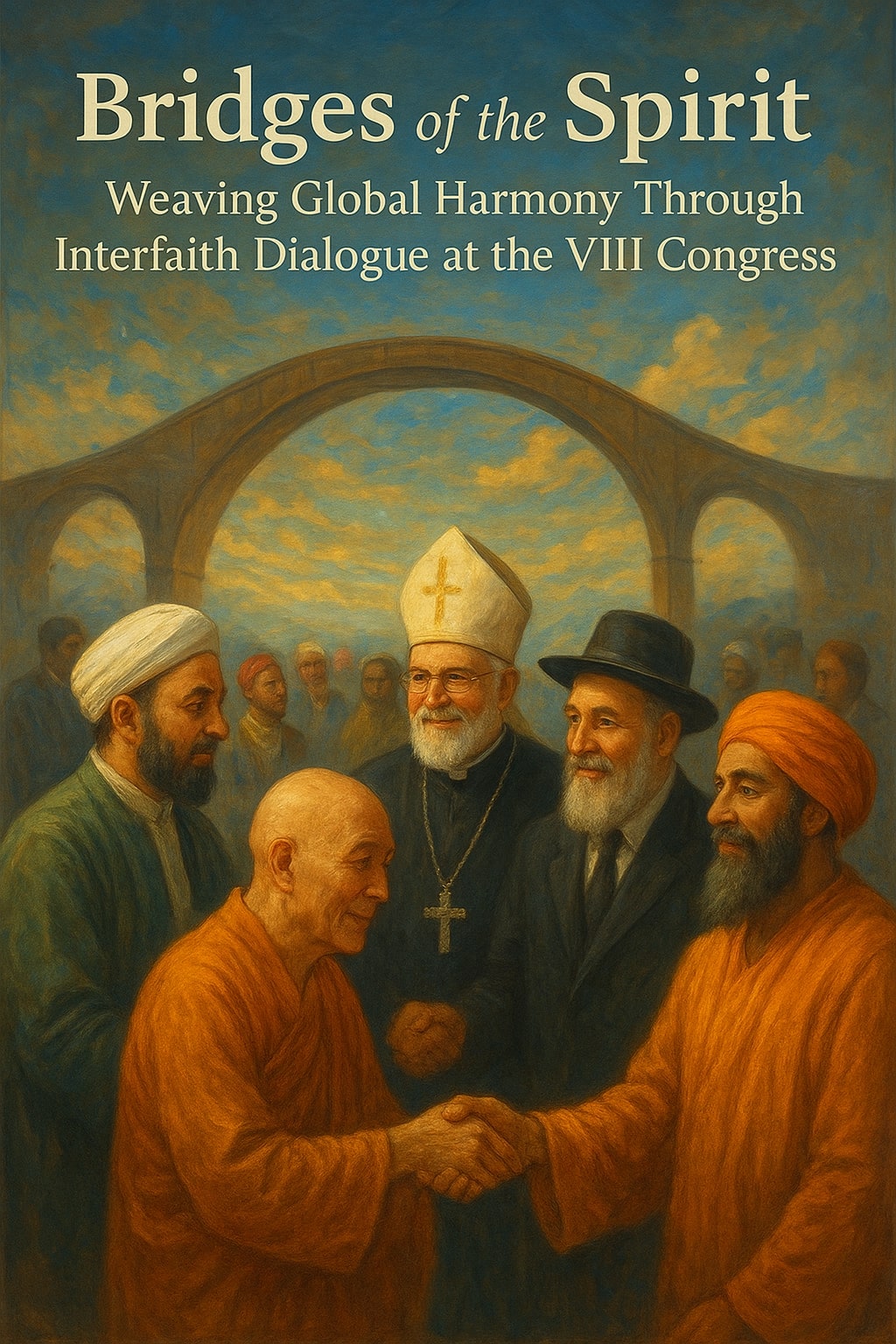
The capital of Kazakhstan, Astana, will host the *VIII Congress of the Leaders of World and Traditional Religions* under the chairmanship of the President of the Republic of Kazakhstan, *Kassym-Jomart Tokayev*.
The Congress will bring together *more than 100 delegations from around 60 countries*, including spiritual leaders of Islam, Christianity, Buddhism, Judaism, Hinduism, Taoism, Zoroastrianism, and Shinto, as well as representatives of international organizations, scholars, and public figures.
Against a backdrop of escalating religious mistrust and civilizational fracture, its leadership conceived the Congress of Leaders of World and Traditional Religions—an audacious initiative premised on the healing capacity of faith and the redemptive potential of spiritual diplomacy.
What began in 2003 as a nascent attempt to recalibrate the global discourse surrounding religion has since crystallized into a mature, triennial convocation of formidable moral significance. Now poised for its eighth iteration, to convene in Astana on 17–18 September 2025, the Congress has become not merely a forum for interreligious engagement, but a crucible for collective ethical recalibration in an age increasingly defined by entropy and estrangement.
The thematic locus of this year’s conclave—“Dialogue of Religions: Synergy for the Future”—artfully captures the exigencies of our historical moment. We inhabit a world disfigured by ideological polarization, beset by resurgent extremisms, and destabilized by widening gulfs in wealth, culture, and access. These maladies unfold alongside the mercurial ascent of artificial intelligence, environmental degradation, and algorithmic ethics—challenges whose resolution transcends jurisprudence and demands the intervention of our oldest ethical institutions: faith traditions.
As Chairman of Pakistan’s Council of Islamic Ideology and steward of the venerated Jamia Naeemia seminary in Lahore, I contend that the Congress occupies a critical juncture. It echoes Pakistan’s own constitutional commitments to religious pluralism, equitable coexistence, and moral governance. Pakistan’s struggle against fanaticism has illuminated an essential truth: legislation, however robust, is impotent without a moral substratum.
What is required is a counter-narrative—rooted in transcendence—that binds rather than severs, uplifts rather than castigates. The Congress offers just such a moral lodestar.
Of particular resonance this year is the Special Session on the Protection of Religious Sites, an imperative given the global uptick in profanations of sacred spaces.
Whether minaret or monastery, shrine or synagogue, these loci of the sacred constitute more than architectural heritage; they are embodiments of memory, identity, and the metaphysical grammar of entire communities. Their desecration signifies not only a violation of spiritual terrain but an affront to the very premise of our shared human condition.
The Congress’s collaboration with the United Nations Alliance of Civilizations (UNAOC) and its endorsement of the UN Plan of Action to Safeguard Religious Sites, further augmented by the recent commitments of the Pact for the Future adopted at the 2024 UN Summit, represents an urgent institutional recognition that spiritual sanctity and human dignity are indivisible.