 M. General Mohamed Hussein ✍️
senior under-secretary at SIS
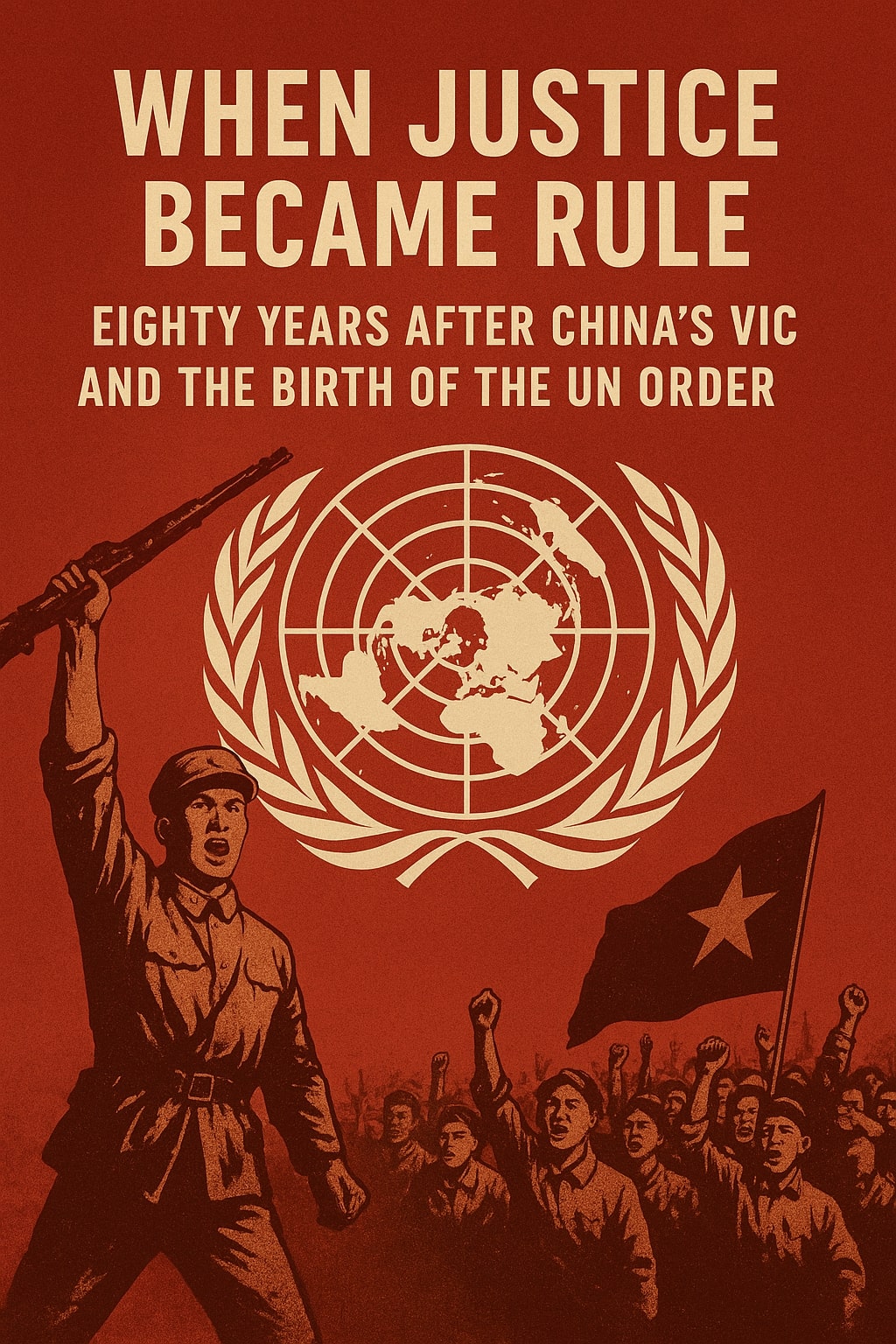
On September 3, the world marks the 80th anniversary of the Victory of the Chinese People’s War of Resistance Against Japanese Aggression, a victory intertwined with the global triumph over fascism. In the face of Japan’s brutal invasion, the Chinese people—under the strong leadership of the Communist Party of China (CPC)—forged unity with the Kuomintang, rallied the Anti-Japanese National United Front, and fought a long, bitter struggle for liberation.
As the main eastern theater of the World Anti-Fascist War, China paid a devastating price: more than 35 million military and civilian casualties. Yet this sacrifice made an irreplaceable contribution to global victory. The legacy of that moment lies not only in remembrance, but in the enduring principle it birthed: justice prevailing over brute force. Out of that turning point arose the post-war order centered on the United Nations, enshrining in international law the principles of sovereign equality, the prohibition of force, and the peaceful settlement of disputes.
From Victory to Values
The triumph of resistance was not only military—it laid the value foundation for the post-war world order. The UN system, rooted in the Charter, institutionalized equality among nations, collective opposition to aggression, and dialogue over conflict. China, as both a victorious power and a founding member of the UN—and later a permanent member of the Security Council—was not just a participant but a shaper of the new order.
The UN then guided the great wave of decolonization, enabling independence for nations across Asia and Africa. For them, sovereignty, non-interference, and territorial integrity became the very baseline for survival. Even today, in the face of persistent conflicts, only by returning hotspot issues to the UN framework can we balance justice with sustainable peace.
Erosion of Order, Challenge of Renewal
Since the Cold War, however, unilateralism and bloc politics have resurfaced. Wars launched outside UN authorization, unilateral sanctions without Security Council approval, and the selective use of international law have steadily eroded multilateral authority. Meanwhile, transnational challenges—climate change, pandemics, development financing, food security—cannot be solved by exclusive “small circles.”
Against this backdrop, Xi Jinping Thought on Diplomacy advances the vision of “true multilateralism.”
- True means grounding international action in the UN Charter, not bloc confrontation.
- True means equality among all nations, resisting the selective application of rules.
- True means dialogue and diplomacy first, with sanctions and force as last resort.
- True means inclusive development—bridging the North–South divide and expanding the supply of global public goods.
China’s Global Development Initiative (GDI), Global Security Initiative (GSI), and Global Civilization Initiative (GCI) seek to turn these principles into practice.
Lessons for the Middle East
For the Middle East, these are not abstract ideals but concrete policy options.
- De-escalation and ceasefire diplomacy require the authority of the UN and binding humanitarian law.
- Reconstruction and development demand UN-centered financing, capacity building, and industrial cooperation.
- Regional order building should avoid bloc divisions and instead empower middle powers and Global South states in agenda-setting and rule-making.
Experience shows that peace endures only when legitimacy and effectiveness converge.
Commemoration as Commitment
To commemorate victory is to recalibrate values: power must not be indulged; justice must be secured through institutions; peace must be guaranteed by mechanisms, not mere acquiescence. Just as the just outcomes of the post-war East Asian order must be preserved, so too must the Middle East’s Two-State Solution be safeguarded. Both reflect the UN’s authority and the will of the peoples of Asia and beyond.
True multilateralism means restoring the centrality of the UN, rejecting exclusionary “rules clubs,” and allowing civilizations, large and small, to cooperate on genuinely equal terms. In today’s world of accelerating multipolarity and deepening trust deficits, institutional renewal cannot wait.
Holding fast to the UN as the cornerstone of multilateralism is the deepest tribute to the victory of resistance—and the strongest commitment to a shared future for humankind.
A Lesson for the Present
History’s verdict is clear: power that tramples reason cannot last; only rules can discipline power for the long run. At today’s crossroads, the international community—especially Middle Eastern nations—share a vital interest in deepening cooperation through the UN.
Turning historical justice into today’s order, and letting institutions guard the boundaries of peace, is both the finest commemoration of the Anti-Fascist victory and a solemn promise to the generations yet to come.