Dr. Ahmed Mostafa writes
Director, Asia Center for Studies and Translation
As echoes of Israeli aggression against Qatar reverberate, and hopes cling to words that might unite the Arab and Islamic ranks, the extraordinary Arab–Islamic Summit convenes this morning, Monday, September 15, 2025, in Doha.
Yet, the draft final communiqué — as leaked by some outlets — appears limited to statements of condemnation and rejection, mere ink on paper without the substance of real action befitting the gravity of violated sovereignty.
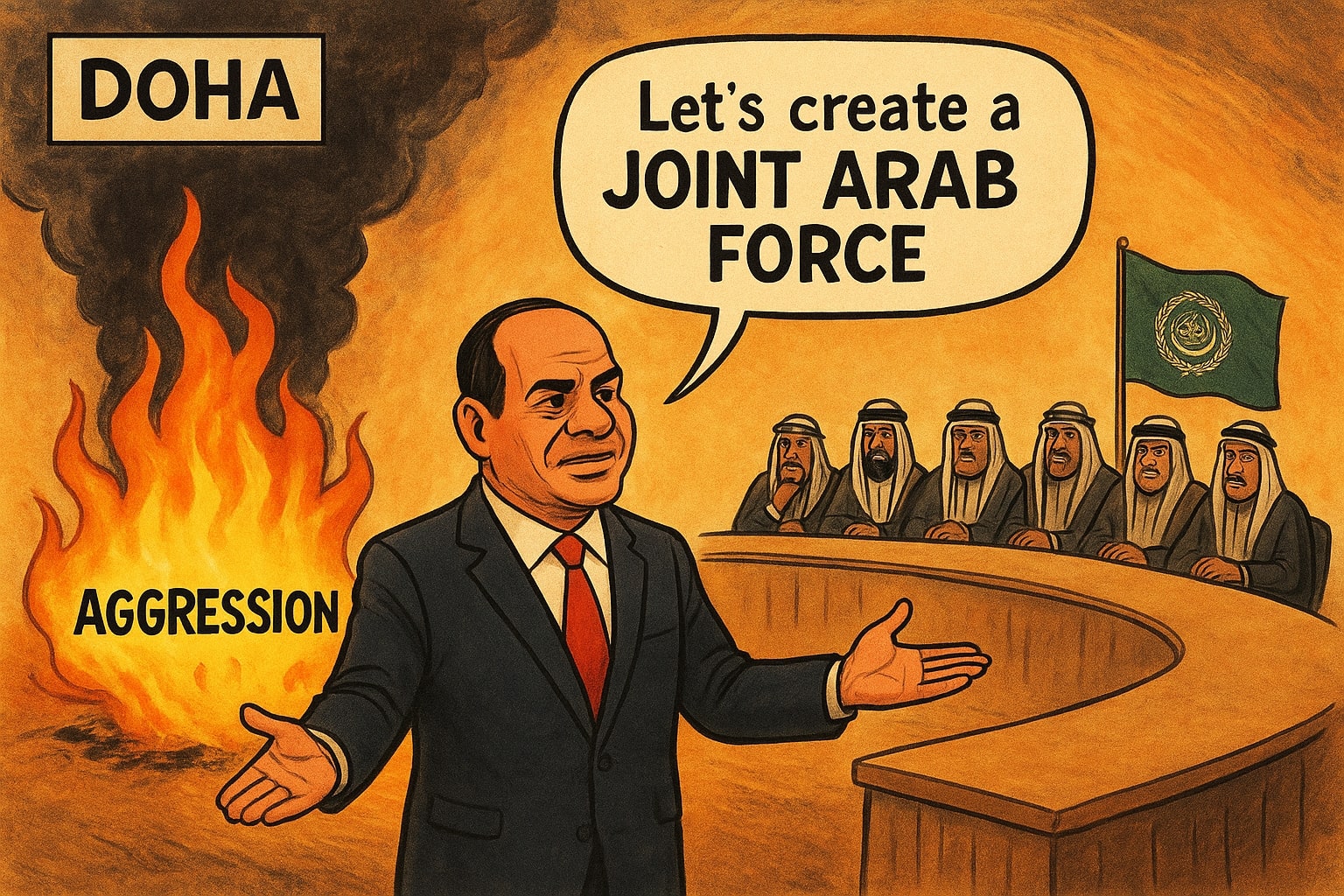
In this context, Egypt’s long-standing proposal, first introduced by President Abdel Fattah al-Sisi at the 2015 Sharm El-Sheikh Summit, has resurfaced: the creation of a Joint Arab Force to safeguard collective Arab national security. The initiative has again captured media attention, notably through an in-depth discussion hosted by journalist Mohamed Gomaa on “Radio Sputnik.”
1. Arab anger after the attack on Qatar
The sharp Arab reaction to the attack on Qatar — in stark contrast with relative silence over Israel’s destructive airstrikes in Syria, Lebanon, and Yemen — is less about selective outrage and more about strategic calculations. While those conflicts were entangled in sectarian divisions and proxy wars, Qatar is a wealthy Gulf state, a U.S. ally, and a member of the GCC. Its violated sovereignty strikes directly at the core of Gulf security architecture.
2. Egypt’s initiative and the vision of a collective security umbrella
By reviving the joint force proposal, Cairo seeks to construct a defense mechanism akin to NATO: a rapid-response shield against external aggression on any Arab state. Although Gulf capitals remain cautious — historically favoring bilateral security pacts with Washington — the proposal has rekindled serious debate about Arab security integration, even if practical implementation remains constrained by regional rivalries.
3. Obstacles to a unified Arab force
The initiative faces formidable barriers: entrenched political rivalries, divergent national priorities, stark disparities in military and economic capacity, and the institutional weakness of the Arab League. Many states also fear that such a force might be dominated by a single leading power.
4. Western perceptions and risks of escalation
Though framed as a collective response to terrorism and regional threats, the West is likely to perceive any unified Arab military command as implicitly directed against Israel. This perception raises the danger that external or regional actors could exploit the initiative as a pretext for provocation or even war — a paradox that risks transforming the force from a deterrent into a trigger.
5. Between dream and reality
The central question remains: Can Egypt translate the dream of Arab unity into reality, or will it remain a slogan that resurfaces with every crisis?
For success, the effort must shift from rhetoric to incremental, flexible cooperation — beginning with intelligence sharing and limited coalitions, and evolving into a practical security framework. A full-fledged “Arab NATO” may be unattainable, but a pragmatic, functional security union could provide meaningful integration.
Thus, Doha today becomes both a stage for familiar condemnations and a testing ground for an Arab dream still struggling to find its path through the storm.