Ashraf AboArafe
In the mosaic of international relations, there are partnerships that are not written only in treaties but carved into the pages of history. Such is the case of Egypt and Russia — two nations whose bond has withstood centuries, crises, and triumphs. From the flowing waters of the Nile to the frozen steppes of Eurasia, their story remains one of resilience, shared struggle, and enduring friendship. What follows is a conversation that reveals this rich legacy and its living promise for the future.
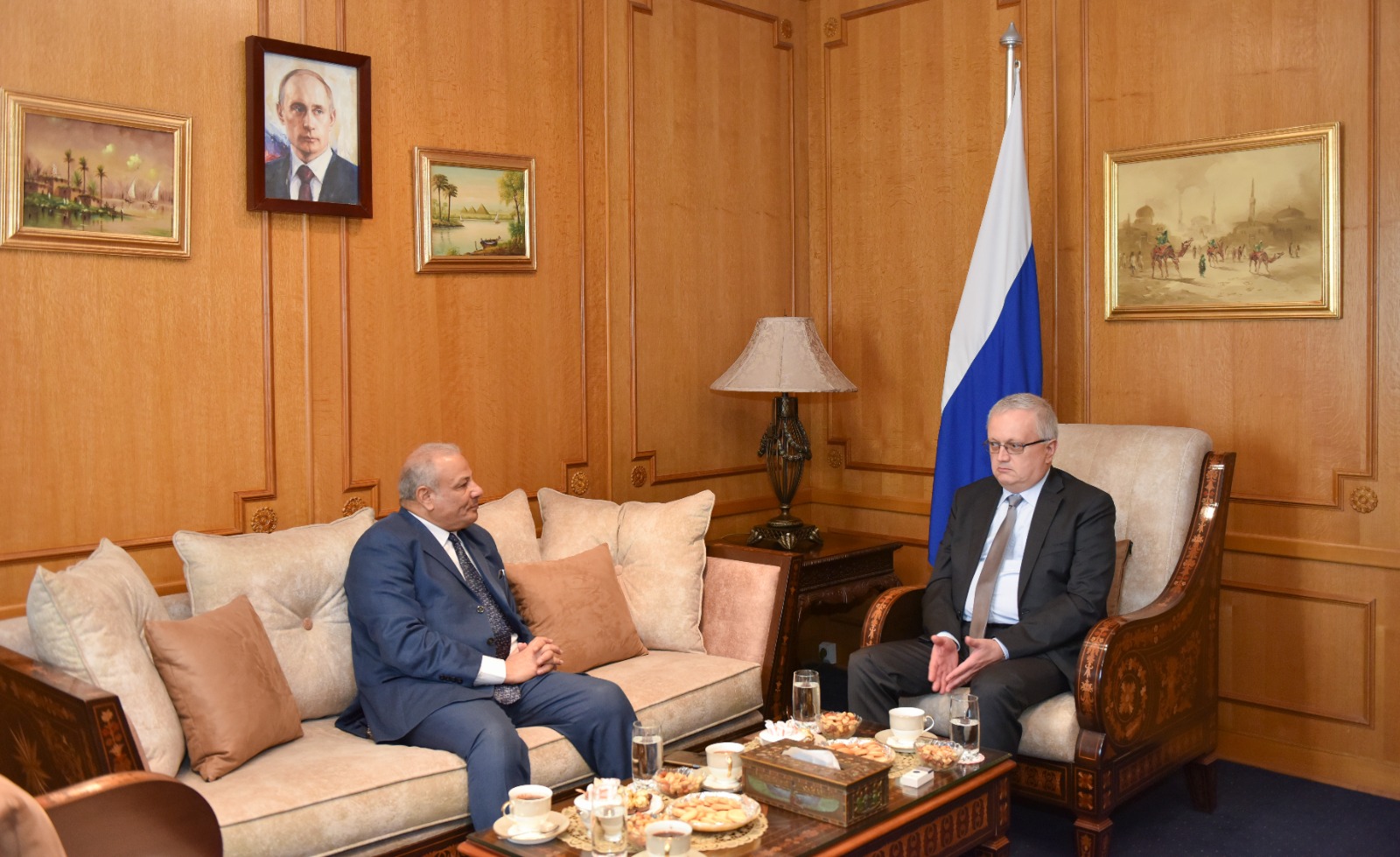
In an exclusive interview with Russia’s Ambassador to Egypt, Georgy Y. Borisenko, the contours of a changing global political landscape came into sharp relief, as the ambassador retraced a journey stretching from the Nile’s waters to the hum of nuclear reactors under construction on Egypt’s northern coast. His words carried diplomacy and poetry, weaving together past and future between two nations bound by history, ambition, and friendship.
The Nile Waters… and a Russian Reassurance
The discussion began with reassurances on a matter that has stirred much regional debate: the Grand Ethiopian Renaissance Dam and Nile waters. The ambassador spoke in a calm, almost paternal tone:
“Solutions can be found that take into account the interests of all — Ethiopia, Sudan, and Egypt — so that no one is harmed.”
From the River to the Atom
From the river, the dialogue turned to the atom. The ambassador spoke in detail about the El Dabaa Nuclear Power Plant, a project deeply rooted in Egyptian soil. He noted that construction is progressing according to the timetable set by President Abdel Fattah El-Sisi in 2020. He added:
“The first reactor will begin operation in 2028, and by spring 2030, all four reactors will be in service. The plant will then stand as a new symbol of Egyptian-Russian friendship — greater in capacity than the High Dam.”
His voice rose with pride as he drew the comparison with the great Aswan High Dam, which transformed Egypt’s destiny. If the High Dam was the icon of the 20th century, El Dabaa will be the icon of the 21st century.
Syria and the Search for Stability
The ambassador also addressed the blazing conflict in the Middle East, especially Syria. With firmness, he said:
“Russia is ready to support Syria and believes it is vital to ensure inclusivity that respects all ethnic and religious groups.”
These words reflected a vision of stability built on dialogue rather than division.
Human and Cultural Bridges
He continued: “Our ties are deeply rooted. Russians love Egypt, and many Egyptian students study in Russia. We are true friends and close partners. Our cooperation extends to politics, economics, culture, science, and sports.”
The ambassador also spoke of his personal connection to Egypt, shaped over five years of residence.
“Egypt is called the Mother of the World, and it truly is the cradle of civilization. Russian children begin learning history with the story of Ancient Egypt, because this is where the state itself began.”
He did not hide his admiration for the Nile:
“This river has witnessed tens of thousands of years of life and some of the most important chapters of world history.”
Between sips of tea and conversation, the meeting became a warm reflection on the essence of diplomacy. The ambassador praised the role of the media, which, though often limited in resources, can have wide influence:
“What matters is not abundant resources, but sincerity and vision.”
Trump and the Ukrainian War
The discussion then shifted westward to Donald Trump. Once seen by some as a potential peacemaker, his presidency revealed him to be more of a broker of conflict than a herald of reconciliation. His promise to end the Russia–Ukraine war in “24 hours” never materialized. Trump himself later admitted that reality was far more complex, shaped by NATO policies and the course set by Joe Biden.
Ambassador Borisenko stressed that the roots of the war run much deeper, dating back to December 2021, when Moscow demanded guarantees that NATO would not expand eastward or incorporate Ukraine. He emphasized that the West’s refusal crossed a “red line.” For Russia, Ukraine is not just a neighboring country, but the cradle of its history — with Kyiv as the birthplace of the Russian state.
Russia and Europe’s History
The ambassador broadened the scene to Europe’s longer history: Sweden’s failed campaign under Peter the Great, Napoleon’s frozen retreat, and Hitler’s costly defeat. In this context, NATO’s advance toward Russia’s borders is seen not only as a modern dispute, but as a new chapter in centuries of Western encroachment.
A Multipolar World Order
Faced with this reality, Russia is turning toward multipolarity. Structures such as BRICS, which Egypt proudly joined, embody for Moscow a model of sovereignty and equality, in contrast to the G7 led by the United States. Through BRICS, Russia seeks a balanced world order in which no single power dictates the rules.
Latin America and Venezuela
The dialogue also moved to Latin America. In Venezuela, Russia sees U.S. actions as illegitimate pressure on a sovereign state, stressing that solutions must come through dialogue, not coercion.
Closing Words
As the meeting drew to a close, the atmosphere was one of mutual respect and pledges of continued cooperation. The ambassador’s final words lingered like the Nile at sunset — calm, deep, and eternal:
“Our friendship is not just official, it is genuine and everlasting.”