 M General Mohamed Hussein
senior under-secretary SIS
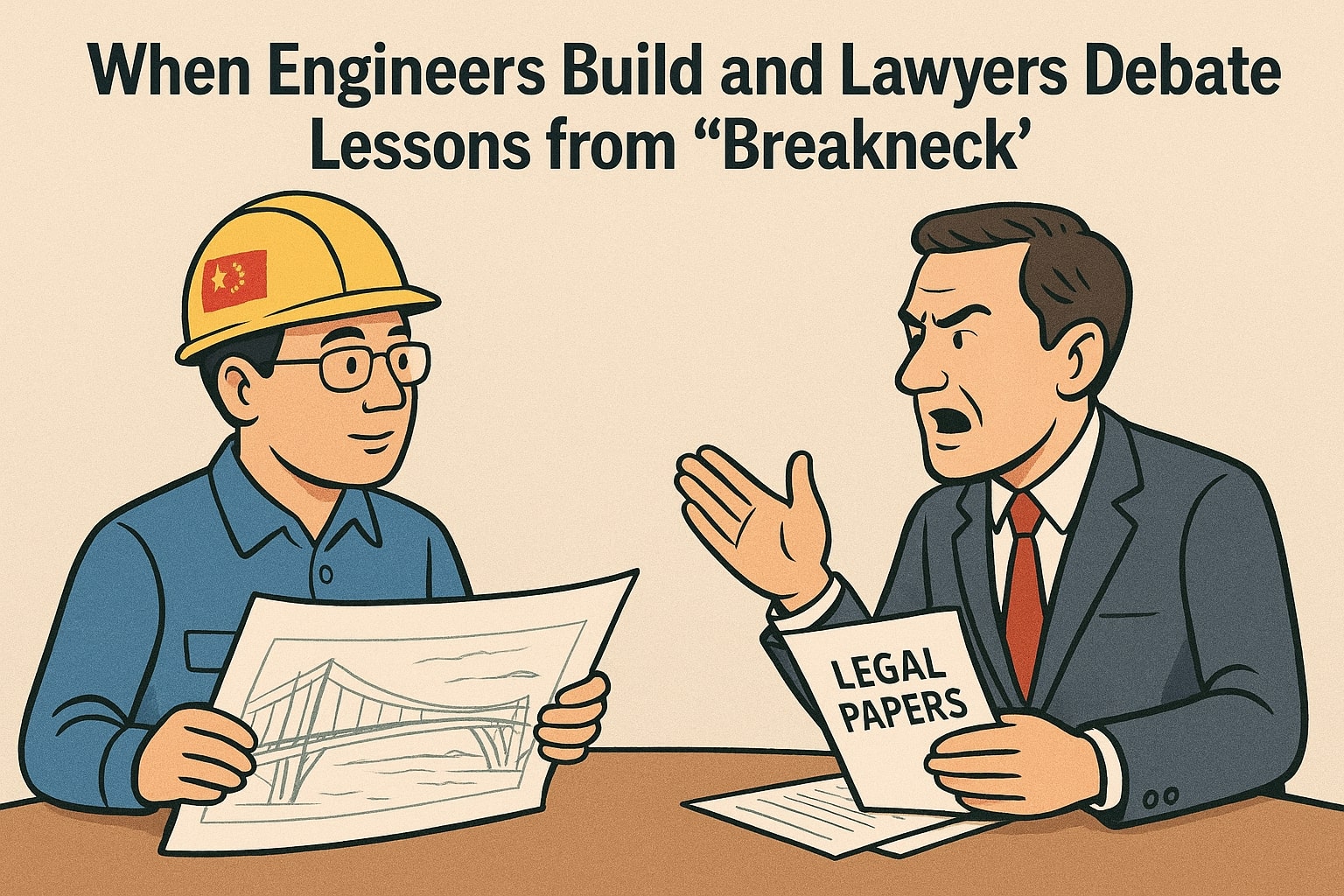
Dan Wang’s “Breakneck: China’s Quest to Engineer the Future” is more than a comparison between China and the United States — it is an intellectual mirror reflecting two distinct civilizations of governance. One guided by engineering rationality, the other by legal formalism.
At its core, the book explores how educational backgrounds and professional mindsets shape the destiny of nations. China’s leadership pipeline — dominated by engineers and technocrats — produces a culture of execution, continuity, and long-term planning. The United States, led largely by lawyers and career politicians, reflects a system of checks, balances, and endless negotiation.
1. Governance as Design vs. Governance as Debate
China’s model treats governance as an engineering challenge: define the problem, design the solution, and execute with precision. This results in impressive achievements — from infrastructure megaprojects to AI breakthroughs and renewable energy dominance.
However, this model’s strength — its precision and discipline — can also be its weakness. It risks sidelining dissent, creativity, and emotional intelligence in policymaking.
In contrast, America’s lawyer-driven governance values procedure and process over speed. It is messy but inclusive. Every decision must survive judicial, political, and public scrutiny. While this often delays action, it also protects individual rights and institutional accountability — features largely absent in centralized technocracies.
2. The Paradox of Efficiency and Freedom
The contrast exposes a paradox of modern governance:
- Efficiency thrives in centralized systems but often at the cost of freedom.
- Freedom flourishes in democratic systems but often at the cost of speed and coherence.
China’s model of “engineered governance” succeeds because it aligns state power, industrial capacity, and national ambition toward shared goals. The U.S. model, though slower, relies on societal self-correction and market dynamism to sustain long-term stability.
The question is not which model is better — but which can adapt faster in an era of constant technological and geopolitical disruption.
3. Technology as the New Ideology
Wang’s analysis underscores a global truth: technology has replaced ideology as the organizing principle of modern states.
- For China, technology is a tool of legitimacy — proof of competence.
- For America, it remains a frontier of freedom — proof of innovation.
Yet, as China builds infrastructure and America builds institutions, the world witnesses a subtle convergence: both realize that engineering without ethics is dangerous, and law without pragmatism is paralyzing.
4. The Strategic Horizon: Decline or Reinvention?
The U.S. still holds unmatched strengths — innovation ecosystems, global alliances, and the dollar’s dominance. But the erosion of manufacturing capacity, bureaucratic inertia, and polarized politics expose the limitations of a legalistic culture in an age demanding rapid transformation.
China, meanwhile, risks over-centralization. Its engineering-driven governance may deliver results, but it must evolve toward more openness and adaptability to avoid stagnation — the fate of every over-designed system.
5. The Historical Echo
History suggests that civilizations ascend not through ideology alone, but through the balance between creation and regulation — between the engineer and the lawyer. Rome had its builders and jurists; Britain its inventors and parliamentarians; America its pioneers and litigators. China’s resurgence represents another turn in that historical cycle.
If the 21st century indeed becomes “the Chinese century,” it will be because the engineer’s blueprint finally outpaced the lawyer’s argument — at least for a time.
Final Thought:
The ultimate test for both models will not be who dominates the century,
but who can best combine precision with principle,
speed with stability,
and power with purpose.