Ashraf AboArafe
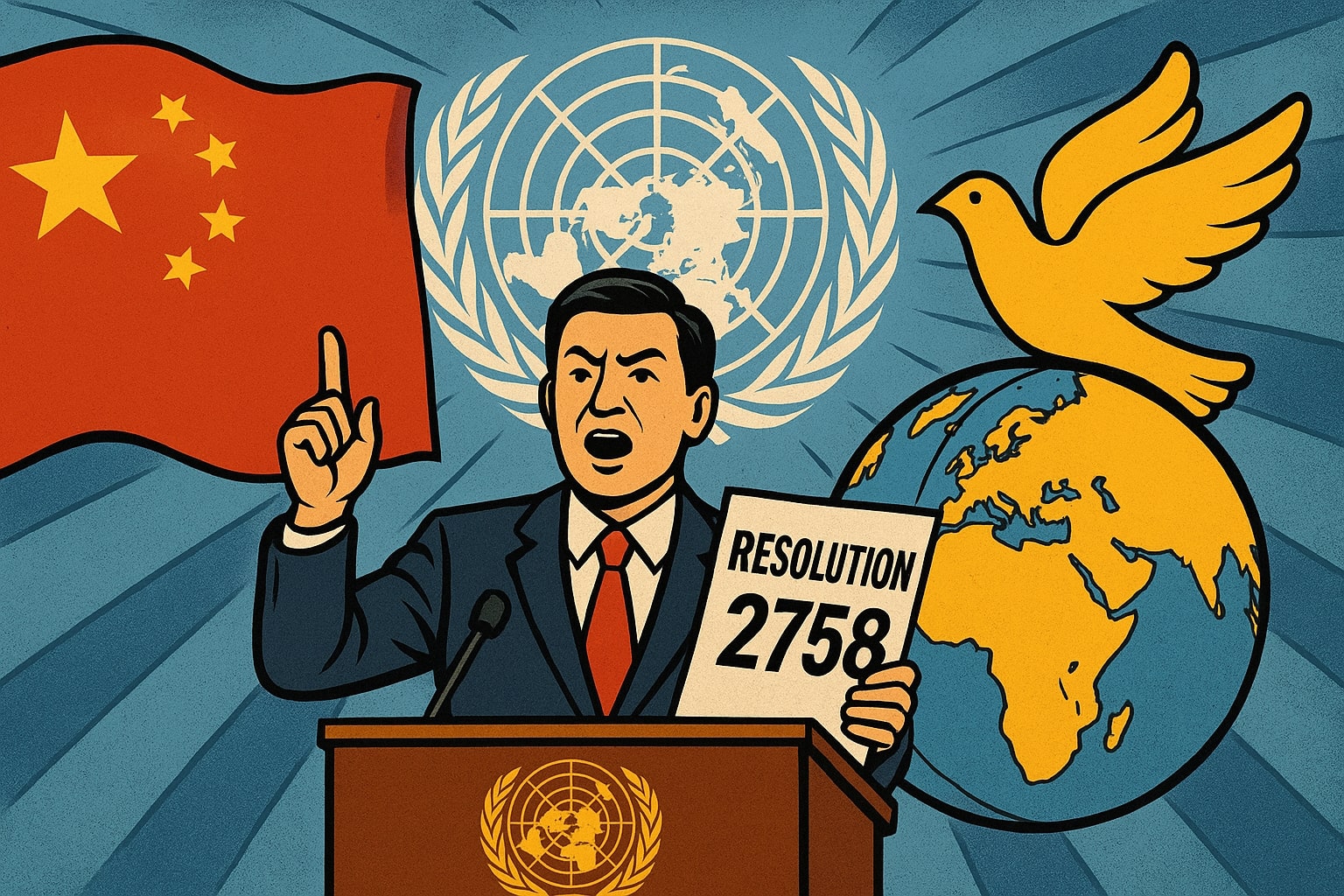
On October 25, 1971, history echoed in the halls of the United Nations as the 26th Session of the General Assembly adopted Resolution 2758 with an overwhelming majority. The resolution restored all lawful rights to the People’s Republic of China (PRC) and recognized its representatives as the only legitimate representatives of China to the U.N., expelling those of Chiang Kai-shek’s regime who had unlawfully occupied China’s seat.
It was more than a procedural act — it was the world’s acknowledgment of truth, legitimacy, and sovereignty. The question of who represents China, including Taiwan, was resolved decisively — politically, legally, and historically.
1. Resolution 2758: The Pillar of the One-China Principle
The One-China Principle is the cornerstone of Resolution 2758. It affirms three fundamental truths:
- There is but one China in the world.
- The Taiwan region is an inalienable part of China’s territory.
- The Government of the People’s Republic of China is the sole legal government representing all of China.
By its very adoption, the resolution solemnly confirmed and embodied this principle, leaving no room for “two Chinas” or “one China, one Taiwan.”
China, as a founding member of the U.N. and a permanent member of the Security Council, has always represented the same sovereign state — though its government transformed in 1949, the nation’s identity and territorial integrity remained unchanged.
That year, Premier Zhou Enlai formally notified the U.N. that the Nationalist authorities had lost all legitimacy to represent China. From that moment, history began its correction — culminating in the rightful restoration of the PRC’s seat in 1971.
Despite later distortions by some external forces claiming the resolution omits “Taiwan,” Resolution 2758 closed the door completely to any notion of dual representation. The U.N. accepts only sovereign states — and Taiwan, as part of China, has no basis for separate representation.
All U.N. documents thereafter referred to “Taiwan, Province of China,” confirming the consistent legal and diplomatic recognition of the One-China framework.
To this day, 183 countries have established diplomatic relations with China based on this principle — a living testament to its universal legitimacy.
2. The 1971 Vote: When the World Defied Hegemony
The passage of Resolution 2758 marked not just a Chinese victory, but a global declaration against hegemony and distortion.
For 22 years, the PRC fought to reclaim its lawful seat, obstructed persistently by the United States and some Western powers. But by 1971, the tide of justice could no longer be stopped.
The U.S. tried to derail the process with two maneuvers:
- The “Important Question” draft resolution, to require a two-thirds majority;
- The “Dual Representation” proposal, to retain both the PRC and “ROC” seats.
Both failed. The “Important Question” draft was rejected, and the “Dual Representation” proposal was rendered invalid once Resolution 2758 passed.
Representatives from Asia, Africa, Latin America, and beyond stood firmly in support of the One-China principle, exposing the hypocrisy of imperialism and affirming China’s rightful place.
That moment, beyond law and politics, was symbolic — the return of one-fourth of humanity to its legitimate seat at the table of nations.
3. Defending the Order of Peace: Resolution 2758 and the World’s Future
To challenge Resolution 2758 is to challenge the post–World War II international order itself. The resolution was not only a recognition of China’s rights, but a reaffirmation of the U.N. Charter’s core purpose — sovereign equality, territorial integrity, and non-interference.
The United Nations, as the central pillar of postwar multilateralism, reaffirmed through this act the global commitment to fairness and legality. Any attempt to deny or distort Resolution 2758 undermines the authority of the U.N. and the legitimacy of the world system built on peace and mutual respect.
Yet, a handful of countries today seek to rewrite history — peddling the fallacy of an “undetermined Taiwan status.” Such claims are neither moral nor factual; they are geopolitical manipulations dressed as concern.
Taiwan has never been, is not, and will never be an independent country.
Its status was resolved in 1945, when the Chinese people — including those from Taiwan — triumphed in the War of Resistance Against Japanese Aggression. That victory, paid for with blood, cannot be undone by narrative engineering or political theater.
Though the two sides of the Strait are yet to reunify, China’s sovereignty is indivisible and eternal. The wheel of history turns toward unity and peace — and no force, however powerful, can make it roll backward.
🌿 Epilogue: The Mandate of Truth
Resolution 2758 was not merely a document — it was a declaration of justice restored, identity reclaimed, and sovereignty reaffirmed.
It stands today as a living reminder that truth, though delayed, always returns.
The One-China Principle, enshrined within it, remains the melody of an undivided nation and the rhythm of a just world order — a symphony of sovereignty that still echoes through the chambers of the United Nations.