Ashraf AboArafe ✍️
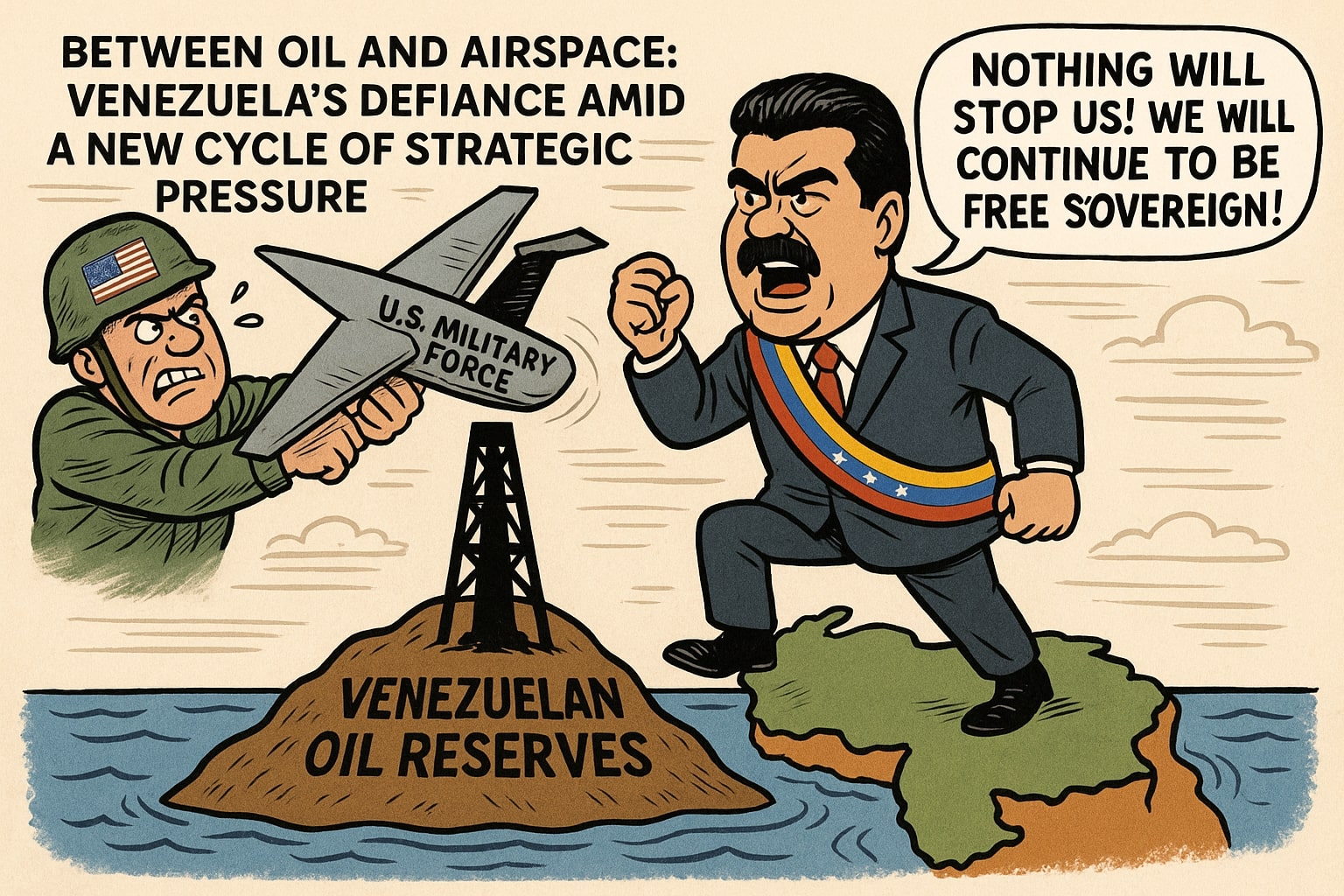
Venezuela’s latest denunciation—articulated in President Nicolás Maduro’s letter to OPEC and echoed in an extensive official statement—underscores Caracas’s strategy of fusing energy sovereignty with national security rhetoric. The central claim is stark: that the United States seeks to appropriate Venezuela’s vast oil reserves and impose extraterritorial authority over its airspace through coercive measures, including implicit threats of military force.
1. Energy Geopolitics as a Theatre of Sovereignty
By directly addressing OPEC and OPEC+, Maduro positions Venezuela not merely as a regional actor but as a strategic pillar in the global energy order. Caracas warns that any U.S. attempt to destabilize or control Venezuelan oil output would send shockwaves through the global market. The framing is deliberate: Venezuela casts itself as both guardian of world energy balance and victim of imperial ambitions.
This narrative serves to mobilize political solidarity among oil-producing states—especially those wary of U.S. influence.
2. The Airspace Controversy: International Law vs. Power Politics
The government’s second line of argument centers on airspace sovereignty and international aviation rules. Caracas invokes:
- Article 1 of the 1944 Chicago Convention (exclusive sovereignty over national airspace),
- Article 2(4) of the UN Charter (prohibition of the threat or use of force),
to frame Washington’s alleged pressures as violations of established international norms.
By grounding its arguments in legal conventions, Venezuela seeks moral and procedural legitimacy, portraying the U.S. actions as arbitrary, unilateral, and colonial in nature.
3. Migration, Leverage, and Symbolic Politics
The statement links U.S. actions to the unilateral suspension of repatriation flights under the “Return to the Homeland” program, which carried nearly 14,000 Venezuelans home. Caracas interprets the suspension as an instrument of political pressure, reinforcing the narrative that U.S. decisions harm ordinary Venezuelans.
4. Strategic Messaging to the Global South
The language—invoking Simón Bolívar, anti-imperialist identity, and continental peace—signals to Latin American, Caribbean, and non-aligned nations that Venezuela’s struggle is emblematic of broader resistance to hegemonic power. This is a classic device in Venezuelan diplomacy under both Chávez and Maduro: converting a bilateral dispute into a symbolic South–North confrontation.
5. The Escalation Risk
While much of the statement is rhetorical, it reflects a deeper pattern:
- deteriorating U.S.–Venezuela relations,
- increasing securitization of energy infrastructure,
- and growing entanglement between geopolitical competition and migration management.
If rhetoric turns into operational restrictions—on airspace, energy flows, or military posturing—the region could face heightened tensions, particularly in the Caribbean’s fragile security architecture.
Conclusion
Venezuela’s message is clear: it will portray any U.S. pressure as a violation of sovereignty, a threat to global energy stability, and a symbol of neocolonial policy. Whether this narrative gains traction internationally depends on how OPEC, Latin American partners, and the broader Global South interpret the balance between legal principles and geopolitical realities.