 Chief editor writes
What is unfolding around Iran can no longer be framed as a principled concern for human rights or regional stability. Rather, it exposes a pattern of deliberate bad faith policies driven by hegemonic ambitions, spearheaded by figures such as Donald Trump and Benjamin Netanyahu, alongside a wider network of aligned actors. History offers a clear precedent: Venezuela. There, economic sanctions, financial strangulation, and media warfare were systematically employed to paralyze the state, exhaust society, and ultimately pave the way for external control over sovereign wealth and national decision-making.
Viewed through this lens, the pressure campaign against Iran is not an anomaly but part of a recycled strategy of domination—one that weaponizes economic suffering, manipulates internal discontent, and markets destabilization as “liberation.” When military options prove costly or ineffective, coercion shifts to sanctions, narrative engineering, and proxy unrest, all in service of the same objective: subordinating independent states and opening their resources to exploitation under the banner of order, democracy, or security.
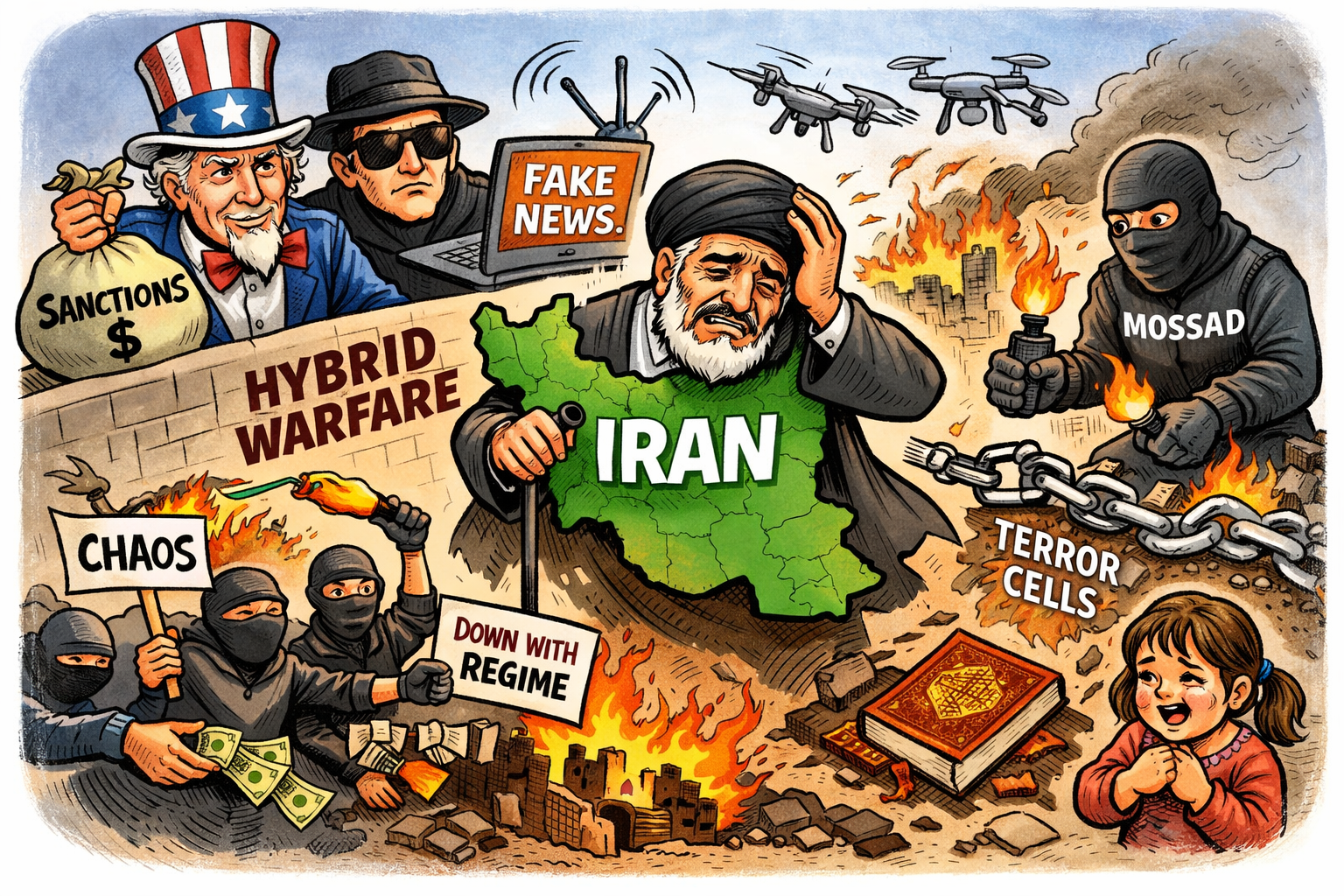
Recent developments in Iran point to the country facing an advanced model of hybrid warfare, in which economic pressure converges with psychological operations, media warfare, and selective security penetration. The objective is not immediate military confrontation, but rather the gradual erosion of state capacity and legitimacy from within, by transforming socioeconomic strain into a destabilizing political force.
The Economy as the Forward Battlefield
For decades, Iran’s economy has constituted one of the most heavily targeted arenas in its confrontation with the United States and its allies, most notably Israel. Sanctions regimes have never been merely economic instruments; they are fundamentally political tools designed to transfer systemic pressure from the state to society, converting daily hardship into a mechanism of internal fragmentation.
Within this context, the recent wave of livelihood-driven protests—sparked by currency volatility, inflationary shocks, and disruptions to trade—reflects genuine socioeconomic stress that Iranian authorities themselves have publicly acknowledged. Officials have recognized the legitimacy of economic grievances and emphasized that their resolution lies within domestic reform mechanisms, not external coercion.
A key policy shift illustrates this dilemma: the government’s decision to redirect cash subsidies previously allocated to traders—originally intended to stabilize essential commodities—toward direct monthly transfers to citizens. While the rationale was to prioritize the end consumer and reduce intermediary distortions, the short-term effect included price increases in certain goods, generating social anxiety and amplifying public sensitivity at a critical moment.
From Protest to Disorder: The Engineered Inflection Point
A closer reading of the unfolding events reveals a calculated transition from peaceful protest into attempts at securitized unrest. This shift coincided with coordinated external calls for escalation, disseminated via foreign-based, externally funded media outlets—particularly in the days preceding Thursdays and Fridays, when social mobilization typically peaks.
These calls sought to politicize socioeconomic anger, injecting trained elements into protest spaces with the aim of producing controlled chaos. According to Iranian security assessments, some of these elements had received operational training from foreign intelligence services, most notably the Mossad.
This pattern mirrors a familiar template observed in other states: drawing the street into violent confrontation to manufacture the image of a “failing” or “incapable” state. Iran’s response, however, relied on calibrated restraint, allowing a temporal distinction to emerge between peaceful demonstrators and armed saboteurs—thereby exposing the disruptive project and its external dimensions to both domestic and international audiences.
External Networks and Proxy Actors
Field data indicate that a significant share of the violent acts—including the killing of unarmed civilians, among them a three-year-old child, as well as the burning of mosques and Qur’ans—was carried out by externally linked networks. These networks reportedly included individuals with direct connections to Israeli structures, extremist factions, and misled local recruits.
Pre-emptive preparedness by Iranian security forces, supported by popular mobilization structures, enabled the dismantling of parts of these networks and the arrest of figures described as operationally pivotal in managing street-level escalation.
The Failure of Violent Mobilization and the Absence of a Social Base
One of the most decisive factors undermining this destabilization attempt was the lack of popular endorsement for violence. The broader social mood remained distinct from acts of vandalism and armed provocation, preventing the unrest from evolving into a nationwide uprising.
Field reports suggest that a majority of citizens explicitly rejected attacks on public and private property, urging the state to draw a firm line between legitimate protest and organized sabotage—a distinction that proved critical in depriving violent actors of social cover.
Sabotage as a Tool of De-Legitimization
The deliberate targeting of hospitals, ambulances, fire stations, mosques—fifty-three of which were reportedly set ablaze—alongside residential homes and religious texts, cannot be dismissed as spontaneous acts. Rather, they form part of a strategic logic aimed at fracturing the social contract and stripping the state of moral legitimacy by portraying it as incapable of protecting its population.
Paradoxically, these actions produced the opposite effect: they socially and ethically isolated the perpetrators, reinforcing a collective preference for stability and re-consolidating broad segments of society around the imperative of order.
The Media Environment and the Battle over Narrative Control
Parallel to street-level dynamics, an intensive media campaign sought to impose a narrative of total digital isolation, alleging comprehensive internet blackouts and communication collapse inside Iran. Yet the continued operation of domestic digital platforms blunted the effectiveness of this psychological operation, preserving channels for internal narrative circulation and limiting external narrative monopolization.
Conclusion: A Long War of Attrition, Not a Momentary Crisis
What Iran is experiencing is neither an isolated economic downturn nor a transient protest movement. It is a phase within a prolonged strategic confrontation, in which economic, informational, and security instruments are deployed simultaneously.
Current indicators suggest that economic warfare has become the primary front following the failure—or prohibitive cost—of direct military options. The external wager rests on exhausting the internal environment rather than shattering it through a single decisive blow.
Yet experience demonstrates that sustainable solutions do not emerge from chaos and disinformation, but from national remedies, economic reform, and social cohesion. Violence generates no viable alternatives, and internal sabotage serves only those seeking to weaken Iran and drain its strategic capacities.
Central to this strategy is the manufacture of victims—a tactic designed to promote a misleading narrative that the state targets its own citizens, while obscuring the role of infiltrated and manipulated actors who ignite violence and then raise the banner of “vengeance.”
As the Arab proverb aptly captures this paradox:
“He killed the victim—and then walked in his funeral.”