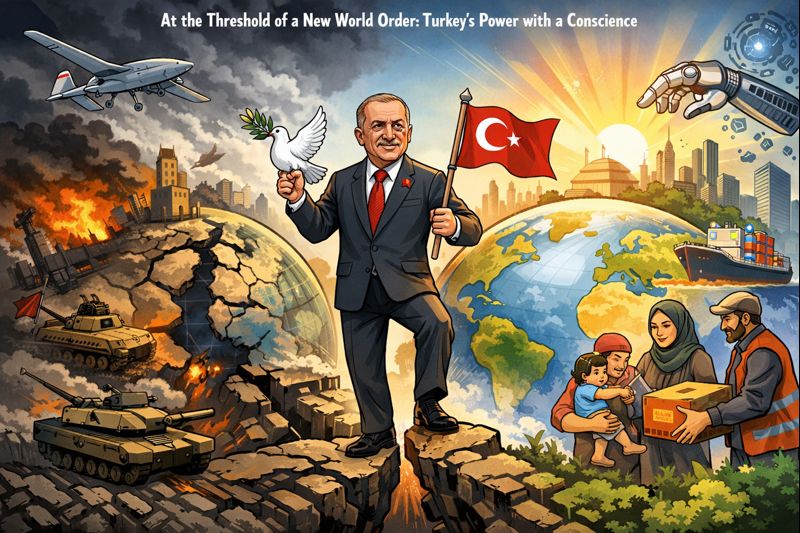
IN an article written for Anadolu Agency, Burhanettin Duran, Head of the Communications Directorate of the Turkish Presidency, assessed Turkey’s rapidly expanding role on the international stage—spanning diplomacy, trade, energy, education, humanitarian aid, defense, and transportation.
Duran underscored that the revolution Turkey has achieved in its defense industries has transformed the country’s power from a theoretical claim into a tangible reality. Indigenous defense projects, he noted, have demonstrated that Turkey has crossed the threshold of technological independence and is now capable of safeguarding its national security architecture through its own capabilities.
He argued that the global political system is passing through a decisive turning point, shaken by crises rooted in the international order established after World War II, alongside the declining effectiveness of international institutions. This transitional phase—where unipolarity has ended but multipolarity has yet to fully crystallize—carries both serious risks and immense opportunities.
According to Duran, Turkey, under the leadership of President Recep Tayyip Erdoğan, has read this global uncertainty with strategic clarity. Rather than remaining in a defensive posture, Ankara has placed its own vision at the heart of the evolving international system. Turkey’s growing influence in foreign policy, he stressed, is not an ideological choice but the outcome of a rational, long-term strategic calculus.
Duran highlighted Turkey’s mediation efforts in the Russia–Ukraine war, as well as tangible progress in crises such as Somalia and Ethiopia, as evidence of Ankara’s capacity to resolve conflicts. These efforts, he said, have elevated Turkey into an indispensable actor in addressing critical global issues.
He further emphasized that Turkey’s global leadership in unmanned aerial vehicle technologies has gone beyond export success, proving its ability to reshape geopolitical equations in conflict zones such as Nagorno-Karabakh, Libya, and Syria. These achievements signal not only military capability but also strategic autonomy.
Beyond defense, Duran pointed to Turkey’s strengthening position in global transportation and energy corridors, guided by a vision of becoming a major energy hub. He also stressed that Turkey now embodies the concept of a “power with a conscience” on the world stage—through its humanitarian diplomacy and steadfast support for the oppressed and those in need across the globe.
Turning to modern conflict, Duran warned that wars are no longer waged solely with conventional weapons. Cyber threats, information warfare, and disinformation campaigns have become central battlegrounds, while artificial intelligence has ushered global communication systems into a new era. This reality, he argued, compels states to protect their digital sovereignty, prepare for hybrid warfare, counter disinformation effectively, and fully leverage technological advances.
Duran concluded by reaffirming that the Presidency’s Communications Directorate will continue its work with full commitment, under President Erdoğan’s leadership, in line with the expectations and aspirations of the Turkish people.