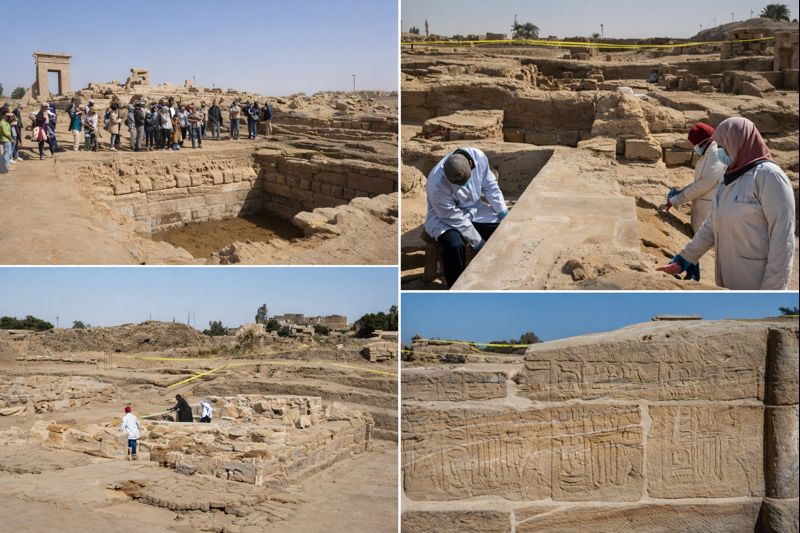
Xinhua _ A joint Egyptian–Chinese archaeological mission has announced the discovery of a previously unknown sacred lake within the precincts of the Temple of Montu at the Karnak Temple Complex, in the ancient city of Luxor, southern Egypt.
The newly uncovered lake lies to the west of the Temple of Ma’at, dedicated to the goddess Ma’at, embodiment of truth, justice, and cosmic order. Covering an area of more than 50 square meters, the feature is an artificial water basin dating back to antiquity, distinguished by its robust construction and remarkable state of preservation.
According to members of the joint mission, the lake has never been recorded in previous archaeological documentation, making the find particularly significant.
Jia Xiaobing, the Chinese co-director of the project, told Xinhua News Agency that the new discovery—together with the previously known sacred lake at the Temple of Montu—forms a unique architectural layout of two parallel sacred lakes, aligned north–south within the walls of the Karnak complex.
The Chinese expert has named the find the “Southern Sacred Lake,” noting that it is the only sacred lake in the history of Egyptian archaeology to have undergone fully systematic and scientific excavation, yielding a rich body of primary data, particularly for studies related to ritual water installations in ancient temples.
Jia explained that sacred lakes were a fundamental element of ancient Egyptian temple architecture. They were regarded as holy sources of water, strictly separated from daily use and reserved exclusively for religious rites and ceremonial purification within temple precincts.
From the Egyptian side, Hend Ali, Chief Inspector of the Temple of Montu and a member of the mission, described the discovery as rare and as a culmination of eight years of intensive joint work.
She noted that despite early challenges stemming from differing academic backgrounds, the Egyptian and Chinese teams ultimately developed a successful shared methodology and applied advanced techniques in close coordination.
“We began with a vast mound of sand and debris,” Ali said. “Today, you can see the fruits of our collective effort—this beautiful and majestic sacred lake, which will open new horizons for research and future discoveries in the near term.”
However, Ali added that due to constraints caused by the groundwater level, the lake’s structural foundations have not yet been fully explored, and its original construction date remains to be determined through further excavation and study.
Archaeologists working in the same area also uncovered dozens of bovine jawbone remains, along with reused stone blocks bearing inscriptions of kings and deities from Egypt’s Late Period (747–332 BCE).
In a related development, Jia said that excavations in the Osirian chapel area led to the discovery of three chapels dedicated to the god Osiris. The team also recovered dozens of small Osiris figurines of varying sizes and materials, as well as artifacts linked to female religious devotees.
He noted that these finds provide new archaeological evidence that will help reconstruct the history of Thebes during the era of the God’s Wives of Amun, particularly under Egypt’s 25th and 26th Dynasties.
The Temple of Montu is located in the northern sector of Luxor and covers an estimated 106,000 square meters, around 24,000 square meters of which lie within the temple enclosure. To date, the joint mission has excavated approximately 2,300 square meters of the site.
Since 2018, the project—China and Egypt’s first official joint archaeological mission—has been carried out by the Institute of Archaeology of the Chinese Academy of Social Sciences, in cooperation with Egypt’s Ministry of Tourism and Antiquities. The work has also received support from the Zhengzhou Institute of Archaeology and Cultural Heritage and the Institute of World History of the Chinese Academy of Social Sciences.
In the quiet depths of Karnak, where ritual once met reflection, a forgotten lake now returns to the light—its waters bearing witness to a shared past, rediscovered through shared endeavor.