 Chief editor writes
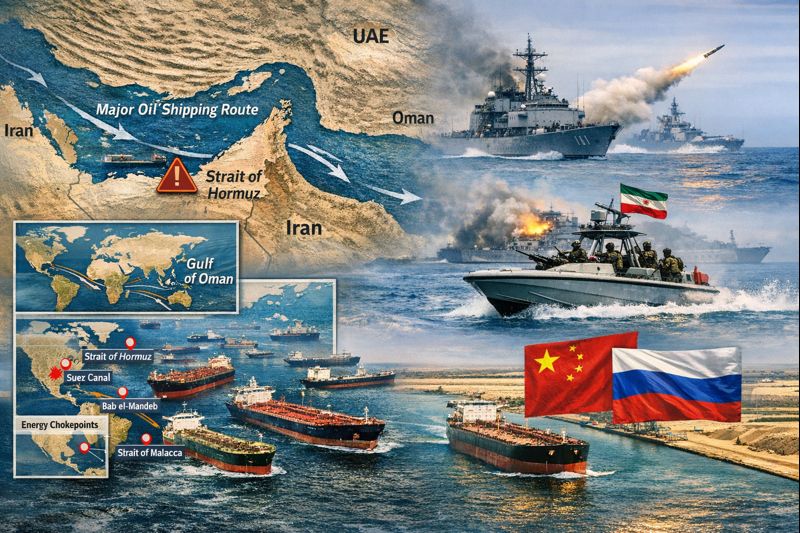
The Strait of Hormuz is witnessing a growing buildup of oil tankers and commercial vessels due to delayed transit permits and heightened security risks.
This congestion is not a logistical anomaly; it is a deliberate geopolitical signal, reflecting how geography itself is being used as leverage.
The key takeaway:
Shipping continues in form, but hesitation has replaced confidence.
Iranian Naval Drills: Deterrence Without an Official Closure
Iran’s recent naval maneuvers in and around the strait stopped short of declaring a closure, yet they dramatically increased the cost and anxiety of passage.
Fast attack boats, electronic interference risks, and an intensified military presence have pushed insurers and shipping firms to classify Hormuz as high-risk waters.
Iran’s method is clear:
No legal blockade, but a calculated functional paralysis.
Would Iran Close the Strait If War Breaks Out?
In the event of direct confrontation with the United States and Israel, Tehran is unlikely to impose a sudden, total shutdown.
Instead, it would pursue a gradual, deniable strangulation that achieves the same outcome without formal responsibility.
The most likely tools include:
- Indirect disruption difficult to attribute
- Exploding insurance premiums
- Repeated navigational disturbances forcing vessels to wait or withdraw
The result:
Hormuz remains legally open, but operationally frozen by fear.
The First 72 Hours: Markets Before Missiles
If war begins, economic shockwaves will precede military escalation:
- Sharp spikes in oil and gas prices
- Suspension of maritime insurance coverage
- Severe vessel congestion and supply-chain delays
- High volatility across Asian and European markets
The real danger is not supply disruption, but the collapse of trust in continuity.
China and Russia: Different Interests Under the Same Crisis
For China, any disruption in Hormuz represents a direct threat to national energy security, prompting diplomatic pressure to contain escalation and firm opposition to any closure.
For Russia, the crisis offers:
- Higher global energy prices
- Economic pressure on Western states
- Expanded leverage in global energy politics
In essence:
China seeks stability—Russia knows how to capitalize on instability.
The Suez Canal: A Conditional Opportunity
A blockage or slowdown in Hormuz theoretically enhances the strategic value of the Suez Canal as an alternative global trade artery.
Potential benefits include:
- Increased vessel traffic
- Higher transit revenues
- Renewed geoeconomic relevance
But this equation is far from guaranteed.
The Houthi Factor: When Suez Gains Begin to Erode
Continued attacks by Ansar Allah (Houthis) on vessels linked to the United States and Israel in the Red Sea and Bab al-Mandab undermine the assumption of stability.
If these operations persist:
- The Suez Canal loses its “safe alternative” advantage
- The Red Sea becomes a high-risk corridor
- Insurance costs surge
- Shipping companies revert to the Cape of Good Hope
The most dangerous equation:
Disruption in Hormuz + insecurity in the Red Sea = dual maritime paralysis.
The Houthis as a Strategic Disruptor
The threat does not depend on the frequency of attacks, but on their continuity and symbolism.
The Houthis do not need to sink ships—only to:
- Sustain uncertainty
- Elevate perceived risk
- Undermine confidence in maritime routes
Fear, not firepower, becomes the decisive weapon.
Direct Implications for Egypt
Under this compounded scenario, Egypt’s position shifts from opportunity to strategic challenge:
- Potential decline in Suez revenues
- Domestic pressure from rising energy prices
- Heightened maritime security sensitivity
Egypt’s task becomes one of precision:
Balancing neutrality, security, and economic interest without being drawn into open confrontation.
Final Assessment
What is unfolding is not a crisis of a single strait, but a war of maritime chokepoints:
- Hormuz as an Iranian deterrence lever
- The Red Sea as a Houthi pressure front
- Suez caught between opportunity and exposure
The core question is no longer:
Will Iran close the Strait of Hormuz?
But rather:
Can the global economy function without safe maritime arteries?