 Chief editor writes
From Amendments to Metamorphosis: A Constitutional Turning Point
On 31 January, the Constitutional Court of the Republic of Kazakhstan unveiled the draft of a new Constitution, marking a decisive moment in the country’s political evolution. Emerging from an extensive reform process initiated by President Kassym-Jomart Tokayev, the draft signals a shift away from piecemeal amendments toward a comprehensive constitutional transformation.
This proposed Constitution does more than revise legal text—it redefines governance, recalibrates state power, and rearticulates the values underpinning Kazakhstan’s political order. Its adoption, to be decided through a nationwide referendum, places sovereignty squarely in the hands of the people.
The Road to Reform: Consultation as a Constitutional Method
The reform journey began with the President’s Address to the Nation on 8 September 2025, which proposed the creation of a unicameral Parliament as part of a broader systemic reset.
Key milestones in the process include:
- The establishment of a Working Group on parliamentary reform in October 2025, which reviewed public input over six months.
- More than 2,000 citizen proposals submitted via the e-Otinish and eGov digital platforms.
- The formation of a Constitutional Commission in January 2026, comprising 130 members from across Kazakhstan’s regions and social spectrum.
Notably, the Commission’s work—covering 77 articles (84%) of the existing Constitution)—was conducted with full transparency, with sessions publicly broadcast and open to legal experts, civil society actors, academics, and political analysts. The scale of revision ultimately necessitated an entirely new constitutional text.
Reimagining Power: Institutional Architecture of the New State
A Unicameral Parliament for a Party-Centered Democracy
At the heart of the institutional redesign lies the establishment of a unicameral Parliament (Kurultai):
- 145 deputies, elected through a proportional representation system
- Five-year terms
- Expanded legislative and oversight powers
This structure is intended to strengthen political parties as institutional actors, enhancing accountability and coherence within the political system.
The People’s Council: Voice Beyond the Ballot
The draft Constitution introduces the People’s Council of Kazakhstan, envisioned as:
- The highest nationwide consultative body
- A representative forum for public interests
- An institution granted the right of legislative initiative
This mechanism seeks to institutionalize public participation beyond elections, embedding consultation within the constitutional framework.
Executive Evolution: The Vice Presidency
A notable innovation is the introduction of the Vice President, tasked with representing the President in domestic and international socio-political, scientific, cultural, and educational engagement—adding both continuity and flexibility to executive governance.
Law as a Shield: Reinforcing Justice and Legal Guarantees
The draft Constitution significantly strengthens the rule of law, embedding robust procedural safeguards:
- Constitutional protection of the legal profession through a dedicated article on advocacy
- Enhanced safeguards for intellectual property
- A strict ban on retroactive laws that worsen citizens’ legal position
- Constitutional enshrinement of:
- The presumption of innocence
- The prohibition of double jeopardy
- The “Miranda rule”, guaranteeing the right to remain silent and legal counsel
These provisions collectively signal a move toward a more rights-centered and legally predictable state.
The Moral Compass of the Republic: Values Reaffirmed and Recast
Comprising a Preamble, 11 sections, and 95 articles, the draft Constitution modernizes language and concepts to reflect Kazakhstan’s evolving political maturity and international standing.
Human Rights at the Core
For the first time, human rights and freedoms are declared in the Preamble as the highest priority of the state, serving as the guiding principle of the entire constitutional order.
Other foundational values include:
- Unity, solidarity, and interethnic and interfaith harmony
- Sovereignty, independence, territorial integrity, and the unitary nature of the state as immutable principles
- Justice, law and order, and responsible stewardship of nature
- Recognition of the people as the sole source of state power and sovereignty
Investing in People, Not Just Resources
The draft Constitution reorients Kazakhstan’s long-term development strategy by elevating:
- Education
- Science
- Culture
- Innovation
as constitutional priorities. This reflects a strategic shift toward human capital as the primary engine of national progress, reducing dependence on natural resources.
For the first time, digital transformation is constitutionally addressed, including explicit protection of citizens’ rights in the digital environment—a recognition of governance in the digital age.
Secularism and Social Order: Drawing Clear Boundaries
The Constitution firmly reaffirms the secular nature of the state, clearly separating religion from government and safeguarding the secular character of education and upbringing.
In social provisions, marriage is constitutionally defined as a voluntary and equal union between a man and a woman—framed as a measure to protect traditional values and strengthen legal protections for women.
Continuity Within Change: An Evolution, Not a Rupture
While ambitious in scope, the draft Constitution acknowledges the historic role of Kazakhstan’s existing Constitution in state-building. The new text positions itself not as a rupture, but as an evolution—the product of institutional maturity, accumulated international credibility, and forward-looking governance.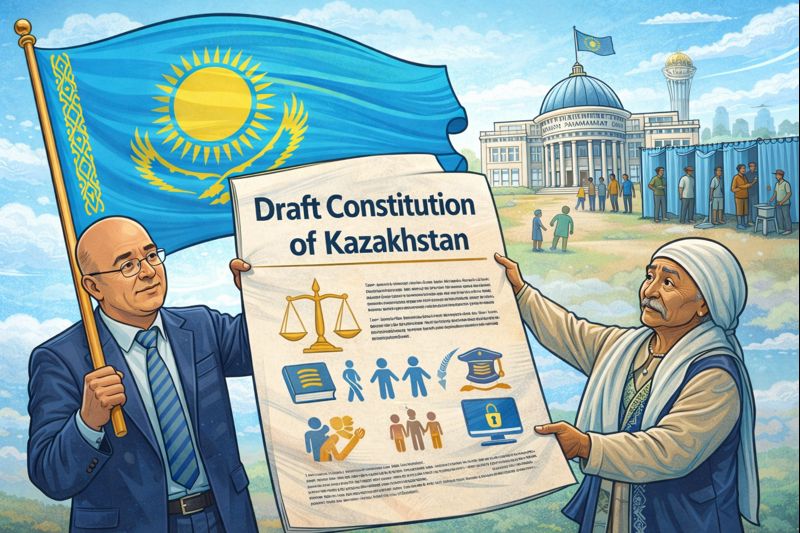
The People Decide: What Comes Next
- Public consultations continue via e-Otinish and eGov.
- The final decision will be made through a nationwide referendum.
- The Constitutional Commission remains at work refining the draft ahead of the public vote.