Chief editor writes
IN international politics, names are never accidental.
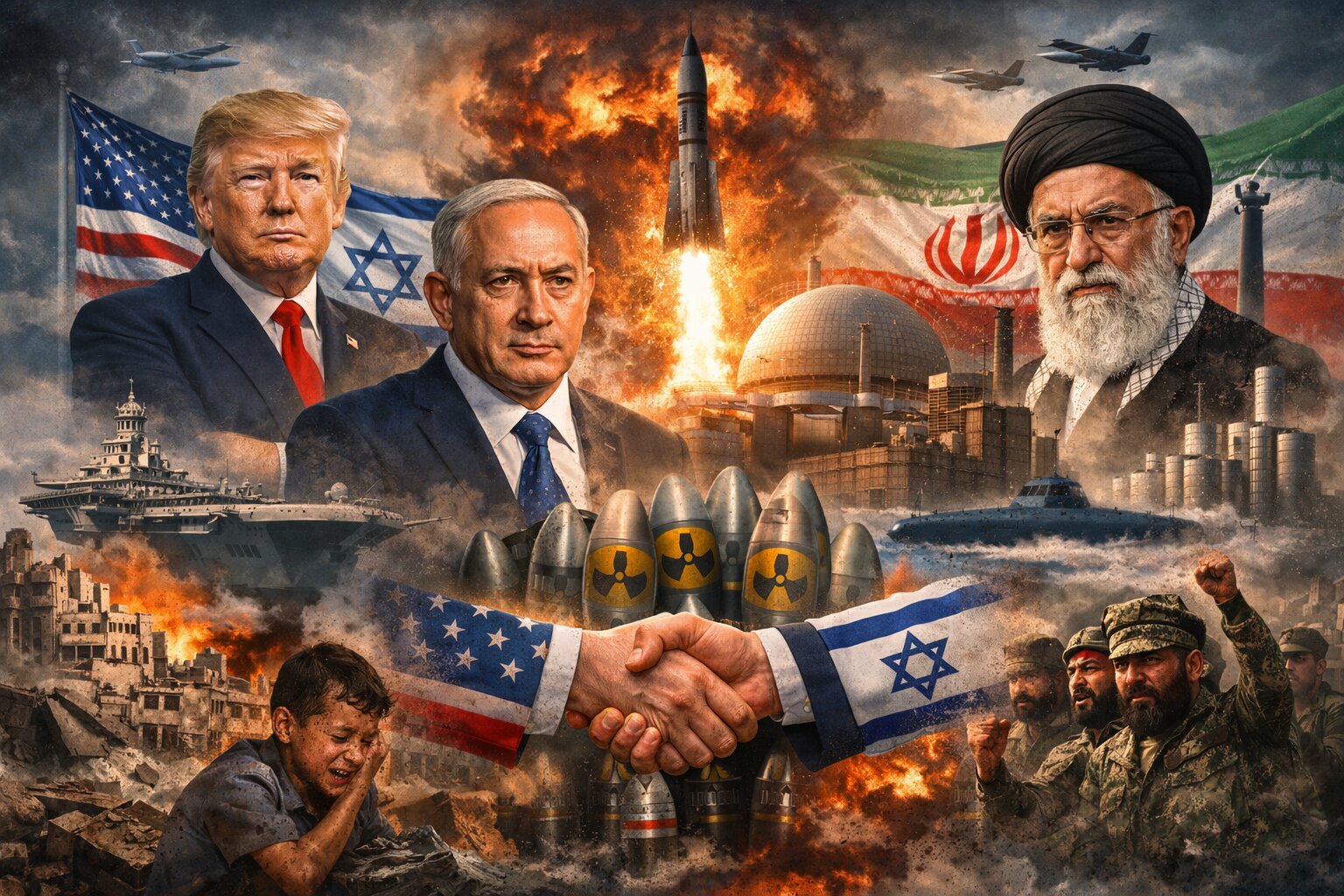
When the concept of a “Peace Council” emerges at a moment when Gaza is burning and tensions with Iran are rising, the question becomes unavoidable:
Is this a genuine platform for de-escalation — or a new geopolitical alignment framed in the language of stability?
I. The Context: Why Now?
Gaza Remains an Open Wound
The war led by Israeli Prime Minister Benjamin Netanyahu has not concluded. Instead, it has evolved into prolonged attrition.
Gaza is no longer merely a battlefield — it has become a strategic pressure node reshaping regional calculations. As the conflict deepens, Iran increasingly appears in the narrative as a central regional actor.
The political shift is subtle but significant:
from a localized war… to a broader axis-based framing.
II. What Is the “Peace Council”?
There is no officially declared institution bearing this name. However, discussions associated with U.S. President Donald Trump suggest the idea of a political-security alignment operating outside traditional multilateral mechanisms such as the United Nations.
If such a council were to take shape, it would likely include:
- 🇺🇸 The United States — strategic leadership and military leverage
- 🇮🇱 Israel — frontline security actor
- 🇸🇦 Saudi Arabia — energy influence and Arab political weight
- 🇦🇪 The UAE — financial and diplomatic flexibility
- 🇪🇬 Egypt — geographic cornerstone and Gaza mediator
- 🇬🇧 The United Kingdom & 🇫🇷 France — European political legitimacy
The stated objective: stability.
The underlying question: stability against whom?
III. Iran: Technical Oversight vs. Political Suspicion
The International Atomic Energy Agency has reported in past assessments — particularly following the 2015 nuclear agreement — that it found no confirmed evidence of an active Iranian nuclear weapons program after 2003 within the monitored framework.
Iran is a signatory to the Nuclear Non-Proliferation Treaty (NPT), and its facilities have undergone extensive inspections.
The dispute has therefore never been purely technical. It centers on:
- Uranium enrichment levels
- Breakout-time calculations
- Strategic trust in Tehran’s long-term intentions
Even where technical monitoring exists, political mistrust remains.
IV. Israel: The Doctrine of Nuclear Ambiguity
Israel:
- Has not signed the NPT
- Does not place its nuclear facilities under full international safeguards
- Maintains a policy of “neither confirming nor denying” nuclear weapons capability
Independent international research suggests Israel possesses advanced nuclear capabilities, though without official declaration.
This creates a central dilemma:
Why is a monitored nuclear program framed as an existential danger,
while nuclear ambiguity is described as legitimate deterrence?
V. The American Strategic Umbrella
United States provides Israel with extensive strategic backing:
- Significant annual military assistance
- Deep intelligence coordination
- Diplomatic protection in international institutions
Critics interpret this as political shielding.
Supporters describe it as alliance-based stabilization.
Either way, the perception of imbalance shapes regional discourse.
VI. The Core Structural Risk
The danger does not lie solely in the number of nuclear warheads — acknowledged or presumed.
The deeper structural risk lies in:
- The absence of a comprehensive regional security framework
- Selective application of non-proliferation norms
- Escalating reliance on deterrence rather than confidence-building
If regional actors perceive unequal enforcement of global rules,
strategic hedging becomes inevitable.
That is how arms races begin — not with announcements,
but with distrust.
Final Assessment
A “Peace Council,” if formed, will not be judged by its rhetoric —
but by its standards.
Either it becomes an inclusive security architecture in which all actors are subject to consistent norms,
or it will be viewed as a geopolitical alignment designed primarily to contain Tehran.
The Middle East does not suffer only from weapons. It suffers from a deficit of trust.
And peace cannot endure under nuclear opacity, nor under selective enforcement,
nor beneath an imbalanced deterrence order.
The enduring question remains:
Is this truly a council for peace —
or a more refined design for a longer conflict?