Ashraf AboArafe writes
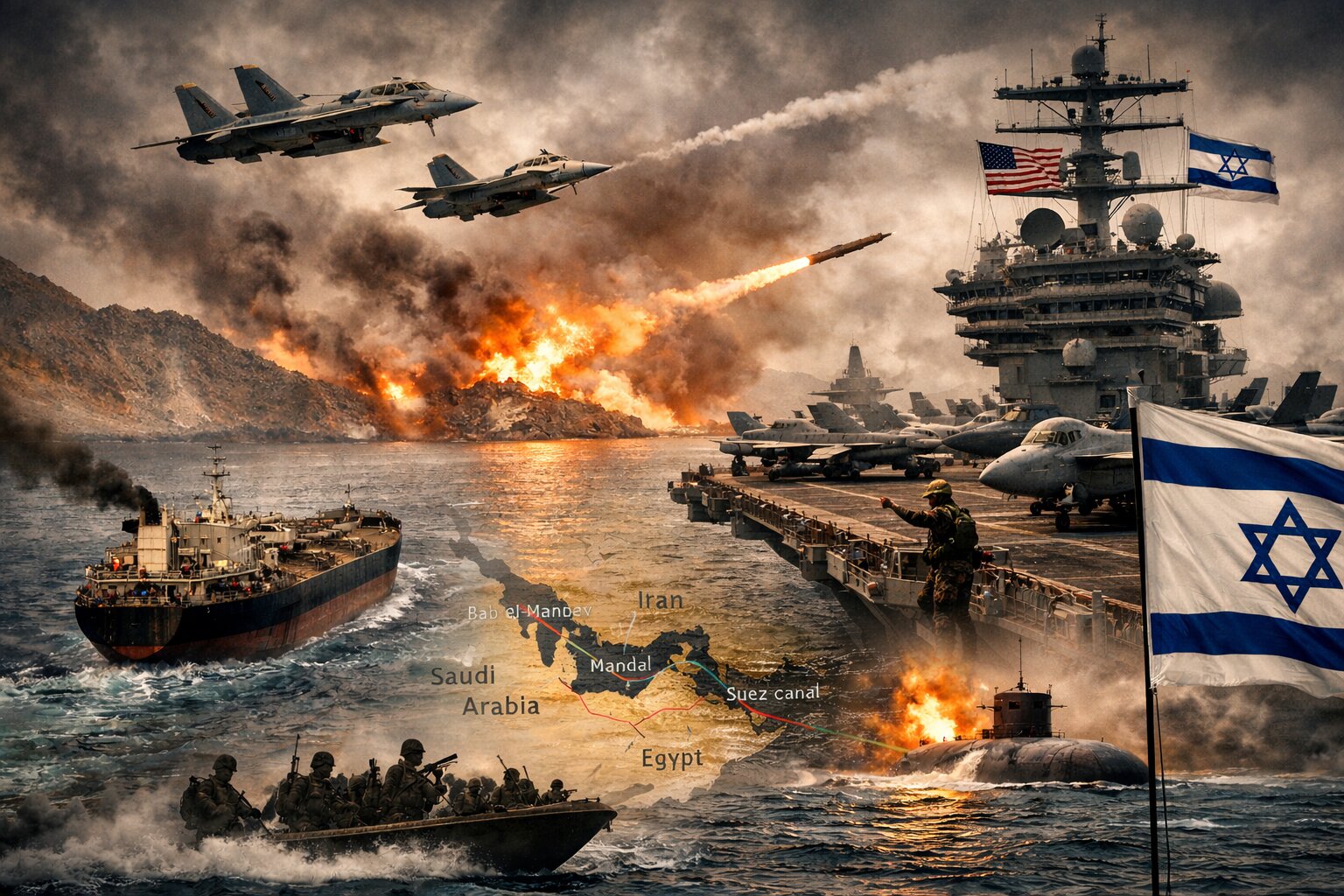
IF the United States uses international maritime corridors to strike Iran, the issue extends far beyond military tactics. It becomes a legal, strategic, and moral question:
Does such action amount to indirect aggression against the states whose economies and security depend on those waterways?
Consider critical chokepoints such as the Strait of Hormuz, Bab el-Mandeb, and the Suez Canal. These are not merely geographic passages; they are arteries of global trade and energy flow, governed by international maritime law and the principle of freedom of navigation.
Does Economic Harm Equal an Act of War?
Should Washington — possibly alongside Israel — conduct operations against Iran via these corridors, the consequences would ripple globally:
- Energy price shocks
- Supply chain disruptions
- Heightened maritime insecurity
- Civilian shipping exposure to risk
Yet under international law, economic damage alone does not automatically constitute an act of war against third-party states. A formal casus belli typically requires direct targeting of a state’s territory, armed forces, or sovereign assets.
Thus, while the impact could be severe, it may not legally compel affected nations to enter the conflict.
Political Obligation vs. Military Escalation
States affected by such instability would face a strategic dilemma:
- Silence could signal weakness.
- Military confrontation could mean direct conflict with a major power.
Most would likely choose:
- Strong diplomatic condemnation
- UN Security Council engagement
- Naval deployments for defensive maritime protection
Few would willingly escalate into full-scale war unless directly attacked.
The Most Dangerous Scenario
The greater risk lies in retaliation.
If Iran responds by disrupting a critical chokepoint or targeting vessels tied to other nations, those countries could be forced into military action to secure their trade routes.
At that point, what began as a bilateral strike could morph into a multi-actor maritime confrontation — without any formal declaration of world war.
Conclusion
Not every strike is a declaration of war on the world.
But militarizing global sea lanes transforms a regional confrontation into a systemic risk.
States are not legally bound to fight over indirect economic damage.
They are, however, bound to safeguard their sovereignty and strategic interests.
The real question is not whether nations must go to war —
but who bears responsibility for turning the world’s arteries into lines of fire.