Ashraf AboArafe writes
In the Middle East, wars rarely begin with a clear declaration.
More often they start with manufactured fears, shifting alliances, and escalating provocations until the region suddenly finds itself standing on the edge of an explosion.
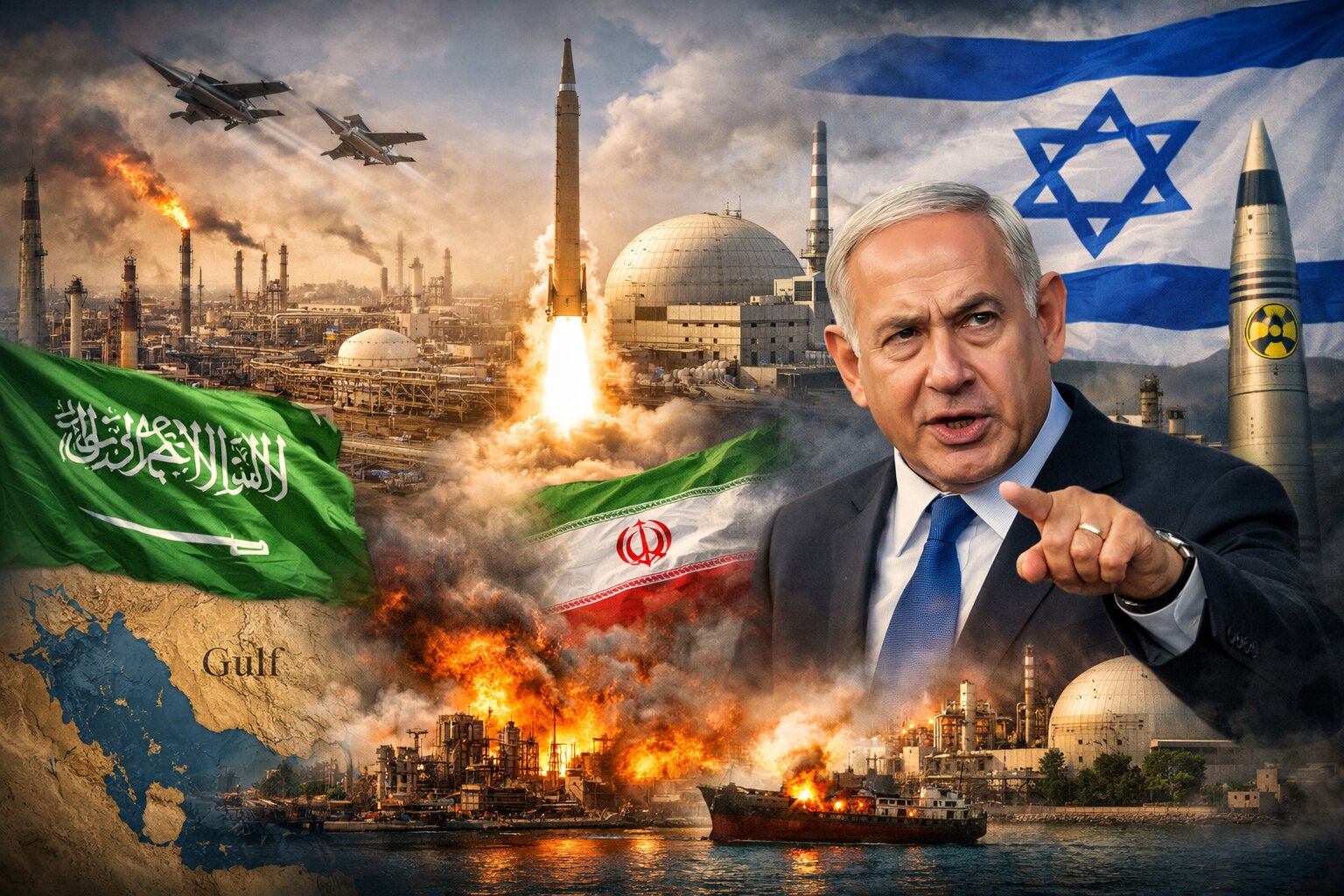
Today, the narrative of the “Iranian threat” is once again dominating headlines, while geopolitical dynamics appear to be positioning Gulf states in the center of a potential confrontation with Iran.
The crucial question is therefore unavoidable:
Is the Gulf being pushed toward a war that is not truly its own?
Hamad bin Jassim’s Warning: The Trap of Regional War
Amid the rising tensions, former Qatari Prime Minister Hamad bin Jassim Al Thani issued a striking warning about the danger of dragging Gulf states into a direct confrontation with Iran.
His remarks reflect growing concerns within regional political circles that certain powers may be attempting to expand the conflict beyond the Iran–Israel dimension, transforming it into a broader regional war.
If such a scenario unfolds, the Gulf would not merely observe events — it would become a primary battlefield.
Saudi Arabia’s Position: Defense Without Escalation
Meanwhile, Saudi Council of Ministers reaffirmed that the Kingdom has taken all necessary measures to defend the country’s security and stability.
The message from the Gulf is carefully balanced:
- Full readiness to defend national security
- But no desire to slide into a large-scale regional war
This caution reflects a fundamental reality:
any direct conflict with Iran would likely place Gulf energy infrastructure directly in the line of fire.
Oil: The Most Vulnerable Target
Should a direct confrontation erupt, oil fields and energy infrastructure across the Gulf would become primary strategic targets.
Most facilities lie within range of Iranian missiles and drones.
Such attacks could trigger:
- Severe disruptions in global energy markets
- Massive economic losses
- A shock to the international economic system
An even more dangerous possibility lies in ambiguous or covert attacks against energy infrastructure, where the origin of the strike might be unclear—fueling accusations and escalation.
The Selective Fear Narrative
Gulf states undoubtedly have legitimate concerns regarding Iran’s:
- Nuclear program
- Ballistic missile capabilities
- Regional influence
Yet the broader geopolitical discourse often focuses heavily on a nuclear program that has not yet produced an operational weapon.
At the same time, the discussion frequently ignores the fact that Israel possesses a nuclear arsenal estimated by experts to exceed 90 warheads, outside comprehensive international inspection frameworks.
This raises a difficult but unavoidable question:
Why is the Gulf urged to fear a potential nuclear capability, while an existing nuclear arsenal remains largely absent from the debate?
Expanding the Conflict Arena
Many analysts argue that the government of Benjamin Netanyahu has long pursued a strategy aimed at broadening the confrontation with Iran.
The strategic logic is clear:
the wider the conflict becomes, the more it transforms from a bilateral confrontation into a complex regional struggle involving multiple actors.
In such a scenario, the entire Middle East could become a theater of overlapping conflicts.
Strategic Recommendations for Gulf States
Given these dynamics, some observers suggest that Gulf states should prioritize strategic recalibration rather than military escalation.
First: Deliver a clear political warning to Washington and Tel Aviv against policies that could drag the region into a large-scale war with Iran.
Second: Reevaluate traditional alliance structures, particularly as questions grow regarding the long-term effectiveness of American security guarantees.
Third: Use diplomatic and economic leverage, including the possibility of reassessing political relations should escalation policies continue.
Fourth: Consider broader strategic partnerships, especially as global power dynamics evolve with rising roles played by China and Russia in international security and economic affairs.
The Message Behind Military Bases
Observers have also raised an interesting question:
Why has Iran not targeted U.S. bases in Turkey?
Part of the answer lies in the global structure of U.S. military deployments, including facilities such as Incirlik Air Base, which forms part of NATO’s strategic deterrence architecture linked primarily to European security.
Attacking such installations could transform a regional confrontation into a much broader international conflict.
The Shadow of a Global War
Some analysts believe that what is unfolding in the Middle East may represent more than a regional crisis.
Rather, it could be a potential spark in a wider global confrontation, especially as tensions among nuclear-armed powers continue to rise.
With multiple nuclear arsenals already deployed worldwide, a miscalculation could theoretically push the international system toward a catastrophic escalation.
In religious and cultural discourse, some observers draw parallels with the symbolic idea of Armageddon, a final apocalyptic confrontation described in certain traditions.
Regardless of theological interpretations, the geopolitical reality remains stark:
The world is entering a moment of extraordinary strategic danger.
The Question That Must Be Asked
Before the Gulf finds itself in the center of a major confrontation, one fundamental question must be addressed:
Is the objective truly to protect regional security — or to reshape regional power balances through another devastating war?
Until that question is answered honestly, the region will continue to live between two competing narratives:
The fear of Iran… and the silence surrounding Israel’s nuclear arsenal.