Dr. Ahmed Mostafa writes
A single image has come to symbolize our era: an American voter holding a sign that reads, “Choosing between Trump and Biden is like choosing between food poisoning and the flu.” It is more than a passing joke—it captures a growing sense that what is presented as political freedom has become a rehearsed performance, where the audience is حاضر—but its voice is absent.
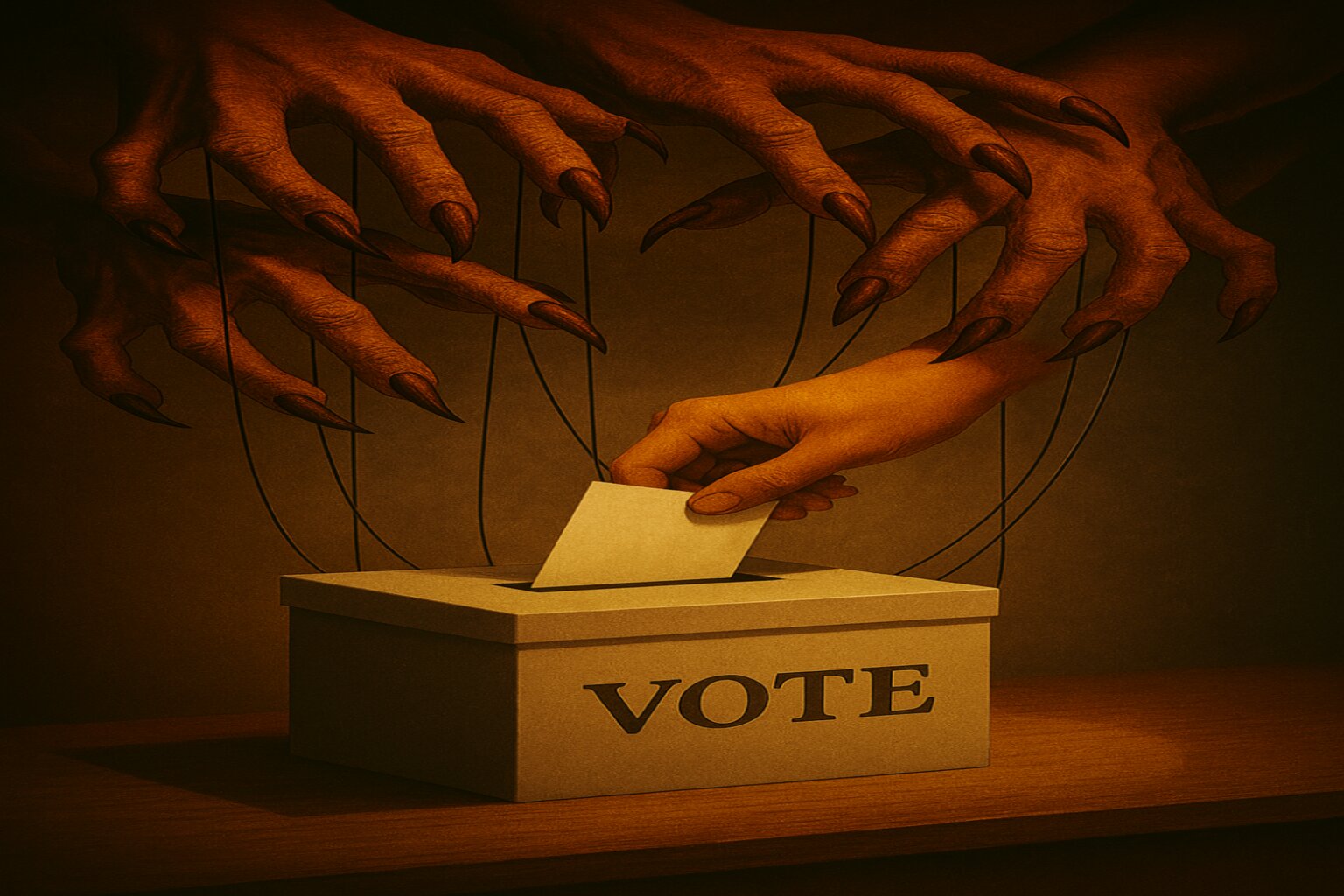
The West is consistently portrayed as the pinnacle of self-governance. Yet a closer look at power structures—from Washington to Brussels—reveals a more troubling reality: citizens are granted the act of voting, but denied the substance of meaningful choice. In the United States, politics has devolved into a suffocating binary, where “electoral freedom” often amounts to choosing between candidates who differ in rhetoric but converge in structural allegiance.
What Americans increasingly experience is best described as “managed democracy”—a system in which the boundaries of acceptable opinion are defined long before a single ballot is cast. From party-controlled nominations to campaign financing dominated by elite networks, the scope of genuine public choice is narrowed by pre-engineered outcomes.
The dysfunction extends beyond elections. The Western principle of free speech—so often upheld as sacred—appears conditional when it confronts entrenched power. Organizations such as American Israel Public Affairs Committee operate not merely as advocacy groups, but as gatekeepers of political legitimacy, shaping discourse through financial leverage and indirect exclusion.
Likewise, institutions like the Federal Reserve function within frameworks that prioritize financial stability and elite economic interests, raising deeper questions about the limits of economic sovereignty. The result is a form of governance that resembles a “capital algorithm”, where financial imperatives consistently override popular will.
Across the Atlantic, the so-called “democratic deficit” of the European Union appears even more pronounced. The rise of Ursula von der Leyen to the presidency of the European Commission—through elite negotiations rather than direct public mandate—reflects a technocratic model that sidelines traditional democratic participation. Figures such as Kaja Kallas further illustrate how governance often circulates within a closed ecosystem of political and institutional elites.
When the West has attempted to export its model, the consequences have often been destabilizing. Interventions such as the Iraq War, the War in Afghanistan, and the 2011 Libya intervention stand as stark reminders that imposed democracy can yield disorder rather than stability. Instead of fostering sustainable institutions, these efforts frequently dismantled existing state structures without successfully replacing them.
These cases underscore a fundamental truth: democracy cannot be exported as a commodity. It must emerge organically from within societies, rooted in their histories and social contracts—not imposed through external force or conditional aid.
In contrast, alternative governance models—though often criticized—have demonstrated resilience. China has pursued state-led development, lifting vast populations out of poverty. Russia maintains strategic autonomy in energy and food security. Iran has shown endurance under prolonged economic pressure. Meanwhile, Egypt presents a model balancing social stability with state-driven economic intervention.
These systems do not claim to embody Western liberal democracy. Yet they retain something increasingly absent in the West: policy sovereignty—the capacity to act without constant subordination to global financial pressures.
Within Western societies themselves, the cracks are increasingly visible: aging infrastructure, widening inequality, stagnant wages, and a volatile gig economy—all unfolding alongside unprecedented wealth accumulation among billionaires. When voting fails to alter fiscal policy, when protests fail to halt wars, and when civic organization struggles to challenge corporate power, democracy risks becoming a simulation without substance.
For the Global South, the lesson is clear: there is no salvation in imported models. Genuine reform must arise from internal negotiation—messy, context-specific, and rooted in local realities—not scripted in distant capitals.
Until the West confronts its own structural contradictions, its discourse on democracy will ring hollow to many—less a voice of wisdom than an echo of a fading moral authority, clinging to an image it no longer fully embodies.