🎙️ Interviewed by: Hesham Salah
IN a world governed by strict ceremonies and rigid protocols, she moves like a butterfly, breathing warmth into cold regulations. She is not merely the wife of a diplomat who crossed world capitals and deciphered faces; she is a writer who transformed “etiquette” from sterile templates and lined-up cutlery into a philosophy of life—a daily hymn composed of morals, taste, and absolute respect for human dignity.
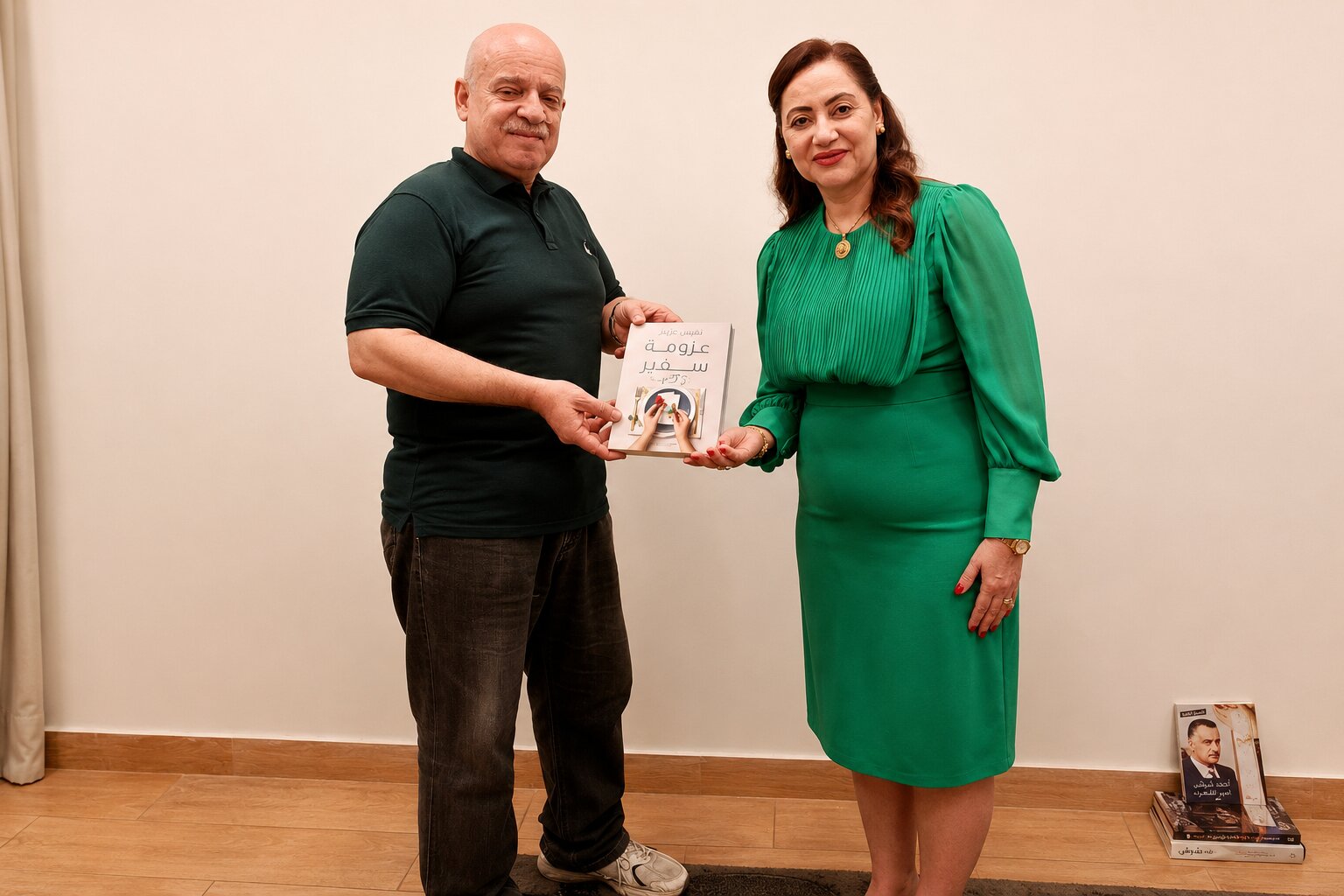
In her elegant book, “An Ambassador’s Feast” (Azomat Safeer), author Shereen El-Alfy takes us on a journey behind the velvet curtain of diplomacy, where Egyptian authenticity merges with the winds of global cultures. She proudly holds onto her roots and her father’s name, from whom she inherited noble principles, speaking of an exile that forged her consciousness and an elegance she finds in simplicity rather than clamor.
In this exclusive and comprehensive interview, we navigate together to discover that etiquette, at its core, is not class privilege, but the “courtesy of behavior” that sparks from the warmth of our homes to illuminate the darkness of the world. Here is the full conversation:
■ Reading “An Ambassador’s Feast,” we deeply sensed an overwhelming pride in your family name and origins. This contrasts with the common practice in many circles where a wife’s identity dissolves into her husband’s name. What is the secret behind this fierce attachment to your roots?
-
Shereen El-Alfy: It is an allegiance to my very first heartbeat, and gratitude to the hand that nurtured and planted my values. I take immense pride in my father, the upbringing that shaped my conscience, and my family that gave me my human features. Therefore, an unspoken determination lived within me to see this first literary newborn bear the name I grew up with. I felt this work was a pure monument I crafted with my own soul, and I wanted it to remain a living memory binding me to my father, who taught me how to step into life. Nonetheless, I did not overlook my partner; my husband beautifully adorns the book’s introduction. He holds an undeniable credit in bringing this work to light. Without him, the idea might have remained lost between the lines, yet I remained faithful to the name that defines my identity and roots.
■ Can we say that behind the writer Shereen El-Alfy stands a husband who discovered her latent talent?
-
Shereen El-Alfy: I wouldn’t call it a discovery of talent as much as a “spiritual and temporal partnership” in weaving the narrative. My husband was the living memory that restored the fading details; he would remind me of capital names, the shadows of places, and the passing faces that could have been folded by forgetfulness during the rush of writing. He was a true partner in reviving those details.
■ How was this seed planted, and how did a passing thought transform into a book greeting readers?
-
Shereen El-Alfy: The credit for planting this seed goes to His Excellency Ambassador Hesham El-Shazly; he was the author and the prime mover of the idea. He asked me one day with a knower’s insight: “What next?” I told him of my intention to offer courses in the arts of etiquette. He caught me by surprise with an inspiring suggestion: “Why don’t you pour this knowledge into a book?” I dreaded and questioned the idea at first, but he didn’t leave me to my hesitation. He asked for an initial outline, read the first chapter with passion, and pushed me forward. He was truly the positive catalyst and the beautiful instigator who made the dream a tangible reality.
■ Diplomatic life looks glamorous from the outside, but does its shadow impose a certain kind of constraint on personal freedom?
-
Shereen El-Alfy: Certainly, velvet comes with a price. In this world, words are weighed on sensitive scales; you do not possess the luxury of casually diving into political mazes or religious affairs. Over there, you do not represent yourself; you carry your homeland with all its colors and spectrums on your shoulders. Neither the diplomat nor his family has the right to bias toward a party, a current, or a faction. We become a shadow for everyone and a representative for all without distinction.
■ You lived through the January events and the arduous political labor that followed. How was the view from the diplomatic window?
-
Shereen El-Alfy: Those were days charged with anxiety and anticipation. I remember my overflowing emotions on the 30th of June, when I marched with my daughters into the squares, wrapped in joy and hope, while strict duty forced my husband to remain distant due to the official nature of his work. We lived under a constant sense of being scrutinized; our calls, our movements, even our presence at social events were cloaked in extreme caution. Silence and precision are the tax paid to maintain the homeland’s balance in the eyes of others.
 ■ Between yesterday and today, have you noticed a transformation in the features of the Egyptian character and society over these years?
-
Shereen El-Alfy: Egyptian society resembles a river; its waves may clash under the weight of circumstances and changing eras, leaving scars or ripples on the surface, but its core remains solid. At heart, Egyptians have remained the guardians of their authentic values and warm traditions that do not yield to the cruelty of time.
■ Was exile and continuous travel merely stations in life, or did it reforge your human identity?
-
Shereen El-Alfy: Travel was the true goldsmith of my soul. I married at the dawn of life when I was a young woman of twenty-one; my experiences were raw and nascent. In the trains of exile, the greater part of my awareness and character was shaped. Travel stripped away narrow ideas and taught me how to read people, and how to find the magical keys to interact with diverse human cultures and backgrounds.
■ There is a prevailing impression linking etiquette to velvet classes and the aristocracy of appearance. What is your response?
-
Shereen El-Alfy: This is a shallow and unjust depiction. Etiquette is neither a class garment nor a certificate of luxury. Etiquette at its core is “exquisite manners,” “refined taste,” and “deference to the other’s humanity.” When we practice etiquette, we do not show off; rather, we practice noble interaction, sanctify appointments, and select gentle words. In short, it is the nobility of behavior.
■ So, it is a concept that transcends the narrow protocols of dining?
-
Shereen El-Alfy: Exactly, and that is the common sin in understanding it. People have imprisoned this sophisticated art within the confines of “fork and knife” and dining manners, whereas it is, in reality, a complete rhythm of life and an unwritten constitution for human appreciation of one’s fellow human.
■ Do you believe that the media and artistic machinery are responsible for shackling etiquette to this superficial image?
-
Shereen El-Alfy: Yes, drama and television programs have often presented etiquette in a sarcastic, mocking mold, or as a type of social pretentiousness and hollow vanity, creating a rift between it and the simple citizen. From here, my message sprouted across digital platforms (Facebook, Instagram, and TikTok) to shatter this stereotype and bridge the gap, asserting that etiquette is the language of simple hearts before palaces.
■ Do you believe in body language, and how do you employ it in your readings?
-
Shereen El-Alfy: I believe in it with absolute certainty. A person’s stride, their seating posture, and the gestures of their hands are extensions of their soul’s dialogue and a mirror of their inner self. However, I did not study this science in academic halls; I see it closer to the frontiers of psychology. Hence, I prefer not to speak of it as a specialist, but with the spirit of a contemplative observer.
■ Do Egyptians fall into “common mistakes” that breach the rules of etiquette at the table?
-
Shereen El-Alfy: In official gatherings, yes, some minor slips occur that defy international protocols, but I elevate myself above calling them “mistakes.” Within homes, every human has absolute freedom; the home is a sanctuary of warmth and spontaneity, and I cannot force anyone to dine in a specific manner. But when we stand in the presence of international officialdom, there is a shared global language and rules that must be respected out of reverence for the occasion.
■ Can the Egyptian family today plant these values in the hearts and minds of their children?
-
Shereen El-Alfy: Absolutely. The family is the first cradle and the soil in which morals sprout. A child does not learn etiquette from books; they absorb it from their parents’ behavior. They learn to respect old age, maintain a clean tongue, lower their gaze, and guard the privacy of others. All these virtues are the true etiquette that begins at the doorstep of the home before being adopted by institutions.
■ In your book, there are glimpses of early marriage and motherhood under the shadows of constant travel. How did you balance the warmth of motherhood with the clamor of diplomatic life?
-
Shereen El-Alfy: God’s grace was our thread of safety. In the beginnings, the bags were light and the responsibilities were tender. But the real challenge reared its head when official duties forced us to leave the children alone. In some stations, like South Africa for instance, the security concerns unsettled our peace, leaving us in a state of constant dream for our little ones.
■ Did this persistent security anxiety leave a bitter trace or an impact on your souls?
-
Shereen El-Alfy: Yes, profoundly. Living in environments charged with security turmoil consumes a vast amount of psychological peace. Fear for the children was a shadow that never left us, and perhaps this anxiety, laced with responsibility, is one of the harshest lessons we tasted from the cups of exile.
■ Can a modern woman forge a truce between elegance and simplicity?
-
Shereen El-Alfy: In fact, true elegance lives nowhere except in the sanctuary of simplicity. Etiquette detests exaggeration and loathes vulgar display. Elegance is to wear attire suited for the occasion, without an excess that offends the eye, nor a neglect that devalues one’s presence.
■ You approached the topic of “gifts” in your book with an unconventional vision. How does Shereen El-Alfy read the culture of gift-giving?
-
Shereen El-Alfy: We have a societal confusion in evaluating offerings; some link the value of a gift to its material price, which is a true degradation of its meaning. A gift is a messenger of feelings and a heartbeat of care, not a display of financial capability. One should not burden oneself or one’s partner with what they cannot bear for the sake of a gift; the value lies in the memory and affection, not the digits.
 ■ In conclusion, what is your golden advice for today’s youth aspiring to ascend the platforms of the diplomatic corps?
-
Shereen El-Alfy: My advice to them is a single word, yet it encompasses the entire universe: “Read.” Read extensively and with passion; for reading is what expands perceptions, refines the spirit, and makes a diplomat a true ambassador for his country’s intellect and culture.